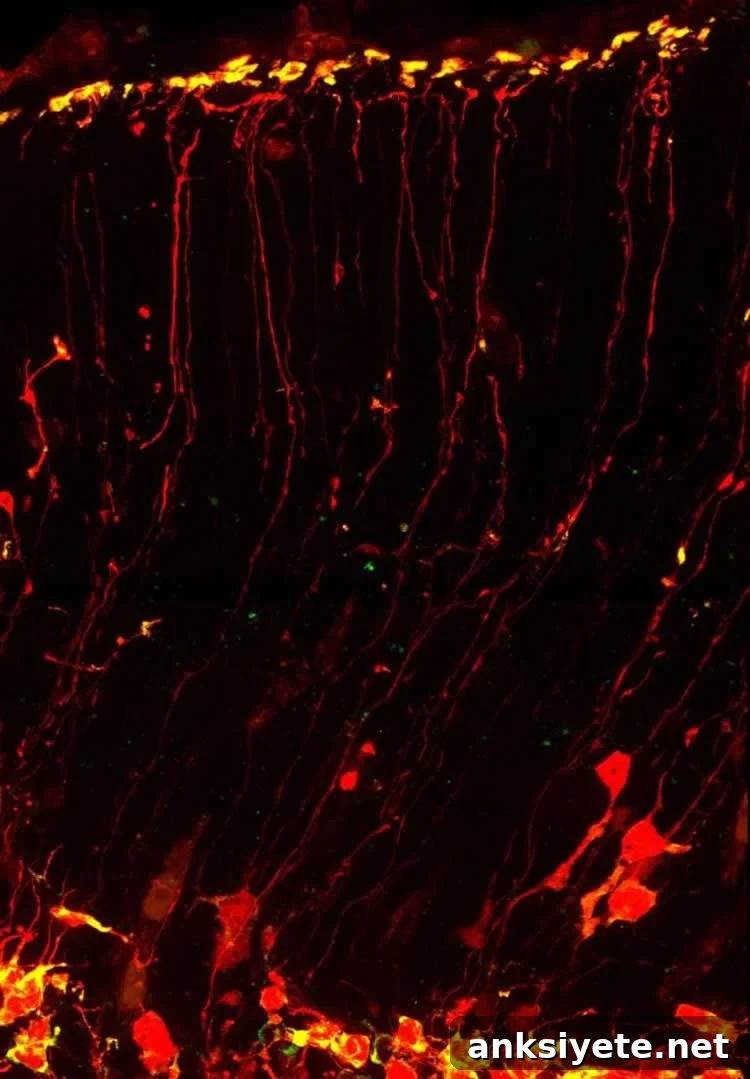
Summary: Researchers observe molecules moving along the length of neural stem cells.
Source: Duke University.
Scientists visualize potential mechanisms driving formation of new neurons in the brain
Researchers at Duke University have captured the first clear images of molecules traveling along a linear pathway that runs the length of neural stem cells—cells essential for generating new neurons during brain development. These observations reveal a transport system that carries messenger RNA and other molecular cargo between the cell body and distant cellular extensions, and point to a role for the Fragile X protein FMRP in moving some of that cargo.
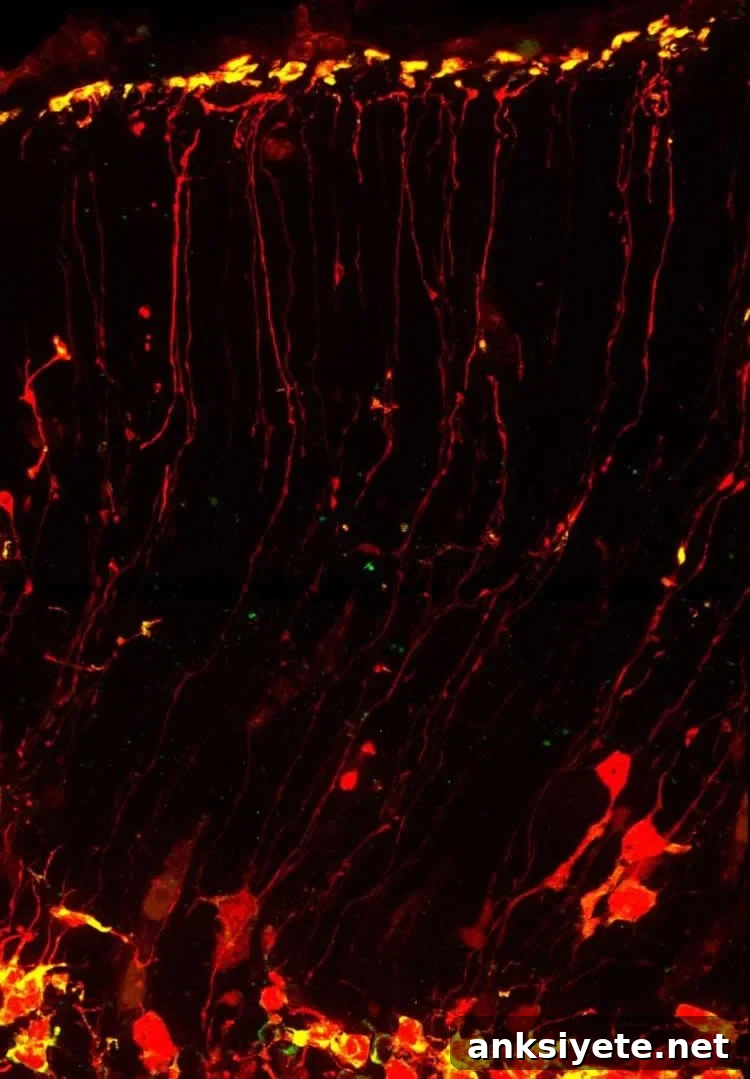
Neural stem cells, often called radial glia in the developing brain, extend long, thin processes whose tips—called endfeet—reach the brain’s outermost layers. These long projections place the endfeet in a different microenvironment from the cell body, and cues at this distant site can influence whether a stem cell self-renews or differentiates into a neuron. Because of the considerable distance between soma and endfeet, researchers suspected these cells must actively transport biological materials, such as messenger RNA (mRNA), along their shafts rather than relying on passive diffusion.
Using high-resolution live imaging, postdoctoral researcher Louis-Jan Pilaz was able to visualize fluorescently labeled mRNAs moving along the basal process of radial glia, frame by frame. The mRNAs moved with pauses and bursts of movement suggestive of directed, motor-driven transport rather than random diffusion.
“We saw these labeled mRNAs pause and then continue as if they had an intention,” said Debra Silver, senior investigator and assistant professor of molecular genetics and microbiology at the Duke University School of Medicine. “No one had seen molecules moving at this speed within neural stem cells before.”
The observations indicate that the basal process functions as a molecular highway, carrying not only mRNAs but also a variety of proteins and RNA-binding factors. When mRNA reaches the endfeet, it can be translated into protein locally. Silver’s team developed a new ex vivo method to mechanically isolate endfeet from the soma and used photoconvertible and fluorescent reporters to demonstrate active protein synthesis within endfeet in intact tissue preparations.
“Until now, tools to evaluate local translation in intact tissue were limited,” Silver explained. “Our approach provides a model to study how mRNA transport and translation occur in the native environment of developing brain tissue.”
The researchers next investigated molecular regulators of this transport system. Among several candidate RNA-interacting proteins they tested, they found that FMRP—the protein missing or deficient in Fragile X syndrome, a common inherited cause of intellectual disability and a condition linked to autism spectrum disorders—binds and moves with a substantial cohort of mRNAs in radial glia.
Prior studies had connected FMRP to neural stem cell behavior, but its precise role in brain development remained unclear. The Duke team used RNA immunoprecipitation and microarray analysis on isolated endfeet to identify the mRNAs associated with FMRP. They found 115 distinct transcripts bound by FMRP; roughly 30 percent of these are linked to neurological disease, and about half of those have been associated with autism.
To test whether FMRP is required for localization of specific mRNAs, the researchers examined one target transcript in a mouse model lacking FMRP. They observed that this mRNA failed to reach the endfeet in the absence of FMRP, providing direct evidence that FMRP mediates active transport and localization of particular RNAs in radial glia.
These results suggest a model in which radial glia carry a regulated local transcriptome far from the soma and use local translation at endfeet to control cytoskeletal dynamics, signaling, and other events that influence neurogenesis and neuronal migration. The study identifies FMRP as an important regulator of RNA localization in stem cells and points to how its dysfunction might contribute to neurodevelopmental disorders.
Silver and colleagues are continuing to investigate how protein production is controlled within endfeet, how these processes change during development, and how distinct functions of FMRP affect brain formation. Their work establishes radial glia as a tractable mammalian model for studying mRNA transport and local translation in vivo and highlights new mechanistic layers in stem cell biology with potential relevance to autism and other brain disorders.
Funding: The research was supported by a Fay/Frank Seed grant from the Brain Research Foundation.
Source: Karl Bates, Duke University
Image credit: Louis-Jan Pilaz, Duke University.
Original research: Pilaz L.-J., Lennox A. L., Rouanet J. P., and Silver D. L., “Dynamic mRNA Transport and Local Translation in Radial Glial Progenitors of the Developing Brain,” Current Biology. Published online October 19, 2016.
Dynamic mRNA Transport and Local Translation in Radial Glial Progenitors of the Developing Brain
Highlights
• The radial glia basal process acts as a highway for active, directed RNA transport.
• mRNAs are locally translated in radial glia endfeet located hundreds of micrometers from the soma.
• Endfeet-localized, FMRP-bound RNAs encode signaling and cytoskeletal regulators, many linked to autism.
• FMRP controls RNA localization and active mRNA transport in radial glia.
Summary
During brain development, radial glial progenitors produce neurons while spanning the neuroepithelium with long basal processes and distant endfeet. These distal structures influence migration, tissue integrity, and proliferation, but their cell biology has been poorly characterized. Using live imaging of embryonic brain tissue, the researchers visualized rapid, directed mRNA transport in radial glia and found that RNA and RNA-binding proteins—including the autism-associated protein FMRP—move along the basal process at speeds consistent with microtubule-based transport, accumulating in endfeet. An ex vivo preparation enabled mechanical isolation of endfeet from the soma and, together with photoconvertible reporters, demonstrated local translation of mRNA at the endfeet. RNA immunoprecipitation and microarray analysis revealed FMRP-bound transcripts enriched for signaling and cytoskeletal regulators implicated in autism and neurogenesis. The team also showed that FMRP controls localization of at least one target transcript. These findings expose a regulated local transcriptome within radial glia and provide a model for studying mRNA transport and local translation in vivo, suggesting that local translation at endfeet can control cytoskeletal and signaling events that shape neurodevelopment.