
Early intervention may improve outcomes.
Premature birth increases a child’s risk of later neurological and psychiatric challenges, and new research suggests those risks are linked to weaker connections among brain networks that support attention, communication and emotional processing.
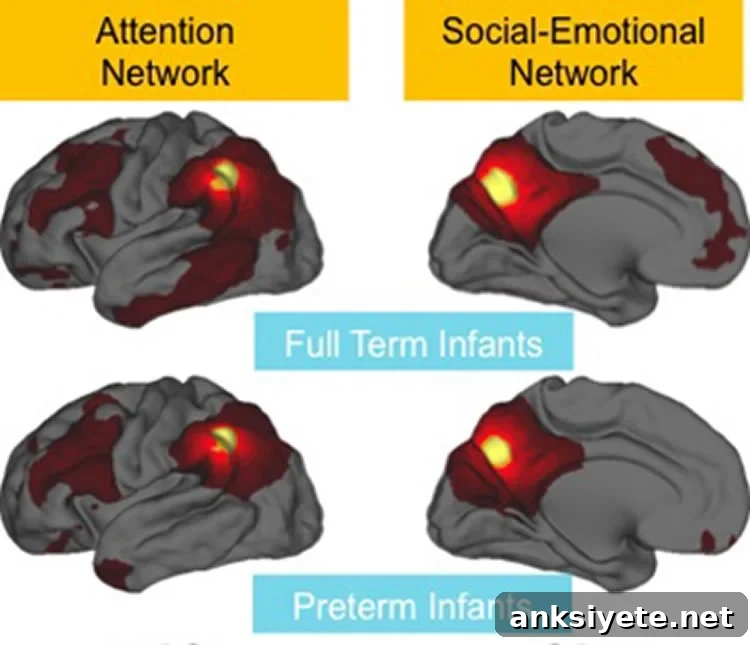
Investigators at Washington University School of Medicine in St. Louis examined brain scans from infants born preterm and at full term to identify early differences in brain structure and function that could explain the higher rates of developmental and psychiatric problems among children born early.
“The brain is especially plastic in early life, which means it may be possible to influence its development with timely intervention,” said lead researcher Cynthia Rogers, MD, assistant professor of child psychiatry. “Rather than waiting for signs and symptoms to appear, we aim to develop objective measures of brain development in preterm infants that indicate who is at greater risk. That would allow clinicians to offer additional support and therapies sooner, when they may be most effective.”
The results were presented Oct. 19 at Neuroscience 2015, the annual meeting of the Society for Neuroscience. A news conference to discuss the study was held at the meeting’s headquarters in Chicago.
About one in nine U.S. infants is born prematurely, and these children face an elevated likelihood of cognitive delays, motor-skill problems, attention deficit hyperactivity disorder (ADHD), autism spectrum disorders and anxiety. To better understand the brain changes that might underlie these outcomes, the research team used functional magnetic resonance imaging (fMRI) and diffusion tensor imaging (DTI) to compare brain organization in newborns born at term with that of babies born at least 10 weeks early.
The study included 58 full-term infants scanned on their second or third day of life and 76 preterm infants who were scanned within a few days of their original due dates. Using DTI, the researchers assessed white matter tracts—bundles of axons that connect brain regions—while resting-state fMRI allowed them to examine intrinsic brain network activity when infants were not performing tasks.
Compared with full-term infants, those born prematurely showed weaker white matter integrity and altered activity in several resting-state networks. The most pronounced differences appeared in the default mode network and a frontoparietal network. Both of these large-scale networks play roles in attention, social processing and emotional regulation and have been implicated in conditions such as ADHD and autism spectrum disorders.
“We observed measurable differences in the organization and coordination of brain circuits in infants born early,” Rogers said. “These circuit abnormalities likely contribute to the developmental and psychiatric difficulties that many preterm children face as they grow.”
By linking early structural and functional brain measures with developmental outcomes, the team hopes to identify biomarkers that predict which children are most likely to experience cognitive or psychiatric problems. Early identification could allow clinicians to prioritize monitoring and provide targeted therapies during a period when the brain can still be shaped by experience and intervention.
The researchers are following the infants longitudinally. They completed behavioral and developmental follow-up assessments at age 2 for all participants and at age 5 for a subset, and they plan additional brain scans and evaluations when the children reach 9 to 10 years old. These follow-up studies will help determine how early brain differences evolve over time and which early measures best predict later impairment or resilience.
“Long-term follow-up is essential,” said Christopher D. Smyser, MD, senior author and assistant professor of pediatric neurology. “Understanding how early brain organization relates to later learning, attention and emotional health will guide efforts to design and deliver interventions that can change developmental trajectories.”
Funding: This research was supported by the National Institute of Mental Health, the National Institute of Neurological Disorders and Stroke, and the Eunice Kennedy Shriver National Institute of Child Health and Human Development of the National Institutes of Health. Additional support came from the McDonnell Center for Systems Neuroscience, the Child Neurology Foundation, the Cerebral Palsy International Foundation and the Dana Foundation.
Source: Jim Dryden – WUSTL
Image Credit: The image is credited to the researchers/Washington University
Original Research Presentation: The study was presented at Neuroscience 2015 in Chicago on October 19, 2015.