
New brain-imaging method offers a measurable biomarker to improve diagnosis and guide treatment for boys with autism
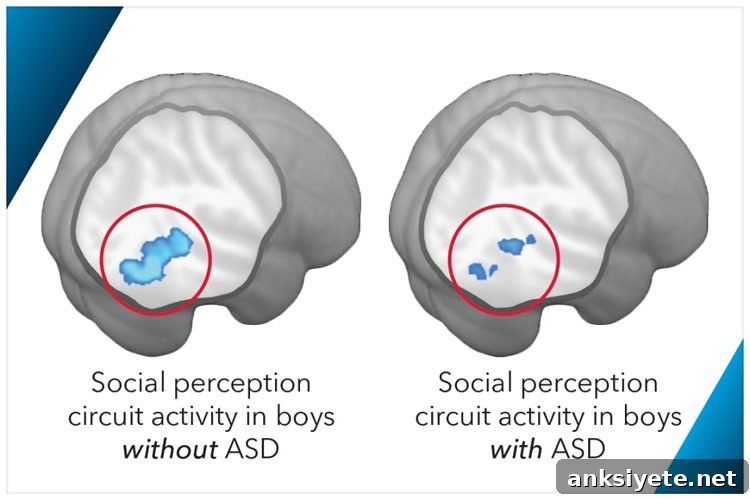
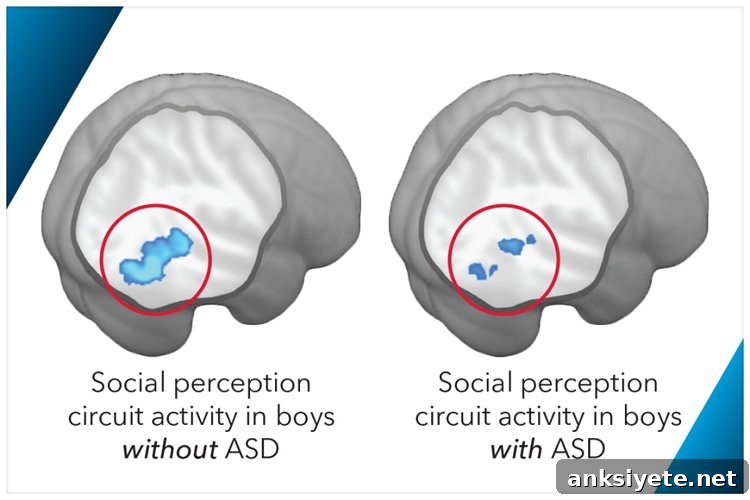
Researchers have developed a brain-imaging method that maps and tracks the function of neural circuits involved in social perception, producing an objective measure that can help diagnose autism spectrum disorder (ASD) in boys and monitor individual treatment response. This approach uses functional magnetic resonance imaging (fMRI) to quantify activity in brain circuits that interpret social cues, offering clinicians a way to evaluate how a specific circuit is working in a patient and whether an intervention is producing change.
The study, titled “Quantified Social Perception Circuit Activity as a Neurobiological Marker of Autism Spectrum Disorder,” appears in JAMA Psychiatry and focuses on the search for reliable, individual-level biomarkers linked to the social perception impairments that characterize ASD. By measuring brain responses to moving point-light displays that represent human motion, the team derived an objective metric of social perception circuit function.
“Biomarkers give us a clearer biological explanation for autism in boys and allow us to match treatments to individuals and measure progress,” said Kevin Pelphrey, co‑author of the study and director of the Autism and Neurodevelopmental Disorders Institute at George Washington University. The new metric can indicate whether a specific treatment is engaging the targeted circuit and producing measurable change.
Researchers analyzed a set of 164 fMRI image frames from each of 114 participants across discovery and replication cohorts. They found that quantified reductions in social perception circuit responses reliably distinguished boys with ASD from typically developing boys. In both the discovery and replication groups, the metric achieved area under the curve (AUC) values indicating good discrimination for males, while it did not reliably distinguish girls with ASD from typically developing girls.
Because the metric measures brain function directly, it can be used to track circuit-level change in response to different interventions—behavioral, pharmacological, or combined—making it potentially valuable for patients whose symptoms are complex or whose best treatment approach is unclear. The ability to measure treatment effect objectively could shorten the diagnostic and treatment trial period, helping families and clinicians make faster, better-informed decisions.
“Behavioral symptoms in ASD are varied and change slowly, which makes it hard to judge treatment effectiveness in a practical time frame,” said Malin Björnsdotter, lead author and assistant professor at the University of Gothenburg. “Functional brain markers offer specific, objective measures that can bridge the gap between behavior and biology.”
Although fMRI is not yet a standard tool in routine ASD care, this work supports the idea that functional brain imaging can play an important role in developing evidence-based, personalized treatments. The Autism and Neurodevelopmental Disorders Institute at George Washington University plans to extend this research by studying larger and more diverse groups of children and adolescents, including participants with other neurodevelopmental conditions, to determine whether the metric can distinguish ASD from other disorders and reliably track treatment effects over time.
The authors caution that the research is still early stage. Most clinics and hospitals do not have the specialized imaging protocols or analysis pipelines used in this study, and widespread clinical use will require simpler, more accessible tools that work across age groups and individuals with challenging behaviors.
“Our next steps must focus on translating these findings into affordable, easy-to-use techniques that can be applied broadly, including to infants and individuals with severe behavioral challenges,” Dr. Björnsdotter said. The research team is also conducting a large-scale study of girls with autism to identify equivalent neural markers for females; initial results are expected from that effort.
Source: George Washington University
Image credit: Researchers / George Washington University
Original research: Abstract for “Evaluation of Quantified Social Perception Circuit Activity as a Neurobiological Marker of Autism Spectrum Disorder” by Malin Björnsdotter, MSc, PhD; Nancy Wang; Kevin Pelphrey; and Martha D. Kaiser in JAMA Psychiatry. Published online April 20, 2016.
Abstract
Evaluation of Quantified Social Perception Circuit Activity as a Neurobiological Marker of Autism Spectrum Disorder
Importance Autism spectrum disorder is characterized by social disability and linked to dysfunction in brain circuits that process social cues. The extent to which neural function mirrors individual behavioral profiles has been unclear, complicating efforts to identify functional neuroimaging biomarkers.
Objective To test whether quantified neural responses in social perception circuits can serve as an individual-level marker of ASD in children and adolescents.
Design, Setting, and Participants The cohort study, conducted at the Yale Child Study Center, included children and adolescents with ASD and typically developing controls. The researchers used discovery and replication cohorts and measured individual social perception circuit function through fMRI responses to coherent versus scrambled point-light displays of human motion.
Main Outcomes and Measures Performance of the quantified brain response metric was evaluated using area under the receiver operating characteristic curve (AUC), sensitivity, specificity, and correlations between brain responses and social behavior.
Results In the discovery cohort (39 participants, ages 4–17), and the replication cohort (75 participants, ages 7–20), reduced social perception circuit responses were identified in boys with ASD. The combined analysis across cohorts reported an AUC of 0.77 for identifying boys with ASD, with sensitivity and specificity both around 76%. The metric did not reliably distinguish girls with ASD from typically developing girls. Brain responses correlated with measures of social behavior in boys but not in girls.
Conclusions and Relevance Quantified social perception circuit activity is a promising candidate neural marker for the male ASD behavioral phenotype. The findings highlight the importance of understanding sex differences in social perception processing and how these differences relate to ASD manifestations.