
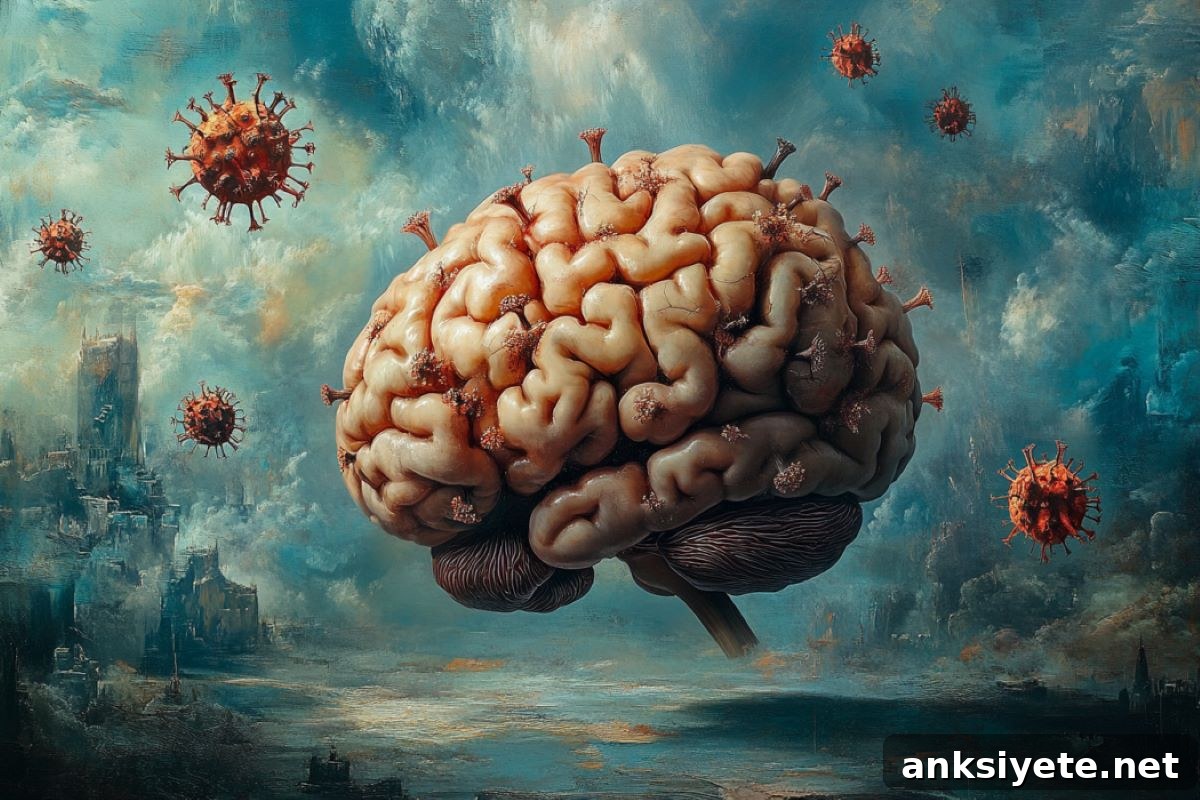
Summary: Researchers have identified a specific mutation in the SARS-CoV-2 spike protein that increases the virus’s ability to infect the central nervous system. This discovery offers a plausible explanation for some neurological symptoms seen during acute COVID-19 and may help clarify mechanisms behind “long COVID.”
The mutation enables the virus to more readily invade brain tissue in experimental models, a finding that could guide the development of therapies aimed at protecting the brain or clearing persistent virus from the central nervous system. The results underscore the importance of addressing neurological complications as part of COVID-19 treatment and recovery planning.
Key Facts:
- A specific deletion or mutation in the SARS-CoV-2 spike protein enhances the virus’s ability to infect brain tissue in mice.
- This change may help explain neurological symptoms associated with COVID-19, including loss of smell and taste, cognitive difficulties, and prolonged post-infection syndromes often referred to as “long COVID.”
- Understanding how spike variants favor infection of the central nervous system could support the design of targeted treatments to eliminate virus from the brain or mitigate neurological damage.
Source: Northwestern University
Researchers at Northwestern University and the University of Illinois-Chicago have discovered mutations in the SARS-CoV-2 spike protein that alter the virus’s ability to infect the central nervous system.
In a collaborative study, scientists compared viral genomes recovered from the brains and lungs of infected mice. They found that viruses replicating in the brain frequently carried a deletion or mutation in a key region of the spike protein—the external viral structure responsible for attaching to and entering host cells. By contrast, viral genomes from the lung resembled the original viral stock used for infection.
When researchers directly introduced viruses carrying this spike alteration into mouse brains, they observed that the deletion persisted in the central nervous system but was largely repaired when those viruses moved back into lung tissue. This pattern suggests that changes in spike influence which cell types the virus can enter and replicate within, and that different tissue environments select for different spike configurations.
“Comparing virus genomes from lung and brain tissues showed a clear enrichment of viruses with a particular spike deletion in the brain,” said co-corresponding author Judd Hultquist, assistant professor of medicine (infectious diseases) and microbiology-immunology at Northwestern University Feinberg School of Medicine. “These results were unexpected and highlight spike’s role in determining tissue tropism.”
How spike changes affect tissue targeting
The spike protein contains regions that direct how SARS-CoV-2 binds to receptors and enters cells. Mutations or deletions in those regions can change which cell types are most susceptible to infection. In this study, alterations in a critical spike segment appeared to favor viral replication in the central nervous system. That raises important questions about whether similar adaptations occur in humans and to what extent direct brain infection contributes to neurological symptoms.
SARS-CoV-2 infection has been linked to a range of neurological effects, from transient loss of smell and taste to longer-lasting cognitive changes often described as “brain fog.” Some patients experience persistent symptoms well after the respiratory illness resolves, a condition broadly classified as long COVID. It remains unclear whether these long-term symptoms result from ongoing viral infection in the brain, immune-mediated damage, or a combination of factors.
“If persistent neurological symptoms are driven in part by viral infection of central nervous system cells, then therapies that specifically target virus in that compartment may be more effective,” Hultquist said. “Our data suggest that spike’s structure is a key determinant of brain infection and therefore a potential therapeutic target.”
The study, titled “Evolution of SARS-CoV-2 in the murine central nervous system drives viral diversification,” will appear Aug. 23 in Nature Microbiology.
Other Northwestern contributors include Lacy M. Simons, Tanushree Dangi, Egon A. Ozer, Pablo Penaloza-MacMaster and Ramon Lorenzo-Redondo.
Funding: This research was supported by the National Institutes of Health (grants R01AI150672; R56DE033249; R21AI163912; U19AI135964), the Department of Defense (grant MS200290), and institutional support for the Center for Pathogen Genomics and Microbial Evolution and the Northwestern University Clinical & Translational Sciences Institute (NUCATS).
About this neurology and COVID-19 research news
Author:Kristin Samuelson
Source: Northwestern University
Contact: Kristin Samuelson – Northwestern University
Image: The image is credited to Neuroscience News
Original Research: The full findings are scheduled for publication in Nature Microbiology.