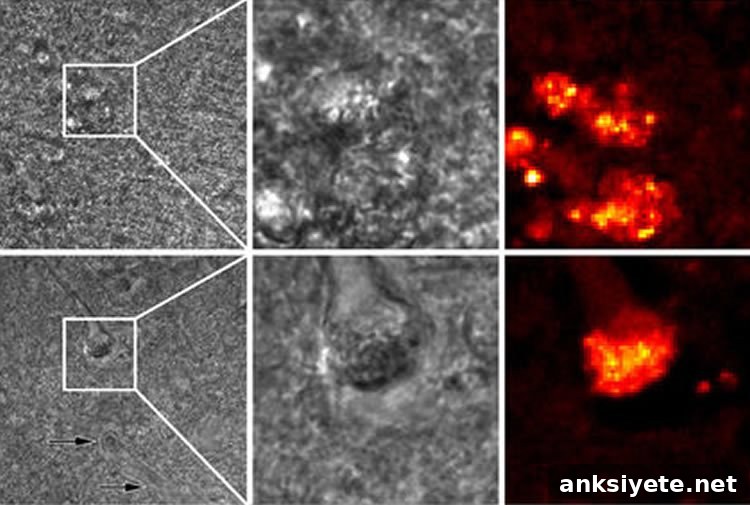
Summary: Researchers at the University of Twente have used hyperspectral Raman imaging to produce clear, label-free images of brain tissue affected by Alzheimer’s disease, revealing both plaques and tangles as well as nearby changes in the surrounding tissue.
Source: University of Twente
Raman optical imaging now reveals Alzheimer’s-related changes in brain tissue, including surrounding regions that show early alterations.
Alzheimer’s disease is marked by protein-rich deposits in brain tissue known as neuritic plaques and neurofibrillary tangles. Using hyperspectral Raman imaging, researchers at the University of Twente have produced high-resolution chemical images of these affected regions. Unlike techniques that require staining or labels, Raman imaging is label-free and detects the specific molecular signatures of proteins, lipids, water and beta-sheet structures; this allows scientists to visualize both the pathological proteins and the altered biochemical environment around them.
The study examined brain tissue from four donors, three diagnosed with Alzheimer’s disease and one control. For each sample, the team acquired thousands of Raman spectra across small tissue areas to generate detailed maps of molecular composition. These maps make it possible to distinguish plaques and tangles from surrounding tissue and to identify a transition zone where tissue shows intermediate chemical properties—potentially indicating how pathology spreads through the brain. Even in the control brain, a very small region showed elevated protein activity, which could represent an initial sign of neurodegenerative change.
How Raman imaging works
Raman microscopy uses a focused laser beam to probe a sample and measures the energy shifts in scattered light. Those shifts correspond to specific molecular vibrations and therefore to the chemical substances present. In this investigation, each 30 × 30 µm area was recorded as a hyperspectral data cube with 64 × 64 pixels, yielding thousands of spectra per sample with a spatial resolution of roughly 0.47 µm. Because Raman spectroscopy requires no chemical pretreatment, it preserves the native state of tissue and provides a powerful, label-free method for chemical imaging.
Resolution smaller than a single cell
Compared with clinical imaging modalities such as MRI, PET and CT, Raman imaging can detect chemical differences on a subcellular scale. The sensitivity demonstrated in these samples allowed visualization of protein-rich deposits at neural cell level and even smaller regions of altered chemistry. Although the present study used fixed brain slices, Raman techniques are compatible with in vivo applications and could potentially aid intraoperative detection of pathological tissue during surgery.
This work was led by Cees Otto of the Medical Cell Biophysics group at the University of Twente and published in Scientific Reports, in collaboration with researchers from Leiden University and international partners. The study demonstrates that hyperspectral Raman imaging combined with multivariate analysis can identify and quantify multiple tissue components—proteins, lipids, water and beta-sheets—in unstained human brain slices from Alzheimer’s disease patients.
Key findings
- Raman images matched classical brain morphology and localized neuritic plaques and neurofibrillary tangles in unstained tissue.
- Protein content inside plaques and tangles was about twice that of the surrounding tissue; beta-sheet content increased more substantially.
- Raman broad-band autofluorescence was higher within plaques and tangles and showed stronger correlation with beta-sheet content than with protein alone.
- Lipid content remained similar inside and outside these lesions, indicating specific alterations in protein and structural protein states rather than bulk lipid loss.
Hyperspectral Raman imaging of neuritic plaques and neurofibrillary tangles in brain tissue from Alzheimer’s disease patients
Neuritic plaques and neurofibrillary tangles are essential criteria for diagnosing Alzheimer’s disease. The authors evaluated unstained frontal cortex and hippocampus samples from three donors with Alzheimer’s disease and one control using hyperspectral Raman microscopy on 30 × 30 µm regions. Data matrices of 64 × 64 pixels enabled quantification of proteins, lipids, water and beta-sheets at 0.47 µm spatial resolution. Hierarchical cluster analysis visualized regions with similar Raman spectra. The resulting Raman images corresponded to classical morphology: protein content was approximately twice as high and beta-sheet signals increased about 5.6-fold inside plaques and tangles compared with surrounding tissue; broad-band autofluorescence increased as well. Lipid content remained largely unchanged. The combination of hyperspectral Raman imaging and cluster analysis permits label-free identification and simultaneous quantification of multiple tissue components in human Alzheimer’s disease brain tissue.
This summary presents the main results and significance of the published study on hyperspectral Raman imaging of Alzheimer’s disease brain tissue.