
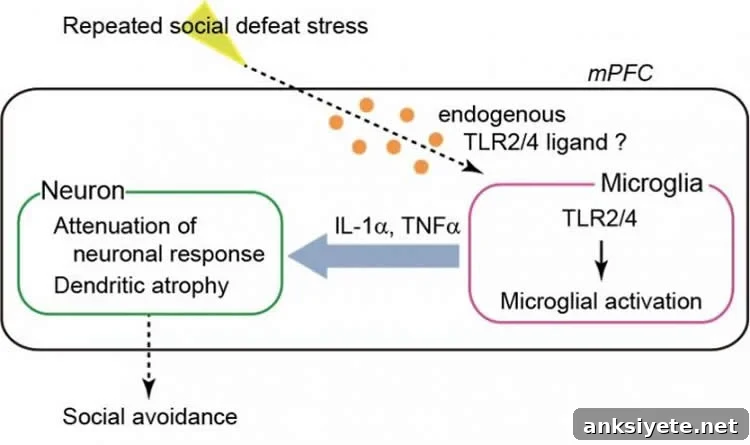
Summary: Repeated social defeat stress activates microglia in the medial prefrontal cortex via innate immune receptors, prompting release of inflammatory cytokines that impair neuronal function and produce depressive behavior.
Source: Kobe University.
Japanese researchers have identified a key role for innate immune–driven neural inflammation in stress-induced depression, revealing potential targets for new antidepressant strategies. Their findings appear in the online edition of Neuron.
The study was led by Professor Tomoyuki Furuyashiki and Assistant Professor Shiho Kitaoka at Kobe University Graduate School of Medicine, in collaboration with Project Professor Shuh Narumiya of Kyoto University Graduate School of Medicine.
Previous clinical and preclinical evidence linked inflammation to depression: elevated inflammatory cytokines in blood samples from depressed patients, activation of microglia (the brain’s resident immune cells) in brains of depressed individuals, and higher rates of depression in people with chronic inflammatory conditions. Yet the precise mechanisms connecting inflammation and stress-induced depression remained unclear.
To investigate how repeated environmental stress triggers depressive behavior, the team focused on a validated animal model called repeated social defeat stress (R-SDS). R-SDS mimics chronic social stress that can erode cognitive function and emotional resilience, increasing anxiety and depressive-like behaviors.
Genome-wide expression analysis of stressed mouse brains revealed upregulation of a putative ligand for Toll-like receptors 2 and 4 (TLR2/4), innate immune receptors known to trigger inflammatory responses. To test the functional importance of these receptors, the researchers used mice genetically lacking both TLR2 and TLR4. Remarkably, TLR2/4-deficient mice were largely resistant to the behavioral effects of repeated social defeat: they did not develop social avoidance or heightened anxiety after stress exposure.
Further examination showed that R-SDS normally activates microglia and induces neuronal atrophy and reduced responsiveness specifically in the medial prefrontal cortex (mPFC), a brain region critical for social and emotional regulation. These microglial and neuronal changes were absent in mice lacking TLR2/4, implicating these receptors as essential mediators of stress-driven microglial activation in the mPFC.
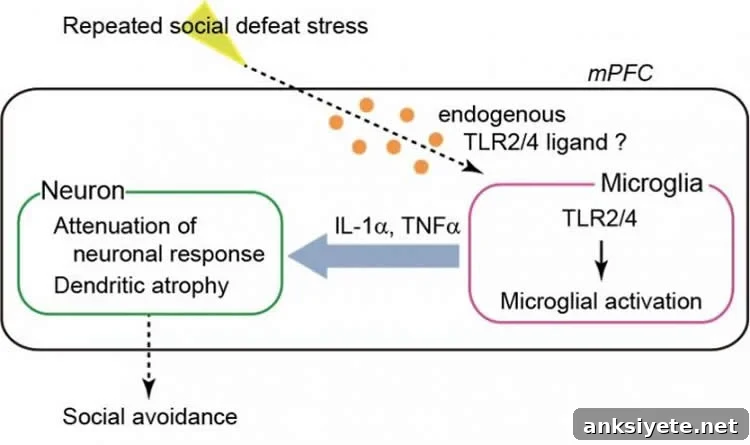
The team then developed an approach to selectively reduce TLR2/4 expression in microglia confined to specific brain regions. Targeted knockdown of microglial TLR2/4 within the mPFC prevented the development of depressive-like behavior following repeated social defeat stress. Molecular analyses revealed that R-SDS induced expression of the inflammatory cytokines interleukin-1 alpha (IL-1α) and tumor necrosis factor alpha (TNFα) in mPFC microglia in a TLR2/4-dependent manner. Local delivery of neutralizing antibodies against IL-1α and TNFα into the mPFC suppressed stress-induced social avoidance, demonstrating that these cytokines mediate the behavioral consequences of microglial activation.
Taken together, the results indicate a clear pathway: repeated social defeat stress elevates endogenous signals that engage TLR2/4 on microglia in the medial prefrontal cortex, triggering release of IL-1α and TNFα. These cytokines contribute to dendritic atrophy and reduced responsiveness of mPFC neurons, and the resulting circuit dysfunction produces social avoidance and other depressive-like behaviors.
Professor Furuyashiki commented: “These findings demonstrate the importance of neural inflammation driven by the innate immune system in stress-induced depression. Targeting innate immune molecules could be a promising strategy for developing new antidepressant therapies.”
Funding: This study was supported by the Japan Agency for Medical Research and Development, Japan Science and Technology Agency, Japan Society for the Promotion of Science, the Ministry of Education, Culture, Sports, Science and Technology in Japan, the Uehara Memorial Foundation, and the Sumitomo Foundation.
Source: Eleanor Wyllie, Kobe University
Publisher: NeuroscienceNews.com organized coverage of the study.
Image source: Image credited to Kobe University.
Original research: “The Innate Immune Receptors TLR2/4 Mediate Repeated Social Defeat Stress-Induced Social Avoidance through Prefrontal Microglial Activation” by Xiang Nie et al., published in Neuron, July 19, 2018.
doi: 10.1016/j.neuron.2018.06.035
The Innate Immune Receptors TLR2/4 Mediate Repeated Social Defeat Stress-Induced Social Avoidance through Prefrontal Microglial Activation
Highlights
• Repeated social defeat stress activates medial prefrontal cortex (mPFC) microglia via innate immune receptors TLR2 and TLR4.
• Activated microglia promote dendritic atrophy and response attenuation in mPFC neurons.
• Microglial activation in the mPFC underlies stress-induced social avoidance.
• TLR2/4-dependent induction of IL-1α and TNFα in mPFC microglia drives social avoidance behavior.
Summary
Chronic environmental stress can provoke neural inflammation that contributes to anxiety and depression. Toll-like receptors (TLRs) are innate immune receptors activated by endogenous or exogenous ligands to initiate inflammatory signaling. The authors demonstrate that genetic loss of TLR2 and TLR4 prevents repeated social defeat stress (R-SDS)-induced social avoidance and anxiety in mice. TLR2/4 deficiency reduces R-SDS-induced microglial activation, neuronal response attenuation, and dendritic atrophy in the mPFC. Microglia-specific knockdown of TLR2/4 in the mPFC blocks social avoidance. Transcriptome analyses show that R-SDS induces IL-1α and TNFα expression in mPFC microglia in a TLR2/4-dependent manner, and blocking these cytokines in the mPFC suppresses stress-induced social avoidance. These findings identify TLR2/4-mediated microglial activation in the mPFC as a critical mechanism linking repeated environmental stress to neuronal dysfunction and depressive-like behavior, highlighting innate immunity as an unexpected contributor to stress-related psychiatric changes.
This article summarizes published research and does not include treatment recommendations. Findings emphasize molecular and circuit-level targets that may inform future therapeutic development for stress-related depression.