Summary: Microscopy analysis reveals detailed structures and functional insights into two calcium homeostasis modulator proteins.
Source: CSHL
Many cell surfaces feature large, mysterious pores that participate in diverse physiological processes — from taste perception to neural function — and have been linked to conditions such as Alzheimer’s disease, depression, and asthma. Determining the molecular architecture of these pores is an essential step toward understanding their roles and targeting them therapeutically.
“One of the most recently discovered of these ‘large holes’ are called calcium homeostasis modulators, or CALHMs,” said Cold Spring Harbor Laboratory Professor Hiro Furukawa. “They form pore-like channels on the membranes of certain cells, including neurons, and allow various ions and small molecules to pass in and out.”
In a study published in Nature Structural & Molecular Biology, researchers in Furukawa’s laboratory resolved high-resolution structures for two CALHM proteins and examined how their architectures relate to function.
“At first glance, having large openings in a cellular membrane seems like a recipe for loss of integrity — you might expect cells to swell or collapse,” said Johanna Syrjanen, a postdoctoral researcher and co-lead on the project. “But cells with properly functioning CALHM channels remain stable, which indicates that the channels are precisely regulated and likely play important physiological roles.”
The team focused on two CALHM family members. CALHM1 is implicated in taste signaling — detecting sweet, bitter and umami flavors — and in airway regulation that may affect asthma. Genetic variations affecting CALHM1 have also been associated with Alzheimer’s disease risk. CALHM2, by contrast, has been linked in prior studies to mood regulation and depression. The structural work revealed a striking difference: CALHM2 assembles into a much larger pore than CALHM1, suggesting distinct permeation properties and regulatory mechanisms.
“We believe the gate‑like opening and closing of these channels is tightly controlled,” Syrjanen said. “Understanding the structural basis for that gating is essential to explain how CALHMs affect taste and how mutations or misregulation might contribute to disease.”
To capture the channels’ structures, the researchers employed single‑particle cryo‑electron microscopy (cryo‑EM). This technique images flash‑frozen protein samples with an electron beam, then combines thousands of particle images in different orientations to reconstruct detailed three‑dimensional density maps. Those maps allow researchers to trace the positions of transmembrane helices and other structural features with high precision.
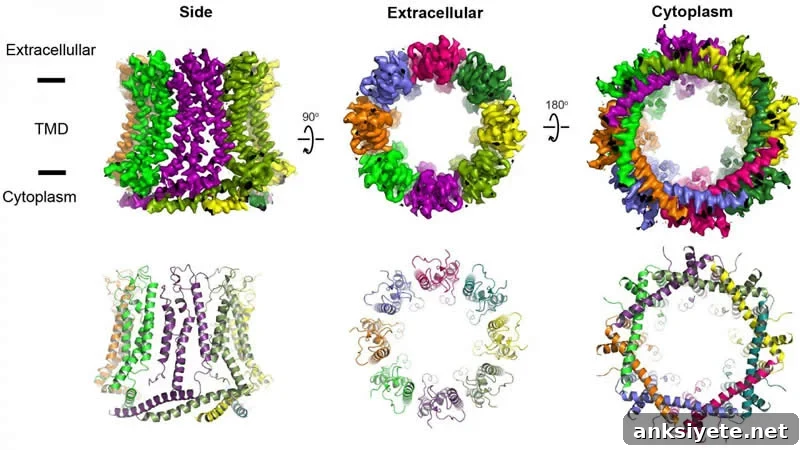
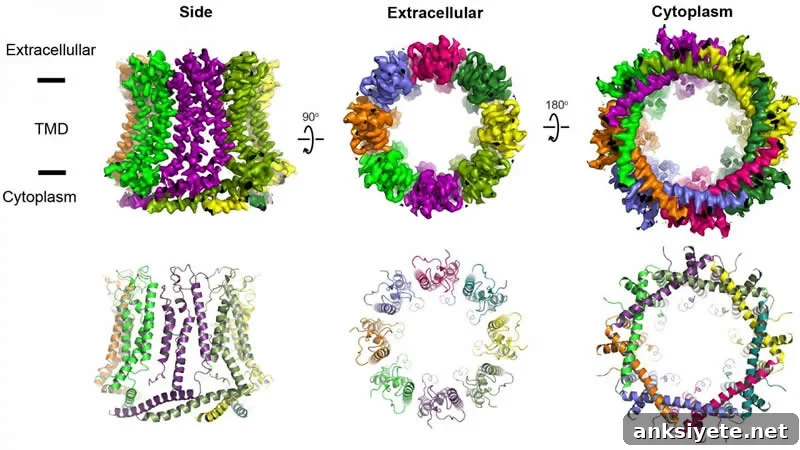
The resulting models show that CALHMs assemble in novel ways: chicken CALHM1 forms an octameric channel, while human CALHM2 assembles as an undecamer. The two proteins each contain four transmembrane helices per subunit, but their distinct oligomeric states create pores of very different diameters. To probe functional consequences, the authors complemented structural data with molecular dynamics simulations. Those simulations indicate that the larger CALHM2 pore can accommodate a lipid bilayer inside the channel lumen, a property not favored in the smaller CALHM1 pore. This suggests a possible relationship among pore size, lipid interaction, and channel activity.
“By providing the first high‑resolution blueprints of these channels, we equip researchers with structural templates that can guide future experiments and drug design,” Furukawa said. “Mapped at this level of detail, CALHM pores become tractable targets for therapeutic strategies aimed at conditions ranging from neurodegeneration and mood disorders to respiratory dysfunction.”
Source:
CSHL
Media Contacts:
Sara Roncero‑Menendez – CSHL
Image Source:
The image is credited to Furukawa lab / CSHL, 2020.
Original Research: Closed access
“Structure and assembly of calcium homeostasis modulator proteins.” Johanna L. Syrjanen, Kevin Michalski, Tsung‑Han Chou, Timothy Grant, Shanlin Rao, Noriko Simorowski, Stephen J. Tucker, Nikolaus Grigorieff & Hiro Furukawa. Nature Structural and Molecular Biology. DOI: 10.1038/s41594-019-0369-9.
Abstract (summary)
Many cell membranes contain large‑pore channels that allow passage of ions and metabolites and thereby influence cell signaling and physiology. CALHMs are a recently identified family of such channels that conduct ions and ATP in a voltage‑dependent fashion and are involved in neuronal excitability, taste transduction, and pathological processes implicated in depression and Alzheimer’s disease. Prior to this work, the structures and assembly modes of CALHMs were not well defined. Using single‑particle cryo‑EM, the study reveals novel assemblies for two CALHM family members — an octameric chicken CALHM1 and an undecameric human CALHM2 — each built from subunits with four transmembrane helices. Molecular dynamics simulations further suggest that the larger CALHM2 pore can stably host lipids arranged as a bilayer, a behavior not observed for CALHM1, pointing to a potential link between pore diameter, lipid accommodation and channel function.