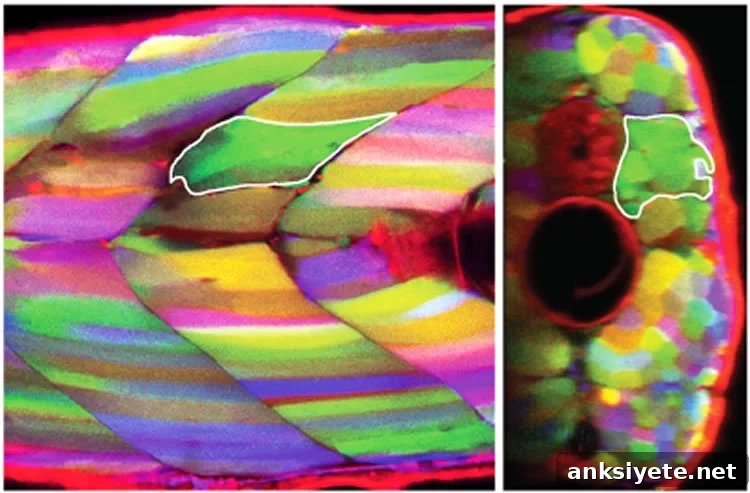
Summary: New research provides the first direct evidence of how muscle stem cells are activated to regenerate damaged muscle tissue.
Scientists at Monash University’s Australian Regenerative Medicine Institute (ARMI) have captured, for the first time in a living animal, how muscle stem cells are recruited to regenerate injured muscle. This discovery could inform therapies to improve muscle repair in the elderly, people with muscular dystrophy, and athletes recovering from injury.
The team, led by Professor Peter Currie, published their findings in the journal Science after using the zebrafish as a model to observe muscle regeneration in vivo. Zebrafish are ideal for this work because they are highly regenerative and, importantly, transparent during key life stages, allowing researchers to image cellular behavior inside a living organism.
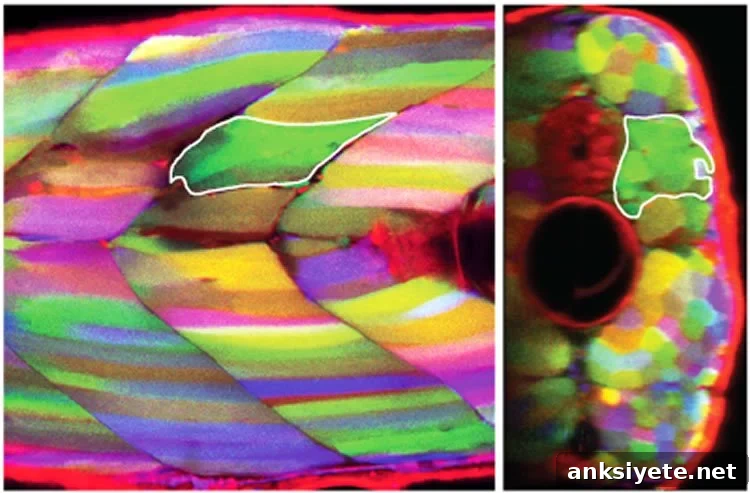
Focusing on adult muscle stem cells—also known as satellite cells—the researchers observed these cells sitting adjacent to mature muscle fibers. When a fiber is damaged, it extends cellular projections that reach out, capture nearby satellite cells, and pull them back to the injury site. Once recruited, those stem cells divide and differentiate to rebuild the damaged muscle fiber.
Previous evidence for the role of satellite cells largely came from in vitro studies or indirect measures. What sets this work apart is the ability to image the entire regeneration process—from injury through fiber replacement—in real time within a living animal. Using advanced microscopy, the team recorded how satellite cells move, interact with both injured and uninjured fibers, and undergo asymmetric cell division that balances self-renewal with production of differentiating progenitors.
Professor Currie emphasized the significance of capturing these events as they occur: “This process has never been caught in action before. Observing muscle stem cells at work in vivo can reveal strategies to better stimulate these cells in human muscle.” The study provides in vivo validation for models that proposed asymmetric divisions of satellite cells generate both long-term stem cells and a clonal population of myoblasts committed to muscle repair.
Key findings:
- Identification and live imaging of a zebrafish muscle stem cell population analogous to mammalian satellite cells.
- Observation that injured muscle fibers extend projections to recruit nearby satellite cells to the damage site.
- In vivo evidence that asymmetric division of these stem cells coordinates both self-renewal and generation of progenitors for regeneration.
- Demonstration of complex interactions between satellite cells and both injured and uninjured fibers during the regeneration process.
Significance: This research improves understanding of the cellular mechanisms that drive muscle repair. By revealing how satellite cells are recruited and how their divisions are coordinated during regeneration, the findings lay groundwork for therapies that could enhance muscle recovery in age-related muscle loss, degenerative muscle diseases such as muscular dystrophy, and acute injury.
Funding: Funding information not available.
Source: Monash University. Image credit: adapted from the Monash University press release.
Asymmetric division of clonal muscle stem cells coordinates muscle regeneration in vivo
Skeletal muscle uses a self-renewing stem cell population, the satellite cell, to enable regeneration. Earlier in vitro studies suggested asymmetric divisions renew rare “immortal” stem cells while producing a clonal population of differentiation-competent myoblasts, but in vivo validation was lacking. Using zebrafish, the researchers defined a muscle stem cell population analogous to mammalian satellite cells and imaged the full process of muscle regeneration from injury to fiber replacement in vivo. The analysis revealed complex interactions between satellite cells and both injured and uninjured fibers and provided in vivo evidence that asymmetric satellite cell division drives both self-renewal and regeneration via a clonally restricted progenitor pool.
Authors: David B. Gurevich, Phong Dang Nguyen, Ashley L. Siegel, Ophelia V. Ehrlich, Carmen Sonntag, Jennifer M. N. Phan, Silke Berger, Dhananjani Ratnayake, Lucy Hersey, Joachim Berger, Heather Verkade, Thomas E. Hall, and Peter D. Currie.
This study captures, for the first time in a living animal, how satellite cells are recruited and divide asymmetrically to repair damaged muscle. By using the transparent and highly regenerative zebrafish, researchers directly visualized the dynamic interactions between injured fibers and nearby stem cells. The findings offer a clearer picture of the initial steps in muscle regeneration and suggest new avenues to stimulate muscle repair in human health and disease.