
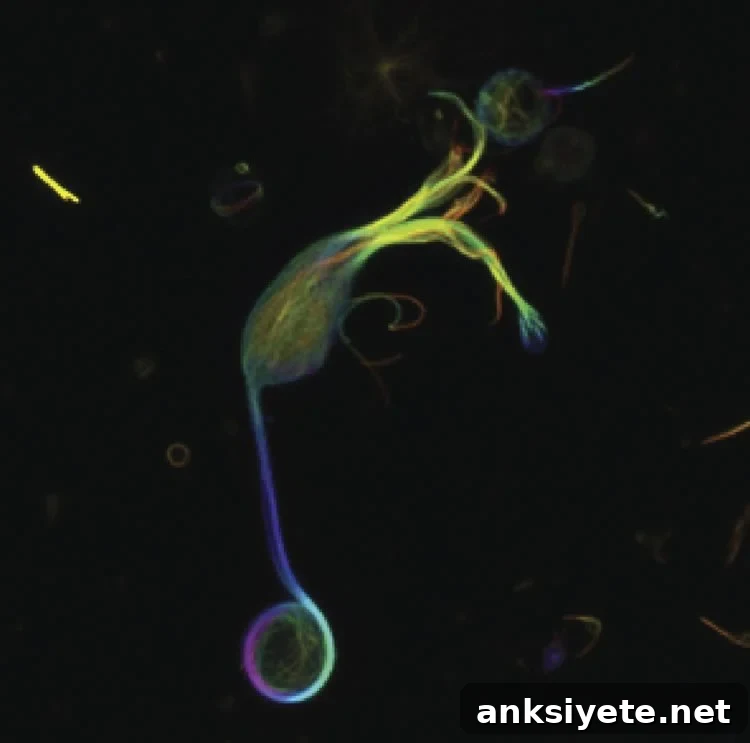
Researchers have identified a prominent band of microtubules in certain retinal neurons that appears to act as a transport pathway for mitochondria, supplying the energy needed for continuous visual processing. These results were published in the July issue of The Journal of General Physiology.
The retina, the light-sensitive tissue at the back of the eye, converts incoming light into neural signals. Within the retina, bipolar cells bridge the gap between photoreceptors (which detect light) and ganglion cells (which relay visual information to the brain). Unlike many neurons, bipolar cells remain continuously active and must sustain the release of vast numbers of synaptic vesicles that carry neurotransmitters, placing exceptional energy demands on their synaptic terminals.
To investigate how these energy needs are met, researchers from the National Heart, Lung, and Blood Institute and Yale University used advanced three-dimensional fluorescence and electron microscopy to examine the subcellular architecture of presynaptic terminals in retinal bipolar cells from live goldfish. Goldfish bipolar neurons are especially useful for this work because some of their presynaptic terminals are unusually large, making it easier to visualize internal structures.
Surprisingly, the team discovered a thick, previously undescribed band of microtubules that extends from the axon into the synaptic terminal and loops around the inner periphery of the terminal. This microtubule “marginal band” runs throughout the presynaptic space and closely associates with a significant population of mitochondria within the terminal.
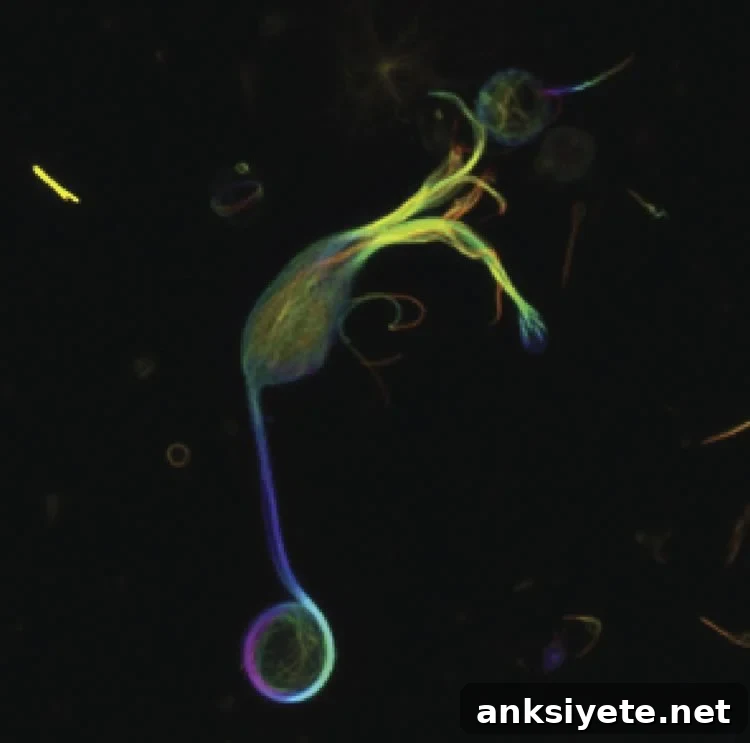
Microtubules are filamentous cytoskeletal components that serve as tracks for intracellular transport. Motor proteins such as kinesins move along these tracks to ferry organelles and other cargo. In this study, when the researchers applied drugs that inhibit microtubule-based kinesin motors, mitochondria failed to reach the synaptic terminal and instead accumulated in the axon. This observation supports the idea that the marginal microtubule band functions as a roadway enabling targeted delivery and positioning of mitochondria within the presynaptic space.
The presence of a structured microtubule band that organizes and transports mitochondria has important implications for how neuronal terminals meet high, sustained energy demands. Mitochondria supply ATP required for vesicle cycling, ion pumping, and other energy-intensive processes that maintain continuous neurotransmitter release. By concentrating mitochondria in the presynaptic terminal, the marginal band likely helps ensure a reliable local energy supply essential for ongoing synaptic activity during visual signaling.
Funding: Supported by the National Institutes of Health / National Heart, Lung, and Blood Institute.
Source: Rita Sullivan King, Rockefeller University Press. Image credit: Graffe et al. Original research article: “A marginal band of microtubules transports and organizes mitochondria in retinal bipolar synaptic terminals” by Malkolm Graffe, David Zenisek, and Justin W. Taraska, Journal of General Physiology, published online June 29, 2015. DOI: 10.1085/jgp.201511396.
Summary (Abstract)
Goldfish retinal bipolar cells contain giant synaptic terminals, densely packed with synaptic vesicles that undergo continuous rounds of exocytosis. To understand how the cytoskeleton and organelles are organized to support persistent synaptic activity, the authors combined 3-D fluorescence and 3-D electron microscopy to resolve the terminals’ internal architecture. They identified a thick marginal band of microtubules that originates in the axon and loops around the terminal periphery throughout the presynaptic region. This structure associates with many mitochondria, and pharmacological inhibition of microtubule-dependent kinesin motors causes mitochondria to accumulate in the axon rather than the terminal. The study concludes that the marginal microtubule band is essential for transporting and localizing mitochondria into the presynaptic space, providing the sustained energy supply required for continuous transmitter release in these large synaptic terminals.