
If you’ve ever discovered a banana covered with a cloud of tiny flies, you were witnessing the busy courtship of Drosophila melanogaster. These fruit flies engage in elaborate mating behaviors on ripe fruit, and male flies make surprisingly precise choices about whom to pursue—decisions that have intrigued scientists for decades.
Researchers at Rockefeller University have now mapped how the male fly brain integrates multiple sensory cues to decide whether to continue or abandon courtship. Their study, published in Neuron, traces the neural circuits that channel taste and smell signals from sensory organs into higher brain centers and shows how a particular group of neurons synthesizes this information to produce a clear behavioral outcome.
Before a male Drosophila begins courtship he taps a potential partner with a foreleg. “That tap lets him sample pheromones on the partner’s waxy cuticle so he can tell whether she’s a suitable and receptive mate,” explains Vanessa Ruta, Gabrielle H. Reem and Herbert J. Kayden Assistant Professor and head of the Laboratory of Neurophysiology and Behavior.
If the chemical cues are favorable, the male follows the female while extending and vibrating one wing to produce a courtship song. If the female accepts, mating follows; if not, the male stops. Prior work identified a cluster of neurons called P1 cells as a key switch for initiating male courtship, but until now the pathways that deliver and combine different sensory signals onto those neurons were not well understood.
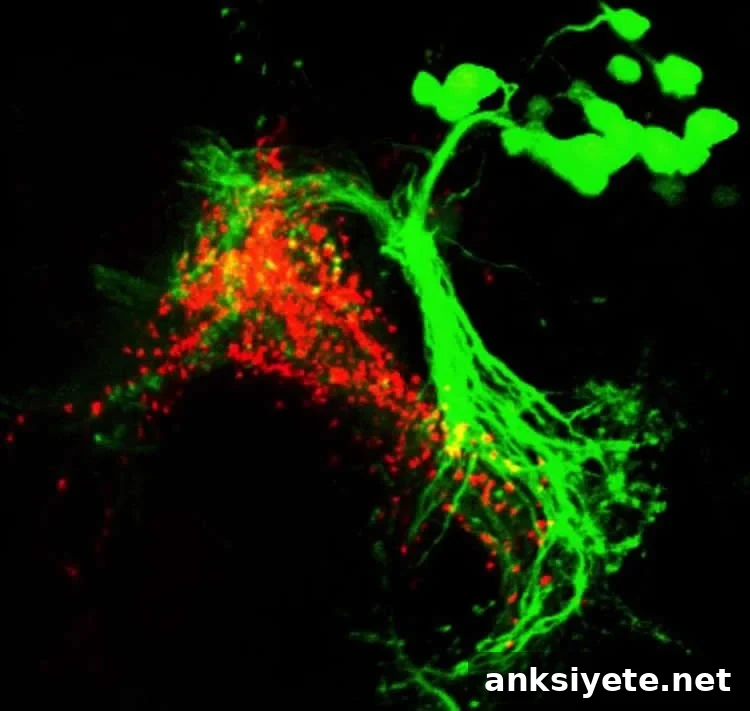
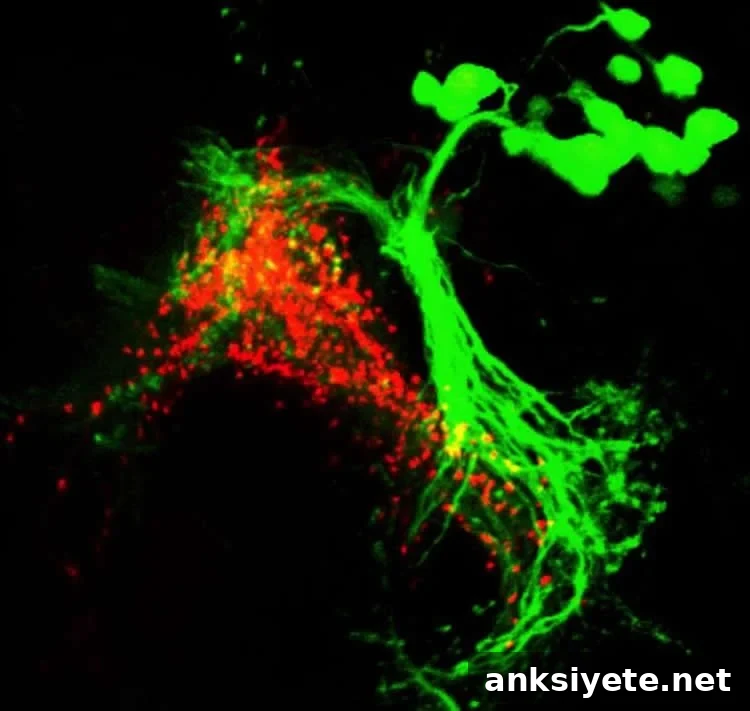
The team shows that P1 neurons receive input from at least three distinct neural groups that deliver complementary—and sometimes conflicting—information. Taste receptors on the male’s foreleg provide pheromone cues that can excite P1 activity and promote courtship. At the same time, olfactory or gustatory signals indicating that the partner is already mated, belongs to another species, or is actually a male can suppress P1 activity.
“P1 neurons integrate both taste and smell,” Ruta says. “Some inputs are excitatory and some are inhibitory, and the male brain combines them to reach a behavioral decision.”
In live imaging experiments, the researchers presented males with a variety of partners: virgin females of the same species, previously mated females, males, and females of different Drosophila subspecies. Monitoring P1 neurons under the microscope, they observed that P1 cells activate robustly only when the male both tastes and smells appropriate pheromones found on a virgin female of his own species. When inhibitory cues were present, P1 responses were reduced or suppressed, and courtship did not proceed.
Mapping the pathways revealed that gustatory and olfactory pheromone circuits converge at the P1 neurons themselves. Moreover, pheromone information travels along parallel excitatory and inhibitory branches, creating a balanced architecture that allows precise discrimination of suitable mates and flexible control of courtship behavior.
About this neurology research
Source: Rockefeller University
Image credit: Laboratory of Neurophysiology and Behavior, The Rockefeller University
Original research: “Multimodal Chemosensory Circuits Controlling Male Courtship in Drosophila” by E. Josephine Clowney, Shinya Iguchi, Jennifer J. Bussell, Elias Scheer, and Vanessa Ruta. Published online August 13, 2015 in Neuron. DOI: 10.1016/j.neuron.2015.07.025
Abstract
Multimodal Chemosensory Circuits Controlling Male Courtship in Drosophila
Highlights
• P1 neurons are tuned to respond selectively to appropriate potential mates.
• Gustatory and olfactory pheromone circuits converge onto P1 neurons.
• Pheromone signals are carried by parallel excitatory and inhibitory branches.
• This neural architecture enables stringent yet flexible control of courtship.
Summary
Across animals, internal states and sensory evaluation create chains of behavior that can be long-lasting and self-perpetuating. In Drosophila, male courtship is a stereotyped ritual gated by sexually dimorphic P1 interneurons. While gustatory pheromones are known to influence P1 activity, the circuit-level mechanisms that combine taste and smell to permit or block courtship were unclear. Using circuit mapping and in vivo functional imaging, the authors trace both gustatory and olfactory pheromone pathways to their convergence on P1 neurons and show how the interplay of excitation and inhibition shapes selective tuning to appropriate sexual partners. Inhibition—even to pheromones that can promote courtship—emerges as a key element that regulates P1 activity. Balanced excitatory and inhibitory inputs allow the fly to discriminate potential mates and to control the transition into courtship robustly.
Understanding how a relatively simple brain like Drosophila’s integrates multiple sensory cues to make decisions can illuminate general principles of neural circuit design. Just as humans weigh conflicting signals—an illuminated crosswalk but an oncoming car—flies combine sensory information to reach adaptive behavioral choices. Studying these circuits in a compact system helps reveal the basic architecture by which brains integrate, assess, and act on multimodal sensory information.