
Summary: Researchers applied machine learning to identify brain-based dimensions of mental health disorders, advancing the search for biomarkers to improve diagnosis and treatment.
Source: University of Pennsylvania.
Researchers at Penn Medicine have used machine learning to map brain network abnormalities to distinct dimensions of psychopathology, an important step toward objective biomarkers that could improve psychiatric diagnosis and care. Led by Theodore D. Satterthwaite, MD, the team analyzed functional brain connectivity and symptom measures to reveal four brain-guided dimensions of mental illness—mood, psychosis, fear, and disruptive externalizing behavior. The study appears in Nature Communications.
Psychiatry currently depends largely on clinical interviews and observations, whereas many other medical specialties use biological tests and imaging to guide diagnosis, prognosis, and treatment. Prior brain imaging studies have shown differences associated with psychiatric diagnoses, but wide variability within diagnostic categories and frequent co-occurrence of disorders have limited translation into clinical tools. The Penn team sought to bridge that gap by letting brain connectivity patterns and symptom data define meaningful dimensions of psychopathology, rather than relying solely on conventional diagnostic labels.
“Psychiatry is behind other fields of medicine when it comes to objective tests,” said Satterthwaite. “Most psychiatric diagnoses are still based on conversation and behavioral observation. One major barrier is that we don’t yet understand how brain abnormalities map onto psychiatric symptoms. Our goal was to use a data-driven approach to link symptom patterns with brain network differences so that biology can inform diagnosis and, eventually, treatment.”
The investigators analyzed data from a large community sample of adolescents and young adults drawn from the Philadelphia Neurodevelopmental Cohort (PNC). A total of 999 participants between ages 8 and 22 completed resting-state functional MRI scans and a comprehensive, structured assessment of psychiatric symptoms. The PNC was led by Raquel E. Gur, MD, PhD, and supported by the National Institute of Mental Health. The research team applied a machine learning technique called sparse canonical correlation analysis to jointly evaluate relationships between whole-brain connectivity and symptom profiles.
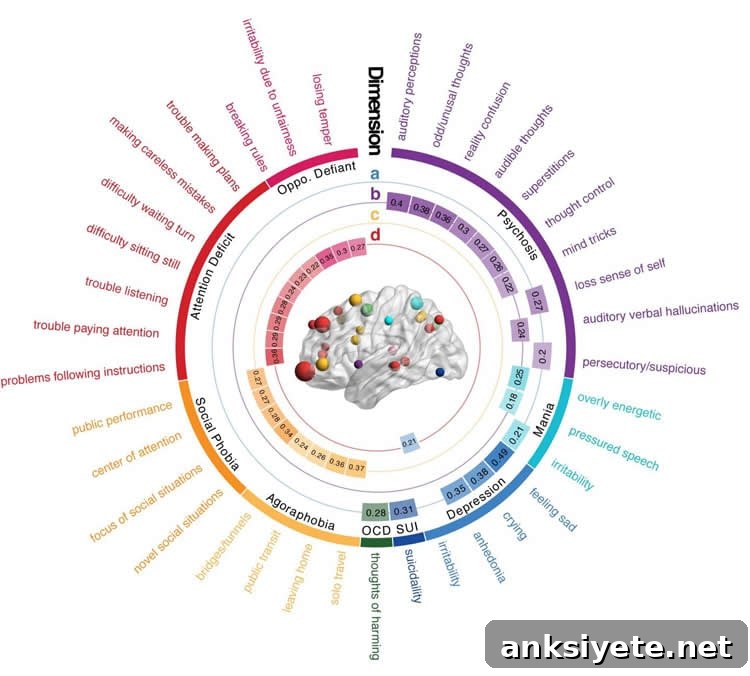
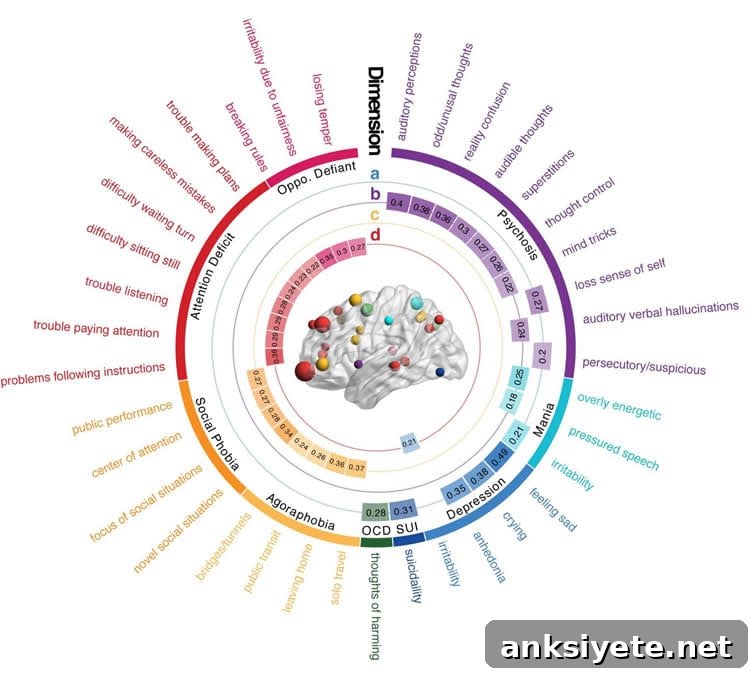
The machine learning analysis uncovered correlated patterns of functional connectivity and psychiatric symptoms that grouped into four distinct, brain-guided dimensions: mood, psychosis, fear, and disruptive externalizing behavior. Each dimension corresponded to a specific pattern of altered connectivity across functional networks, indicating that different symptom constellations are linked to distinct network-level brain signatures.
Importantly, the brain-guided dimensions did not align cleanly with traditional clinical categories. Each dimension included symptoms drawn from multiple diagnostic domains. For instance, the mood dimension incorporated items commonly associated with depression (such as persistent sadness), mania (including irritability), and obsessive-compulsive symptoms (such as intrusive thoughts about self-harm). The disruptive externalizing dimension was driven largely by symptoms typical of Attention Deficit Hyperactivity Disorder (ADHD) and Oppositional Defiant Disorder (ODD), and it also included an irritability symptom that is often classified within mood disorders. These results indicate that when symptom reports and brain connectivity are considered together, symptom clusters cross conventional diagnostic boundaries and instead form dimensions tied to specific connectivity patterns.
“Beyond the unique connectivity signatures for each dimension, we observed shared network abnormalities across dimensions,” said Cedric Xia, MD-PhD candidate and lead author. “In particular, the default mode network and the fronto-parietal (executive) network—which typically become more segregated during healthy development—showed abnormal integration across all four dimensions.”
The default mode and frontal-parietal networks play central roles in complex cognitive functions including self-referential thought, executive control, memory, and social cognition. The observed loss of typical segregation between these networks supports the hypothesis that many psychiatric conditions are associated with atypical brain maturation and network organization.
The study also examined developmental and sex-related differences. Connectivity patterns associated with mood and psychosis dimensions became more pronounced with age, suggesting that these brain-symptom relationships strengthen across adolescence into young adulthood. In addition, connectivity patterns tied to mood and fear were stronger in female participants than in males, indicating sex differences in the neural architecture linked to certain symptom dimensions.
These findings demonstrate that a brain-guided, dimensional approach can reveal meaningful, reproducible links between functional brain networks and clinical symptoms across conventional diagnostic labels. By allowing biological signals to guide how we define psychiatric syndromes, this work lays groundwork for creating network-based biomarkers that could ultimately help clinicians diagnose conditions more precisely and tailor treatments to the underlying neural circuitry.
Additional Penn authors include Zongming Ma, Rastko Ciric, Shi Gu, Richard F. Betzel, Antonia N. Kaczkurkin, Monica E. Calkins, Philip A. Cook, Angel García de la Garza, Simon N. Vandekar, Zaixu Cui, Tyler M. Moore, David R. Roalf, Kosha Ruparel, Daniel H. Wolf, Christos Davatzikos, Ruben C. Gur, Raquel E. Gur, Russell T. Shinohara, and Danielle S. Bassett.
Funding: The study was supported by multiple grants from the National Institutes of Health. The Philadelphia Neurodevelopmental Cohort received dedicated support, and additional support came from the Penn-CHOP Lifespan Brain Institute and the Dowshen Program for Neuroscience.
Source: Hannah Messinger – University of Pennsylvania
Publisher: Organized by NeuroscienceNews.com
Image Source: NeuroscienceNews.com image is credited to Penn Medicine.
Original Research: Open access research titled “Linked dimensions of psychopathology and connectivity in functional brain networks” by Cedric Huchuan Xia et al., published in Nature Communications, August 2018.
doi: 10.1038/s41467-018-05317-y
Abstract
Linked dimensions of psychopathology and connectivity in functional brain networks
Neurobiological abnormalities associated with psychiatric disorders do not map cleanly onto existing diagnostic categories. High rates of comorbidity suggest that circuit-level abnormalities span traditional diagnoses. Using sparse canonical correlation analysis in a sample of youths, the study identified correlated patterns of functional connectivity and psychiatric symptoms. Four dimensions—mood, psychosis, fear, and externalizing behavior—were each associated with distinct connectivity patterns (correlations r = 0.68–0.71). Across dimensions, a common feature was reduced segregation between the default mode network and executive networks. Connectivity related to mood and psychosis strengthened with development, and sex differences appeared for mood- and fear-related connectivity. Key findings were replicated in an independent dataset, supporting the notion that connectivity-guided dimensions could form the basis for network-based biomarkers in psychiatry.