
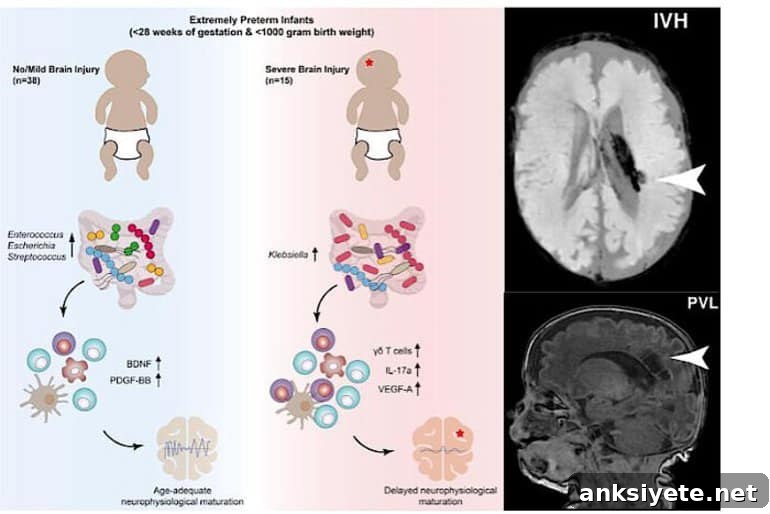
Summary: An overgrowth of the bacterium Klebsiella in the gut of extremely premature infants is linked to higher levels of specific immune cells and to the development of neurological injury. The findings support a connection between the gut microbiome, immune responses and early brain development.
Source: University of Vienna
Extremely premature infants face a high risk of brain injury. Researchers at the University of Vienna and the Medical University of Vienna have identified microbial and immunological signals outside the brain that correlate with neurological damage, revealing potential early targets for intervention.
The team discovered that Klebsiella overgrowth in the gastrointestinal tract of very preterm infants coincides with elevated levels of particular immune cells and with worsened brain injury outcomes.
The study appears in the journal Cell Host & Microbe.
Complex interplay: the gut-immune-brain axis
Gut development, immune maturation and brain development are tightly interconnected—a relationship often described as the gut-immune-brain axis. Gut microbes help shape immune responses, while the immune system monitors and reacts to microbial populations. The gut also communicates with the brain directly through neural pathways such as the vagus nerve and indirectly via immune signaling.
“We investigated how this axis influences brain development in extremely preterm infants,” says David Seki, first author of the study. Premature newborns have immature microbiomes and immune systems, making them prone to microbial shifts that can affect the developing brain.
Microbiome and immune patterns predict brain injury
The researchers identified specific microbiome and immune signatures that correlate with both the occurrence and severity of brain injury. Many of these signatures emerged before measurable changes appeared in brain imaging or electrophysiology, suggesting a time window in which progressing injury might be prevented or attenuated.
“We found reproducible patterns linking gut microbial composition to immune activation and to suppressed electrocortical maturation,” explains David Berry, head of the research group at the Centre for Microbiology and Environmental Systems Science (CMESS) and Operational Director of the Joint Microbiome Facility shared by the University of Vienna and the Medical University of Vienna.
Key biomarkers and mechanistic insights
The interdisciplinary team identified biomarkers that point toward possible therapeutic strategies. Excessive growth of Klebsiella and associated increases in γδ T cell levels were consistently associated with worse brain outcomes, according to Lukas Wisgrill, neonatologist at the Medical University of Vienna. These immune changes corresponded with greater secretion of pro-inflammatory factors and reduced release of neuroprotective molecules.
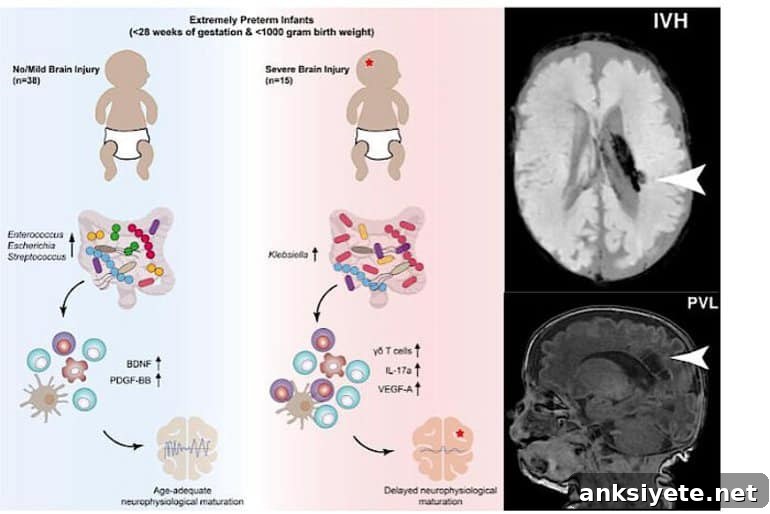
The study followed 60 infants born before 28 weeks gestation and weighing under 1 kilogram. Over weeks and months, researchers combined microbiome profiling (including 16S rRNA gene sequencing), blood and stool immune analyses, continuous brain-wave monitoring (aEEG), and MRI scans to create a comprehensive, longitudinal dataset.
Implications and next steps
These findings indicate that an aberrant gut-microbiota-immune-brain axis may drive or worsen brain injury in extremely premature neonates. Because many microbial and immunological signals precede detectable brain changes, they could serve as early biomarkers for identifying infants at risk and for guiding timely interventions.
The project, led jointly by Angelika Berger (Medical University of Vienna) and David Berry (University of Vienna), serves as the basis for further studies that will examine the microbiome’s long-term impact on neurodevelopment. The team will continue following the original cohort to assess motor and cognitive outcomes that emerge over several years.
“Understanding how early gut-immune-brain interactions shape long-term development is our priority,” says Angelika Berger. The researchers acknowledge the vital participation of the infants’ families, whose consent and cooperation made the detailed longitudinal study possible.
About this microbiome and brain development research news
Author: Pia Gärtner
Source: University of Vienna
Contact: Pia Gärtner – University of Vienna
Image: Image credited to Seki et al.
Original Research: Open access. “Aberrant gut microbiota-immune-brain axis development in premature neonates with brain damage” by Seki et al., Cell Host & Microbe. DOI: 10.1016/j.chom.2021.08.004
Abstract
Aberrant gut microbiota-immune-brain axis development in premature neonates with brain damage
Premature infants face a substantial risk of perinatal white matter injury, yet detailed understanding of the gut-microbiota-immune-brain axis in this population has been limited. The study profiled gut microbiota, immune markers and neurophysiological maturation in 60 extremely premature infants receiving standard neonatal care, including antibiotics and probiotics.
Findings show that infants with severe brain injury exhibit suppressed maturation of electrocortical activity, elevated γδ T cell counts, increased T cell secretion of vascular endothelial growth factor, and reduced secretion of neuroprotective factors. Klebsiella overgrowth in the gut strongly predicted brain damage and was linked to a pro-inflammatory immune state. These results suggest that disrupted development of the gut-microbiota-immune-brain axis may contribute to, or exacerbate, brain injury in extremely preterm neonates and point to potential early biomarkers and intervention targets.