Summary: New research suggests fruit flies use dopamine in learning processes similar to those in mammals.
Source: University of Sussex
Researchers at the University of Sussex have produced a computational model showing how dopamine in the fruit fly brain may support learning using mechanisms comparable to those in mammals.
A team in the School of Engineering and Informatics, led by Dr James Bennett with colleagues Andrew Philippides and Professor Thomas Nowotny, developed a biologically informed model of the Drosophila mushroom body that tests whether reward prediction error (RPE) signals — a central concept in mammalian learning — can also operate in insects. Their results are published in Nature Communications.
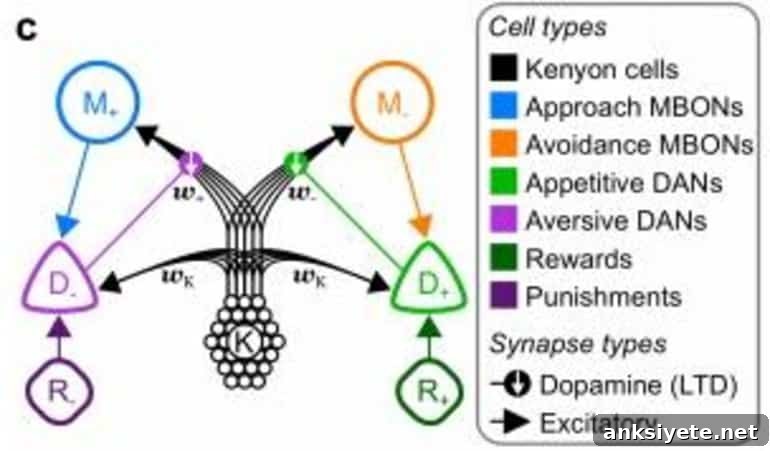
The model integrates anatomical and physiological data from recent experiments to simulate how distinct neuron types and their connections within the mushroom body interact during learning. Specifically, it examines how dopamine neurons could encode prediction errors by comparing expected rewards with actual outcomes, and how those signals might drive synaptic changes that underlie associative learning.
Fruit flies use a compact yet sophisticated neural structure, the mushroom body, to form associative memories. Prior attempts to reconcile insect experimental data with the reward prediction error hypothesis produced mixed conclusions. The Sussex team designed their model to test whether apparent contradictions can be resolved when the role of feedback signals from output neurons to dopamine neurons is included.
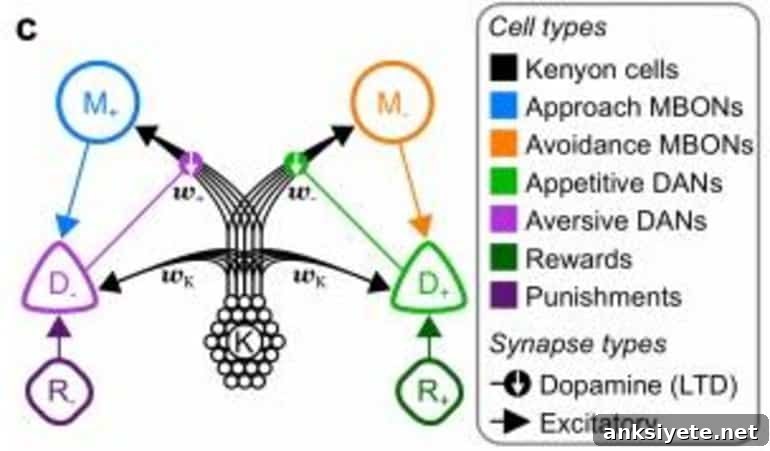
Their computational framework proposes that dopamine neurons do not simply register absolute reinforcement. Instead, these neurons signal reinforcement prediction errors by receiving feedback that represents predicted outcomes. This allows the system to calculate the difference between expected and received reward — the core of RPE-based learning — and to adjust synaptic plasticity accordingly. The model formulates plasticity rules that minimize prediction errors and demonstrates in simulation that mushroom body output neurons come to represent accurate reward predictions.
Importantly, the model reproduces a wide range of experimental phenomena observed in fruit fly conditioning studies, including classic conditioning and blocking effects. The team shows that the absence of blocking in certain experiments does not necessarily refute prediction-error-dependent learning, but may instead reflect particular circuit dynamics that their model captures.
Dr Bennett explains that including connections from output neurons back to dopamine neurons is a novel feature compared with earlier models of the mushroom body. These feedback connections enable the predicted value of a reward — for instance, the sugar content of food — to be compared with the actual reward the fly experiences. Such comparisons enable more precise learning and adaptive sugar-seeking behaviour.
The model also accounts for experimental manipulations where specific neurons are either silenced or activated. By matching a broad set of behavioral outcomes, the model provides testable mechanistic hypotheses about how particular neuron types influence learning and decision-making in Drosophila.
The research team formulated five clear experimental predictions derived from the model, intended to guide future laboratory work. Validating these predictions with genetic and physiological tools available in insects could clarify whether insects employ RPE-like computations and, if so, reveal conserved principles of learning across species.
Professor Nowotny notes that bridging insect and mammal studies offers two major advantages: the powerful genetic methods available in insects and the smaller, more tractable size of insect brains. Together, these features can help scientists dissect circuit-level mechanisms that underlie learning and may ultimately shed light on mammalian brain function and disorders linked to reward processing, such as addiction and depression.
About this neuroscience and learning research news
Source: University of Sussex
Contact: Neil Vowles, University of Sussex
Image: Image credited to University of Sussex
Original Research: Open access. “Learning with reinforcement prediction errors in a model of the Drosophila mushroom body” by James E. M. Bennett, Andrew Philippides & Thomas Nowotny. Published in Nature Communications.
Abstract
Learning with reinforcement prediction errors in a model of the Drosophila mushroom body
Accurate decision making in a changing environment requires learning correct predictions about outcomes. In Drosophila, such learning is mediated in part by the mushroom body, where dopamine neurons signal reinforcing stimuli and modulate synaptic plasticity upstream of mushroom body output neurons. Building on earlier models in which dopamine neurons signal absolute reinforcement, this study proposes that dopamine neurons instead signal reinforcement prediction errors by using feedback predictions from output neurons. The authors derive plasticity rules that minimize prediction errors, verify through simulations that output neurons learn accurate reinforcement predictions, and propose connectivity that explains a wider range of physiological observations than models constrained only by current experimental data. Both constrained and augmented versions of the model reproduce a broad set of conditioning and blocking experiments. The work also demonstrates that the absence of blocking in some cases does not imply the absence of prediction-error-dependent learning, and it presents five experimentally testable predictions.