
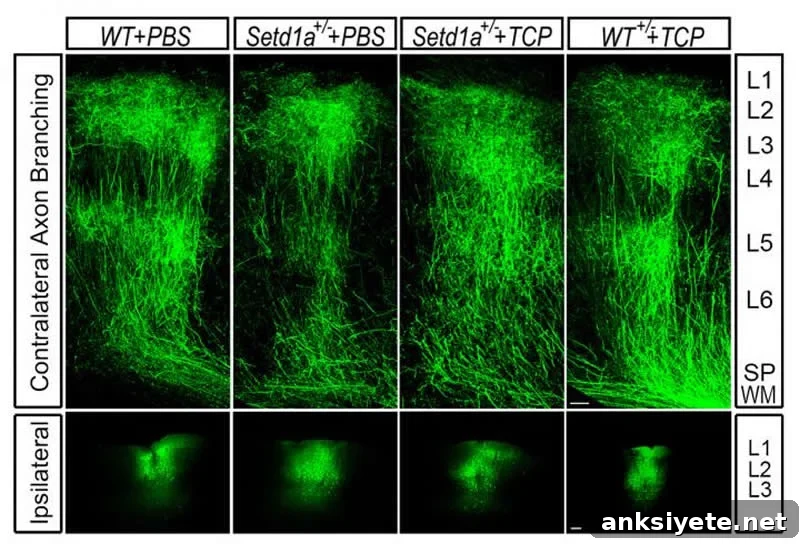
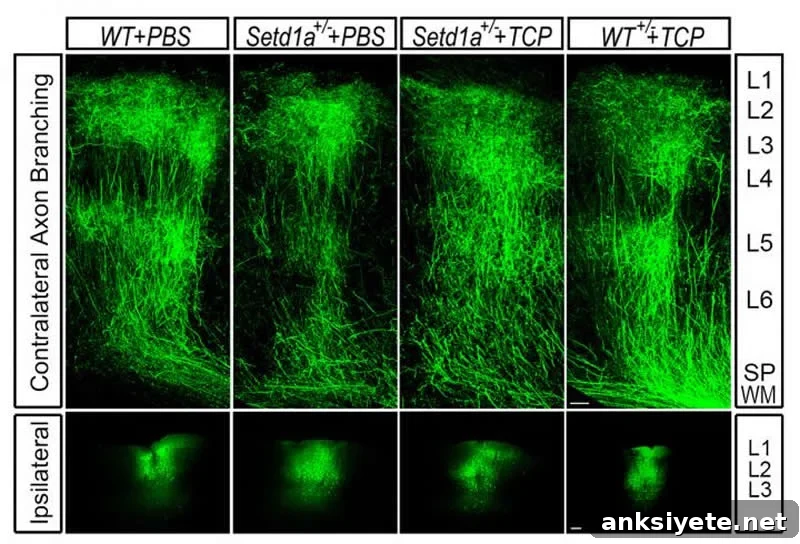
Summary: Neurons in mice lacking normal SETD1A function show shorter, stunted branches. Turning off the gene LSD1 reverses the harmful effects of SETD1A deficiency, restoring axon growth and improving working memory. Pharmacological inhibition of LSD1 corrected both the cellular defects and the behavioral memory deficits seen in this schizophrenia model.
Source: Zuckerman Institute at Columbia University
Columbia researchers restored normal working memory in a mouse model of schizophrenia, reversing a core cognitive symptom that has been difficult to treat in humans.
Working memory—the brain’s ability to hold and manipulate information briefly, such as remembering a phone number long enough to dial it—is profoundly impaired in people with schizophrenia. These deficits undermine reasoning, perception and decision-making and are not reliably addressed by current antipsychotic medications. By repurposing a drug being developed for leukemia, researchers at Columbia University repaired the affected neurons in mice with SETD1A deficiency and restored both cellular structure and memory performance.
Published in Neuron, the study challenges the idea that cognitive and cellular problems tied to schizophrenia are irreversible once symptoms appear. It offers a potential therapeutic route for the many millions worldwide living with schizophrenia.
“Schizophrenia is often considered a neurodevelopmental disorder that starts long before diagnosis, which makes it hard to understand and treat,” said Joseph Gogos, MD, PhD, a principal investigator at Columbia’s Mortimer B. Zuckerman Mind Brain Behavior Institute and the paper’s senior author. “Our findings demonstrate how genetic insights can guide drug strategies to restore cognitive and cellular function in the adult brain after disease onset.”
While antipsychotics can reduce hallucinations, delusions and paranoia, they do little for working memory deficits that affect nearly all patients and seriously limit everyday functioning. To address this, the team focused on SETD1A, a gene that encodes an enzyme regulating other genes and that earlier studies linked to schizophrenia risk.
The researchers used mice engineered to produce only half the normal amount of SETD1A, modeling the gene’s reduced function seen in some patients. These mice displayed clear working memory impairments and struggled with a simple maze test. Examination of neurons in the prefrontal cortex—an area essential for memory and complex behavior—revealed markedly altered morphology: axons and dendritic branches were shorter and stunted, preventing normal neural connectivity.
“The misshapen axons prevented neurons from forming the connections required for proper circuit function,” said Jun Mukai, PhD, co-first author of the paper.
Because SETD1A itself lacked an obvious pharmacological target, the team looked for interacting factors that could be manipulated. Collaborating with geneticist Stavros Lomvardas, PhD, they discovered that inhibiting LSD1, a gene-encoded demethylase, counteracted SETD1A deficiency. Inhibiting LSD1 in adult SETD1A-deficient mice reversed axonal growth defects and restored working memory within weeks.
“Administering an LSD1 inhibitor produced a dramatic behavioral recovery, and we saw axonal branching restored to near-normal patterns,” Dr. Mukai said. “This indicates the treatment acts on the underlying molecular drivers of the memory problems, not just the symptoms.”
The study also clarifies SETD1A’s role in the adult brain. SETD1A binds both promoters and enhancers across the genome and can both activate and repress gene expression depending on context. Many SETD1A targets are highly expressed in cortical pyramidal neurons, and the gene’s activity influences a network of factors that collectively shape neuronal growth and circuit function.
“SETD1A isn’t just important in development; it supports ongoing adult brain functions such as axonal growth,” said Enrico Cannavó, PhD, co-first author.
The investigators propose that SETD1A affects many downstream genes and proteins whose combined dysregulation leads to the cognitive and circuit abnormalities observed. Because psychiatric disorders typically arise from multiple genetic and environmental influences rather than a single broken gene, these mechanistic insights may open the door to more targeted, personalized treatments—especially for patients with SETD1A-related dysfunction, and potentially for a broader group with similar circuit-level problems.
“Although SETD1A mutations account for a small fraction of schizophrenia cases, the cellular and cognitive deficits they cause resemble those seen more broadly among patients,” said Dr. Gogos, who is also a professor of neuroscience at Columbia University’s Vagelos College of Physicians and Surgeons. “Therapies targeting SETD1A pathways may therefore have wider relevance.”
The team plans to further define SETD1A’s functions in the adult brain and to refine studies of LSD1 inhibitors as a therapeutic approach. Several LSD1 inhibitors are already in early clinical trials for leukemia and other cancers, and the researchers are evaluating whether these compounds could be repurposed for cognitive deficits in schizophrenia.
Funding: Supported by the National Institutes of Health (R01MH080234, R01DA036894).
The authors report no financial or other conflicts of interest.
Source:
Zuckerman Institute at Columbia University
Media contacts:
Anne Holden – Zuckerman Institute at Columbia University
Image source:
Jun Mukai / Gogos lab / Columbia’s Zuckerman Institute
Original research:
Recapitulation and Reversal of Schizophrenia-Related Phenotypes in Setd1a-Deficient Mice. Joseph Gogos et al., Neuron.
Abstract summary:
SETD1A is a lysine methyltransferase and an established schizophrenia susceptibility gene. Mice with a heterozygous loss-of-function mutation in Setd1a show altered axonal branching, disrupted cortical synaptic dynamics and working memory deficits. Setd1a binds promoters and enhancers with notable overlap with Mef2 on enhancers; its targets are highly expressed in pyramidal neurons and display a mix of transcriptional up- and downregulation. Evolutionarily conserved Setd1a-bound enhancers are linked to neuropsychiatric risk. Restoring Setd1a expression in adulthood rescues cognitive deficits. The study identifies LSD1 as a key opposing demethylase and demonstrates that pharmacological inhibition of LSD1 fully rescues the behavioral and morphological deficits in Setd1a-deficient mice. These findings advance understanding of how SETD1A mutations increase schizophrenia risk and suggest new therapeutic strategies.