
Summary: A new study clarifies how astrocytes contribute to neurodegeneration across multiple diseases.
Source: University of Melbourne.
Astrocytes illuminate mechanisms of neurodegeneration across many disorders
Recent research reveals how astrocytes—glial cells usually essential for healthy brain function—can become damaging after injury or in disease and contribute to the death of neurons and other central nervous system (CNS) cells.
Astrocytes have long been associated with the pathology of many human neurodegenerative conditions and injuries, including Alzheimer’s disease, Huntington’s disease, Parkinson’s disease, traumatic brain injury, and spinal cord injury. Until now, however, the processes that produce toxic astrocytes and the specific roles these cells play in degeneration were not well understood. This new study provides a clearer mechanistic picture and suggests therapeutic possibilities that could make these conditions more treatable.
The study, published in Nature and led by teams at The University of Melbourne and Stanford University, characterizes the behavior of injured or diseased astrocytes in the CNS following acute damage and during chronic neurodegenerative disease. By distinguishing functional subtypes of reactive astrocytes, the work explains previously contradictory observations in the literature—why astrocytes sometimes protect neurons and in other situations appear to promote neuronal damage.
In a healthy CNS, astrocytes support neurons by supplying nutrients, maintaining ion balance, promoting synapse formation, and assisting with waste clearance. After injury, astrocytes can form scar tissue that helps seal damaged regions and can aid regrowth of severed fibers. However, the study identifies a subtype of reactive astrocytes—termed A1—that becomes harmful under specific inflammatory conditions.
Dr. Shane Liddelow of the University of Melbourne and Stanford University explains that astrocytes are often referred to as “helper” cells, but when they become reactive in certain ways they can turn neurotoxic and actively kill neurons and oligodendrocytes. The research shows that pro-inflammatory microglia (the CNS immune cells) activate A1 astrocytes by releasing a trio of signaling molecules—interleukin-1 alpha (Il-1α), tumor necrosis factor (TNF), and complement component C1q. Together, these factors are necessary and sufficient to convert normal astrocytes into the A1 neurotoxic state.
A1 astrocytes lose several normal supportive functions: they no longer promote neuronal survival, axon outgrowth, synaptogenesis, or phagocytosis. Instead, they release neurotoxic factors that lead to the death of neurons and oligodendrocytes. Importantly, the study demonstrates that blocking A1 formation prevents the death of axotomized CNS neurons in vivo, indicating a direct and actionable link between these reactive astrocytes and neuronal loss after injury.
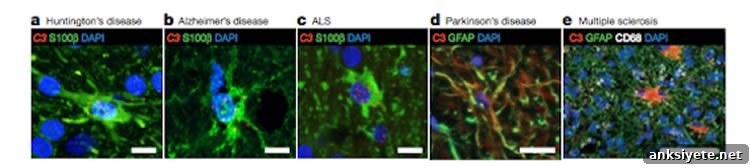
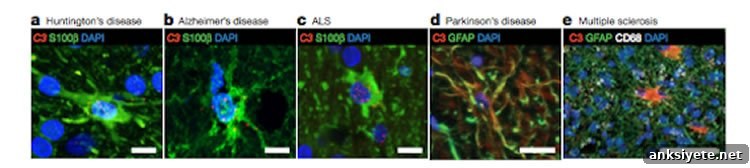
The researchers also find that A1 astrocytes are abundant in human tissue from multiple neurodegenerative diseases, including Alzheimer’s disease, Huntington’s disease, Parkinson’s disease, amyotrophic lateral sclerosis (ALS), and multiple sclerosis (MS). These observations support the idea that A1 astrocytes contribute to the progression of diverse neurodegenerative disorders and highlight them as a promising therapeutic target.
Because A1 formation is driven by specific inflammatory signals from activated microglia, new therapeutic approaches could focus on interrupting that signaling cascade, neutralizing the neurotoxic activity of A1 astrocytes, or even reprogramming astrocytes back into a protective state. Such strategies would complement neuron-centered therapies and treatments aimed at other glial cells, such as oligodendrocytes in demyelinating diseases like MS.
Ultimately, this research opens a path toward treatments that target the glial environment in addition to neurons. If therapies can prevent or reverse the A1 transformation, it may be possible to reduce secondary neuronal loss after injury and slow or halt progression in chronic neurodegenerative diseases. Reversing astrocytes from a “toxic” to a “helper” state is a long-term goal for the research teams.
Source: Elisabeth Lopez – University of Melbourne
Image source: Image credited to the researchers.
Original research: Shane A. Liddelow et al., “Neurotoxic reactive astrocytes are induced by activated microglia,” Nature. Published online January 18, 2017. DOI: 10.1038/nature21029.
Abstract
Neurotoxic reactive astrocytes are induced by activated microglia
Reactive astrocytes are strongly induced by central nervous system (CNS) injury and disease, but their role is poorly understood. Here we show that a subtype of reactive astrocytes, which we termed A1, is induced by classically activated neuroinflammatory microglia. We show that activated microglia induce A1 astrocytes by secreting Il-1α, TNF and C1q, and that these cytokines together are necessary and sufficient to induce A1 astrocytes. A1 astrocytes lose the ability to promote neuronal survival, outgrowth, synaptogenesis and phagocytosis, and induce the death of neurons and oligodendrocytes. Death of axotomized CNS neurons in vivo is prevented when the formation of A1 astrocytes is blocked. Finally, we show that A1 astrocytes are abundant in various human neurodegenerative diseases including Alzheimer’s, Huntington’s and Parkinson’s disease, amyotrophic lateral sclerosis and multiple sclerosis. Taken together these findings help to explain why CNS neurons die after axotomy, strongly suggest that A1 astrocytes contribute to the death of neurons and oligodendrocytes in neurodegenerative disorders, and provide opportunities for the development of new treatments for these diseases.
“Neurotoxic reactive astrocytes are induced by activated microglia” by Shane A. Liddelow, Kevin A. Guttenplan, Laura E. Clarke, Frederick C. Bennett, Christopher J. Bohlen, Lucas Schirmer, Mariko L. Bennett, Alexandra E. Münch, Won-Suk Chung, Todd C. Peterson, Daniel K. Wilton, Arnaud Frouin, Brooke A. Napier, Nikhil Panicker, Manoj Kumar, Marion S. Buckwalter, David H. Rowitch, Valina L. Dawson, Ted M. Dawson, Beth Stevens & Ben A. Barres. Nature. Published online January 18, 2017. DOI: 10.1038/nature21029.