
Summary: New research reveals how brains distinguish self-generated visual motion from external motion to guide behavior.
Source: Rockefeller University.
Brains predict their own movements to shape perception and behavior
What we see is not always a literal reflection of the world—our brains actively filter incoming visual information to prevent self-motion from being mistaken for movement in the environment. Researchers at The Rockefeller University report new findings showing how this predictive filtering works at the level of single neurons in the tiny brain of the fruit fly, with implications for understanding similar mechanisms in larger brains.
“Every time you move your eye, the whole world moves on your retina,” says Gaby Maimon, head of the Laboratory of Integrative Brain Function. “But you don’t perceive an earthquake happening several times a second.” That stability emerges because the brain issues internal copies of motor commands to its visual system. These copies allow the visual circuits to anticipate the sensory consequences of self-motion and selectively suppress or enhance neural responses so behavior remains accurate and adaptive.
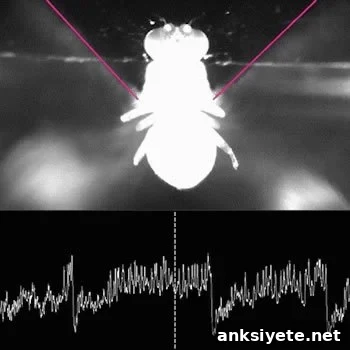
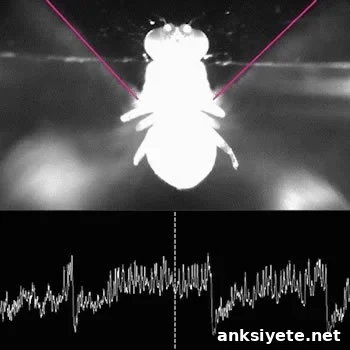
Studying this process in humans is difficult because our brains contain roughly 80 billion neurons. The fruit fly, Drosophila melanogaster, offers a far simpler system: its brain has about 100,000 neurons but faces the same computational challenge of distinguishing predicted, self-generated visual motion from unexpected motion in the environment. Maimon and colleagues used the fly to examine how motor-related signals shape visual processing during rapid gaze shifts and turns.
Flies do not move their eyes independently; their eyes are fixed to the head, so gaze shifts require coordinated rotations of the head and body. To maintain stable flight they rely on reflexes that correct unintended perturbations—such as the optomotor response, which counter-rotates the head and adjusts wing motion when wind or turbulence displaces the animal. But when a fly intentionally turns to change direction, those same reflexes would be counterproductive if left active. The brain therefore needs a way to suppress specific visual reflexes during deliberate movements while retaining sensitivity to other kinds of motion.
In prior work Kim and Maimon identified two groups of motion-sensitive visual neurons that are suppressed during rapid, intentional turns. In the new study, Kim, Lisa Fenk and Maimon recorded electrical activity from individual neurons while filming the flies’ head and wing movements. They compared natural turns with experiments in which tethered flies were shown visual scenes that simulated accidental rotations, enabling the team to tease apart neural responses driven by actual self-initiated motor commands from responses to external visual motion.
The neurons they examined respond to visual motion across multiple rotational axes. Some cells are more tuned to yaw (horizontal rotation), while others respond more to roll (rotation around the body axis). Crucially, during intentional turns the motor-related signals that reach these neurons are not uniform: they are precisely calibrated to suppress sensitivity to visual motion specifically along the yaw axis. Neurons most sensitive to yaw receive the strongest inhibitory input; neurons less sensitive to yaw receive weaker input. Sensitivity to roll remains intact.
This axis-specific silencing allows the fly to perform the sequence of movements required for a deliberate turn—first rolling, then counter-rolling—without triggering reflexive yaw corrections that would counteract the intended direction change. In effect, the brain temporarily renders the insect selectively blind to the component of visual motion that would otherwise drive maladaptive head corrections, while preserving visual processing needed for other stabilizing actions.
Maimon describes the computation as akin to tuning out a single instrument within a full orchestra: the brain subtracts one component of a compound sensory signal carried by a population of neurons while leaving other components unchanged. This study is the first to show how brains can remove a specific signal component from a multi-signal circuit with such precision, and it offers a model for how larger, more complex brains might accomplish related tasks.
Funding and acknowledgments
The research was supported by the New York Stem Cell Foundation (NYSCF-RQ1NI13), the Searle Scholars Foundation, and the National Institute on Drug Abuse of the NIH (DP2DA035148). Gaby Maimon is a New York Stem Cell Foundation–Robertson Investigator. Lisa Fenk received support from a Leon Levy Fellowship in Mind, Brain, and Behavior at The Rockefeller University.
Study highlights and abstract
Highlights
- Motion-processing neurons contribute to controlling head stability during flight.
- During intentional turns these neurons receive precisely tuned motor-related inputs.
- Those inputs suppress specific visual responses while preserving others.
- Targeted modulation of visual signaling prevents maladaptive head movements during turns.
Abstract (summary)
Vision influences behavior and ongoing behavior modulates vision across species. Using genetics, electrophysiology, and high-speed videography in Drosophila, the study shows that motion-sensitive visual neurons help regulate gaze-stabilizing head movements. During flight turns, flies suppress their gaze-stability reflexes along the rotation axis needed to complete the maneuver. Motor-related inputs pervasively silence predicted visual responses to rotations around that axis while leaving sensitivity to other axes intact. This work proposes a function for behavioral modulation of visual processing and demonstrates how the brain can remove a single sensory signal from a circuit carrying multiple related signals.
Original research: “Quantitative Predictions Orchestrate Visual Signaling in Drosophila” by Anmo J. Kim, Lisa M. Fenk, Cheng Lyu, and Gaby Maimon, published in Cell (January 2017), doi:10.1016/j.cell.2016.12.005.