
CT Scans of Fossil Primate Skulls Reveal How Extinct Primates Moved
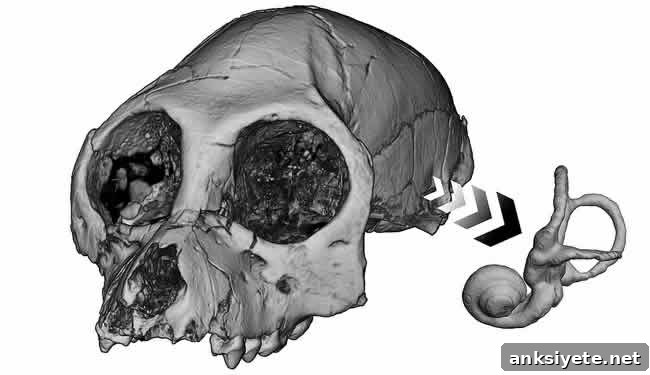
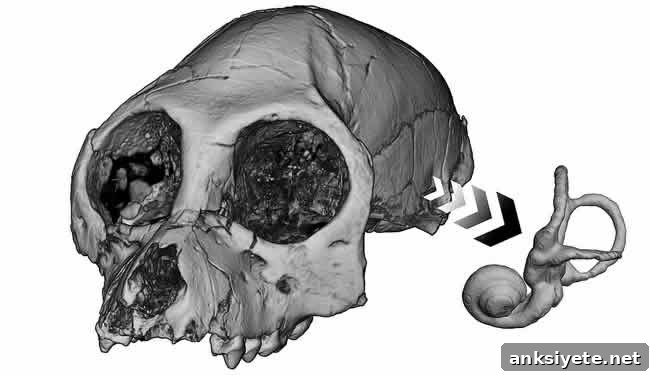
CT scans of fossilized primate skulls and skull fragments from both the Old and New Worlds can provide valuable insight into how extinct species moved, even when postcranial bones are missing, according to an international team of researchers. By examining the inner ear’s bony labyrinth—the cochlea, the vestibule, and the three semicircular canals—scientists can infer locomotor behavior from preserved skull material.
The semicircular canals, which detect head motion and help coordinate movement with vision, are often well preserved in fossil skulls because they are embedded in dense bone. “Almost in every case where there is a fossilized skull, the semicircular canals are present and well preserved,” said Timothy Ryan, assistant professor of anthropology, geosciences and information sciences and technology at Penn State. This durability allows researchers to compare fossil canal structures with those of living primates whose locomotor habits are known.
Why the Semicircular Canals Matter
Previous studies show a direct relationship between semicircular canal size and agility: larger canals generally indicate greater sensitivity to head movements, which is associated with quicker, more acrobatic locomotion such as leaping and brachiation. There is also a correlation between canal size and overall body size, so the researchers corrected for body size when comparing species.
Where limb bones are absent, the semicircular canals offer a reliable alternative for reconstructing locomotor behavior. By comparing corrected canal dimensions across species, the researchers were able to place extinct primates on a spectrum from slow-moving, terrestrial species to fast, agile arboreal species. This method provides robust predictions when fossil canal measurements fall within the range displayed by living primates with known behaviors.
Findings Across Time and Geography
The team compared CT scans from 16 fossil species representing New World monkeys, Old World monkeys, and early apes with scans from extant primates. Some of the fossils examined are among the oldest known anthropoids—members of the broader group that includes monkeys, apes, and humans—collected from the Fayum Depression of Egypt.
Results indicate that the earliest anthropoids moved at a medium to medium-slow pace, slower than many had predicted. Early anthropoids predating the divergence of Old World monkeys and apes, such as Aegyptopithecus from about 29 million years ago, also fell into this medium-slow category. After the split between Old World monkeys and apes, both lineages show a shift toward medium to medium-fast agility similar to modern macaques. This includes Proconsul heseloni from Kenya, often regarded as one of the earliest apes.
New World monkey fossils dating from roughly 12 to 20 million years ago displayed canal proportions consistent with relatively agile arboreal behavior, comparable to cebus monkeys or tamarins. For many of these New World species, only cranial material is known, so the semicircular canal approach provides the first concrete predictions about their locomotion. “Most of the fossil New World monkeys we examined are known only from cranial material with no associated post-cranial fossils,” said Ryan. “We had no idea about their locomotion.”
Implications for Primate Evolution
The researchers conclude that the last common ancestor of Old World monkeys and apes likely had medium-level agility, resembling living macaques. Surprisingly, early apes such as Proconsul appear more agile than expected, suggesting that the slower locomotor patterns seen in large-bodied modern apes like gorillas and orangutans may be derived rather than primitive. In other words, some contemporary great apes may have evolved reduced agility from more nimble ancestors.
Research Team and Funding
Collaborators on the project include Mary T. Silcox (University of Toronto), Alan Walker (Penn State), Xianyun Mao (Penn State), David R. Begun (University of Toronto), Brenda R. Benefit and Monte L. McCrossin (New Mexico State University), Philip D. Gingerich, William J. Sanders, and Iyad S. Zalmout (University of Michigan), Meike Köhler and Salvador Moyà-Solà (Catalan Institute of Paleontology, Autonomous University of Barcelona), Erik R. Seiffert (Stony Brook University), Elwyn Simons (Duke University), and Fred Spoor (Max Planck Institute for Evolutionary Anthropology).
Funding for the research was provided by the National Science Foundation and the National Science and Engineering Research Council of Canada.
Notes about this research and article
This study used high-resolution CT scans and comparative analysis to reconstruct locomotor agility from the semicircular canals preserved in fossil crania. The findings were published in Proceedings of the Royal Society B: Biological Sciences on June 13, 2012, under the title “Evolution of locomotion in Anthropoidea: the semicircular canal evidence.” The work emphasizes how inner-ear anatomy can fill gaps in our understanding of extinct primates when postcranial remains are missing.
Contact: Andrea Elyse Messer, The Pennsylvania State University. Source: The Pennsylvania State University news release. Image adapted from Penn State University image with credit to Timothy Ryan, Penn State. This work is licensed under CC by NC 3.0.