
Summary: Researchers describe how an interactive music listening device and music-based activities can support social, emotional, and sensory development in children on the autism spectrum.
Source: University of Delaware
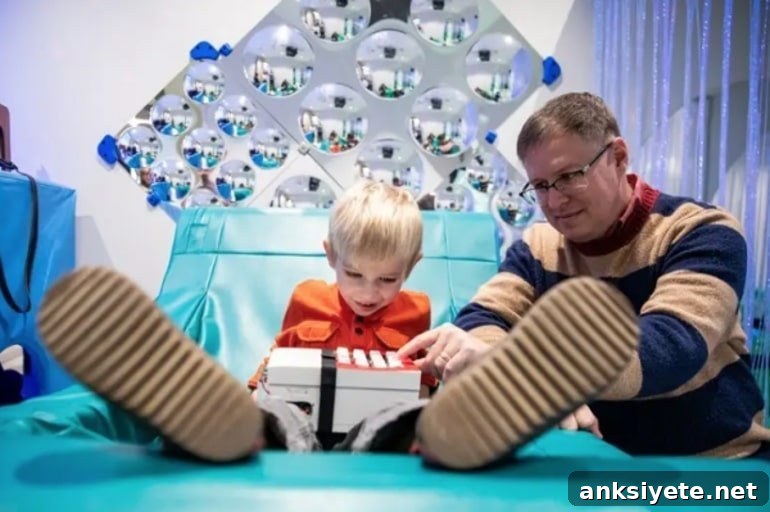
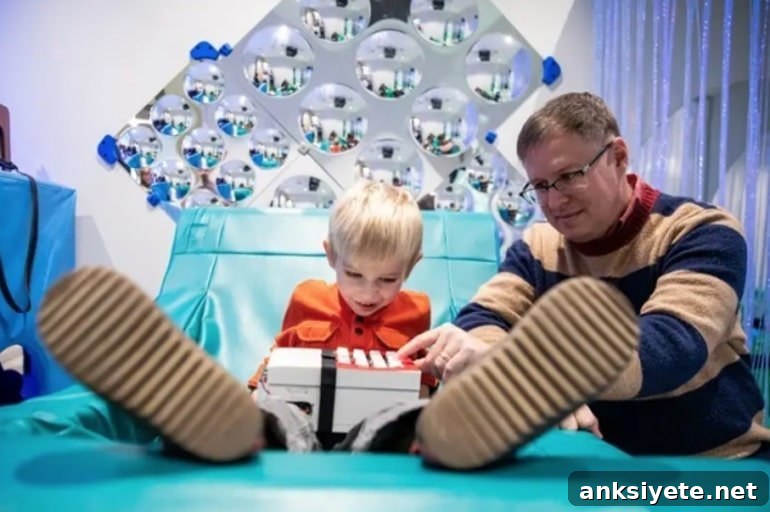
Inside a colorful sensory room equipped with soft lighting, fiber-optic curtains, and a vibrating haptic chair, familiar children’s songs such as “Row, Row, Row Your Boat” take on new life. Children on the autism spectrum are invited to shape the music themselves — pressing buttons, adding rhythms, and discovering combinations of sounds that they enjoy.
In the Route 9 Library and Innovation Center’s Sensory Room, the music adapts to each child’s preferences. Some children pause to listen, smile, or dance when they hear a sequence they like. Others intently explore the sounds available, experimenting with tempo, texture, and instrumentation. These interactions offer researchers and caregivers crucial insights into individual auditory preferences and sensitivity.
The interactive listening device was developed by University of Delaware researchers Daniel Stevens, professor of music theory in the School of Music, and Matthew Mauriello, assistant professor of computer and information sciences in the College of Engineering, together with their students. Their interdisciplinary collaboration blends music theory, human-computer interaction, and assistive technology to design music experiences tailored for children with developmental disabilities.
The project received a $50,000 award from the Maggie E. Neumann Health Sciences Research Fund, which supports interdisciplinary innovations aimed at improving the lives of people with disabilities. That funding helped turn a classroom idea into a working prototype and field-ready device.
The core concept originated with sophomore Elise Ruggiero, a double major in music performance and psychology, who drew on personal experience: her younger brother was diagnosed with autism at age 2.
Ruggiero recalls that loud or poorly matched music often made her brother anxious and prevented him from engaging in shared musical activities. As a freshman in a music theory class, she took on a community-focused assignment from Professor Stevens: design a musical solution to a real-world problem. Her proposal to create an adjustable, interactive music device for children with autism was selected by the class to move forward.
Stevens encouraged students to apply music skills to community needs, challenging them to rethink how musical experiences can be composed and delivered. Students worked with local organizations, including Autism Delaware, and invested many hours designing what they describe as modular music — musical material that can be modified in real time to suit sensory and emotional needs.
“Listeners with autism have diverse auditory needs,” Stevens explains. “Some children are overwhelmed by fast tempos, dense textures, or sudden changes; others need more stimulation to remain engaged. By making musical elements adjustable, we can create participatory experiences that are accessible and meaningful.”
Mauriello brought expertise in human-computer interaction to build the technology that makes these musical adjustments possible. His lab focused on designing an intuitive interface and reliable data collection so the device can both empower children to shape sound and provide researchers with patterns of listening behavior.
The prototype is housed inside a white, 3D-printed box and features light-up buttons and pictorial presets representing different instruments and textures. Each button press changes the music — sometimes subtly, sometimes dramatically — and every interaction is logged. Those usage data help the research team identify common preferences and displayable metrics that composers and therapists can use to craft better, personalized music for children with autism.
“We want to learn how children on the spectrum hear and interact with music by analyzing the larger patterns that emerge,” Stevens says. “Music is built from melody, harmony, rhythm, and texture — elements we often take for granted. For listeners with sensory sensitivities, every sound matters, and the way we design sound can support their participation.”
Simon Brugel, a sophomore computer science major who is on the spectrum, contributed to the software development and brought firsthand insight into sensory preferences. “I’m sensitive to loud noises and certain timbres,” he notes. “I can hear subtle traits in sounds that others might miss and I prefer some instruments to others.” His involvement highlights how inclusive design benefits from the perspectives of people with lived experience.
Other students, such as music education major Abby Von Ohlen, saw the project as an opportunity to observe how small musical changes — a single track or a reduced volume — can transform someone’s listening experience. For many participants, the device made music more approachable and enjoyable.
Early trials have been encouraging. Feedback suggests the device is engaging, and parents and children recommended design variations to increase appeal — for example, embedding the controller in a toy-like housing such as a small vehicle to encourage mobility while listening. For older users, the team envisions a mobile app offering similar adjustable listening controls for managing sound in public settings.
Ruggiero says the project shaped her academic and career goals. “I didn’t expect my classroom idea to develop into something this meaningful,” she says. “It’s inspired me to pursue music therapy and research that makes music accessible to people on the spectrum.”
Stevens and Mauriello hope the device will become a permanent feature in the Route 9 Library sensory room and that similar tools will be used in music and special education settings. “Research shows music participation supports social, emotional, and motor development,” Stevens notes. “We aim to make engaging, participatory musical experiences accessible to every child with autism, both locally and beyond.”
For more information about the project, contact [email protected].
About the fund
The Maggie E. Neumann Health Sciences Research Fund, established in 2020, supports research intended to improve health and quality-of-life outcomes for children and adults with physical and developmental disabilities. Although the fund is housed in the College of Health Sciences, it prioritizes interdisciplinary projects spanning multiple colleges.
The fund was created through a gift from Donald J. Puglisi and Marichu C. Valencia in honor of their granddaughter, Maggie E. Neumann. Puglisi is a member of the University of Delaware Board of Trustees and the donors serve on the President’s Leadership Council.
About this music and autism research news
Author: Marina Affo
Source: University of Delaware
Contact: Marina Affo – University of Delaware
Image: Photo credit: Ashley Barnas/University of Delaware