
Brain region tuned to object categories is made of small neuronal clusters that encode visual features
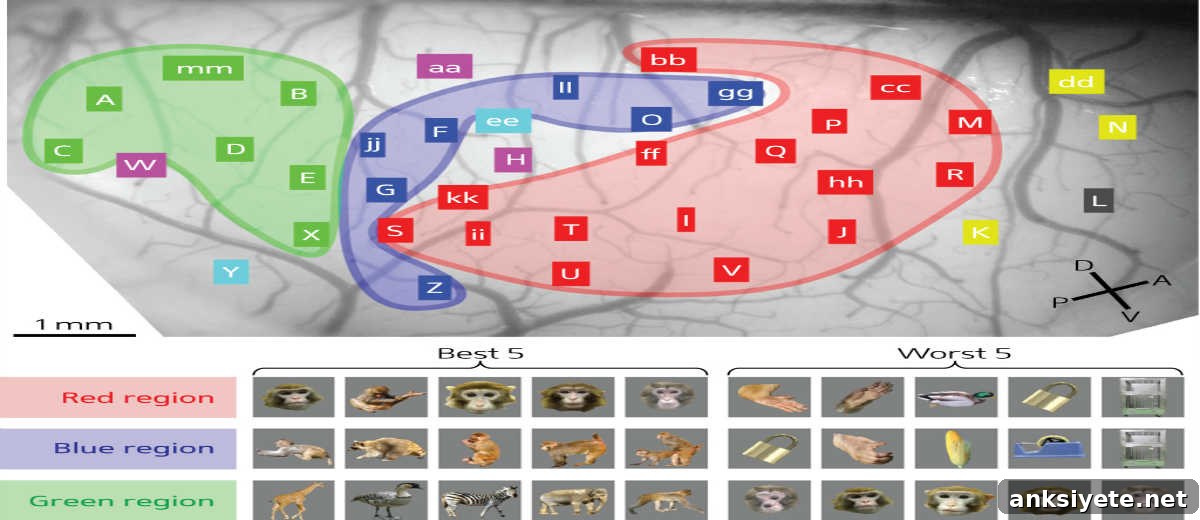
The brain’s capacity to recognize objects depends on its ability to integrate and interpret vast amounts of visual information. Researchers at the RIKEN Brain Science Institute, led by Takayuki Sato and Manabu Tanifuji, have shown that in macaque monkeys this capacity is supported by a mosaic-like arrangement of neurons in the anterior inferior temporal (IT) cortex. Within this area, localized clusters of neurons encode different visual features in an organized, hierarchical pattern.
Two main theories have competed to explain how primate visual cortex supports object recognition. One proposes that distinct cortical modules are dedicated to processing specific object categories—such as faces—while recognition arises from interactions among these category-specific modules. The alternative theory suggests that visual cortex extracts generic features (edges, textures, parts) that are later combined to form representations of specific objects.
Earlier evidence for both ideas came mostly from indirect measures of brain activity, such as blood flow or metabolic signals, which reflect neural activity only indirectly. To clarify the underlying neuronal organization, Sato, Tanifuji and colleagues performed dense electrophysiological mapping in anesthetized macaque monkeys while presenting a broad set of color images spanning faces, hands, bodies, food and various other objects. Rather than relying on metabolic signals, the team recorded electrical activity directly from multiple sites across the anterior IT cortex to identify where neurons responded to which object categories and features.
The recordings revealed that some cortical regions in anterior IT are most responsive to faces while others respond preferentially to monkey bodies. Conversely, the researchers did not find distinct regions that preferred hands, food items or many types of man-made objects. Within category-selective areas, however, the organization is finer: small clusters of neurons responded selectively to particular visual features of faces. These micro-clusters showed different tuning — for example, they distinguished human versus monkey faces and differentiated between normal and scrambled face images.
Together, these findings indicate a hierarchical, mosaic-like organization in which object-category information and constituent feature information are represented at different spatial scales. A broader patch of cortex can be biased toward a category such as faces, and within that patch smaller neuronal clusters encode specific facial features or subcomponents. This structure combines both ideas from prior models: category-selective modules coexist with a feature-based decomposition at a finer spatial scale.
Takayuki Sato comments that these cortical mosaics seem to be an efficient way for the brain to pack both category-level and feature-level visual information into limited cortical space. He suggests that a similar organizational principle might apply across other sensory modalities, such as the auditory system, where coarse category representations may coexist with finer feature-selective clusters.
If comparable mosaic-like structures are present in the human anterior IT cortex, the results could deepen our understanding of human visual recognition and the neural basis for associating visual categories with language. The work provides a clearer picture of how neurons in ventral visual cortex are arranged to support rapid, reliable recognition of objects and faces.
Notes about this neuroscience and object recognition research
Contact: Takayuki Sato — RIKEN Brain Science Institute
Source: RIKEN press materials describing the study and its findings
Image source: Image credited to Takayuki Sato, adapted from RIKEN materials
Original research: Sato, T., Uchida, G., Lescroart, M. D., Kitazono, J., Okada, M. and Tanifuji, M., “Object representation in inferior temporal cortex is organized hierarchically in a mosaic-like structure,” Journal of Neuroscience. (Published online December 19, 2013; DOI: 10.1523/JNEUROSCI.5557-12.2013)
Keywords: anterior inferior temporal cortex, object recognition, macaque, neurons, cortical mosaic, faces, visual features, neuroscience