
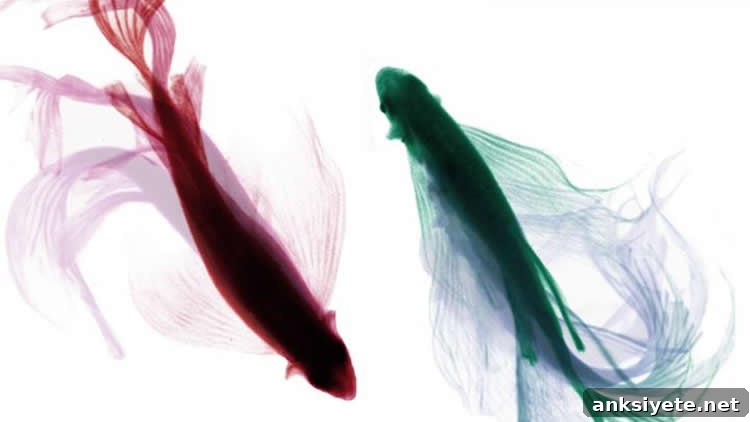
Summary: Researchers have pinpointed a group of neurons essential for social behavior in zebrafish. When these neurons are disabled, the fish’s ability to orient to one another breaks down in a manner that resembles social interaction deficits observed in people with autism spectrum disorders and schizophrenia.
Source: University of Oregon
University of Oregon researchers have identified specific forebrain neurons that drive social orienting in zebrafish. Disrupting these neurons causes breakdowns in social orientation similar to the social deficits seen in some human neurodevelopmental disorders.
Scientists from the University of Oregon report that a population of neurons in the ventral telencephalon — a forebrain region with evolutionary ties to mammalian areas that regulate memory, emotion, and social behavior — is required for zebrafish to visually orient toward one another. These neurons express cholinergic markers and the transcription factor Lhx8a, which has parallels in mouse and human gene networks. Their findings open a new direction for studying the biological foundations of social behavior and the neural circuits that underlie it.
The study, published in Current Biology on July 26, details behavioral experiments, lesion studies, and genetic analysis that together define a conserved neural substrate for social orienting. Lead author Sarah J. Stednitz, then a doctoral student, first noticed a consistent “get-to-know-you” swimming pattern when two adult zebrafish were placed in adjacent tanks separated by a clear divider. The fish repeatedly oriented toward one another in a predictable sequence despite the barrier, indicating a robust visual social interaction.
To investigate the neural basis of this behavior, the team used pharmacological methods previously shown to impair social-related neurons in mammals. Fish treated with the drug lost their tendency to perform the stereotyped orienting behavior. Interestingly, healthy partner fish also reduced their orienting when paired with a drug-impaired fish, demonstrating that social engagement in zebrafish depends on reciprocal signaling: one fish’s correct social behavior triggers the other’s response. Non-fish objects and inactive conspecifics failed to elicit the orienting behavior, underscoring that this response is specific to socially engaged partners rather than mere presence or proximity.
To quantify these interactions, the research team developed custom software to measure orientation angles and movement patterns across roughly 500 zebrafish. These quantitative tools allowed the researchers to show that orienting behavior is a sensitive and reliable metric of visual social interaction and that one individual’s behavior is the dominant driver of the other’s response in a pair.
Using both manual lesions and genetic ablation, the investigators found that removing the identified ventral forebrain neurons suppressed social orienting without broadly impairing locomotion or basic visual responses. This specificity indicates that these neurons are dedicated to social attention rather than general sensorimotor functions. The neurons’ molecular profile — cholinergic identity and expression of Lhx8a — parallels features of mammalian neuronal populations implicated in social behavior, supporting the idea of an evolutionarily conserved circuit controlling social orienting.
The work represents a strategic shift in the laboratory’s focus. “We had been studying autism-associated genes at the synapse for many years, often in the spinal cord,” said co-author Philip Washbourne. “But reflexive circuits do not explain the complex social deficits seen in autism. Moving to social behavior allowed us to target synapses and circuits more likely to be relevant to those disorders.”
Moving forward, the team aims to create and analyze zebrafish with mutations in genes analogous to human autism-associated genes to determine whether those mutants show reduced social orienting. If mutant fish recapitulate social deficits, the model could be used for screening compounds or interventions that restore social interaction.
Funding: This research was supported by the National Institutes of Health.
Source: Jim Barlow, University of Oregon
Publisher note: Organized by NeuroscienceNews.com. Image credit: University of Oregon.
Original research: “Forebrain Control of Behaviorally Driven Social Orienting in Zebrafish” by Sarah J. Stednitz, Erin M. McDermott, Denver Ncube, Alexandra Tallafuss, Judith S. Eisen, and Philip Washbourne. Current Biology, published July 26, 2018. doi:10.1016/j.cub.2018.06.016
Forebrain Control of Behaviorally Driven Social Orienting in Zebrafish
Highlights:
- Orienting behavior provides a sensitive measure of visual social interaction.
- Social orienting depends on correct behavior by a social partner.
- Lesioning the ventral forebrain disrupts social orienting.
- Orienting is controlled by an evolutionarily conserved neuronal population.
Summary:
Deficits in social engagement are diagnostic criteria for several neurodevelopmental disorders, including autism and schizophrenia. Genetically tractable models such as zebrafish can help identify developmental mechanisms underlying these impairments, provided subtle behavioral changes can be measured reliably. Here, we combine behavioral assays, lesioning, and genetic tools to refine our understanding of zebrafish social behavior and to locate the neuroanatomical substrates that drive it. We characterized a stereotyped orienting behavior between pairs of adult zebrafish that reflects social attention. In paired interactions, one fish’s orienting behavior primarily drives the same behavior in its partner. Ablation of a cholinergic neuronal population in the ventral telencephalon suppresses social interactions while preserving other locomotor and visual functions. These neurons express Lhx8a, a transcription factor required for the development of cholinergic forebrain neurons in mice, and reside in a region homologous to mammalian forebrain areas implicated in social behavior. Our data suggest an evolutionarily conserved neuronal population controls social orienting in zebrafish.