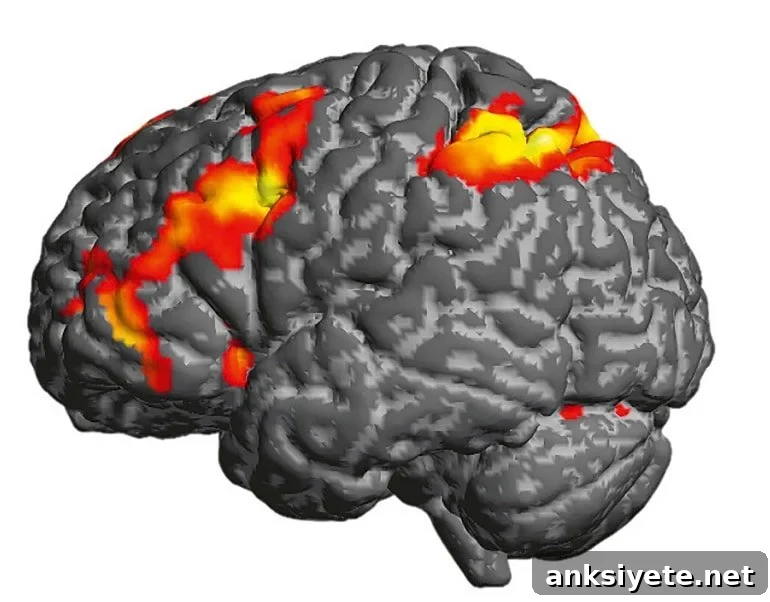
Summary: Researchers using mathematical models to examine how the brain predicts and learns found that signals encoding prediction accuracy localize to the anterior insula, and that individual anxiety levels modify activity in this region.
Source: ETH Zurich
Mental health conditions are still diagnosed mainly from symptoms, making individual prognosis difficult. An ETH researcher aims to change this by applying quantitative, model-based approaches to brain data.
Why do we experience emotions? Klaas Enno Stephan, a professor at ETH Zurich and the University of Zurich, suggests a functional explanation: emotions may signal conscious awareness of otherwise unconscious bodily processes. As both a clinician and a neuroscientist, Stephan studies how visceral signals and brain activity interact to guide behavior.
He points to simple examples of predictive bodily regulation: at the sight of food, the body can release insulin before blood glucose rises. These anticipatory responses occur without conscious control because the brain constantly builds models of the world and uses them to forecast future states.
“The brain constructs internal models and issues predictions that guide anticipatory corrective actions,” Stephan explains. The overarching aim of these processes is to preserve homeostasis—the body’s internal balance in variables such as blood sugar, core temperature, blood pressure and pH. When the brain detects deviations from expected internal states, it triggers corrective responses, typically outside conscious awareness.
However, when a discrepancy threatens vital balance, conscious feelings can arise to mobilize immediate, coordinated responses. “Emotions may correspond to conscious states that motivate specific actions to protect bodily integrity,” Stephan says. Fear and anxiety, for example, can direct attention to potential threats and trigger escape or avoidance behaviors.
Managing expectations
Not all anxiety reflects an acute threat. Some people experience chronic, heightened anxiety that can be maladaptive. One hypothesis is that such anxiety stems from overly precise or inflexible internal predictions about bodily states. If the brain’s model expects perfect regularity—for instance, in heart rate—normal physiological fluctuations are interpreted as errors, producing persistent alarm.
When minor, benign variations are treated as threats, corrective efforts can paradoxically worsen the situation. Attempts to consciously regulate breathing or heart rate may increase sympathetic arousal, accelerating and destabilizing cardiac rhythm and creating a vicious cycle of anxiety and physiological dysregulation.
To test whether exaggerated predictive precision is reflected in specific brain circuits, Stephan and his colleague Olivia Harrison designed an experiment focused on the anterior insula, a region implicated in integrating interoceptive signals (internal bodily sensations) with expectations.
Participants with varying anxiety levels underwent functional magnetic resonance imaging (fMRI) while wearing a device that could transiently increase breathing resistance. In an initial learning phase, certain visual cues reliably predicted whether breathing would be normal or become harder. In a subsequent phase, those cue–outcome associations were reversed.
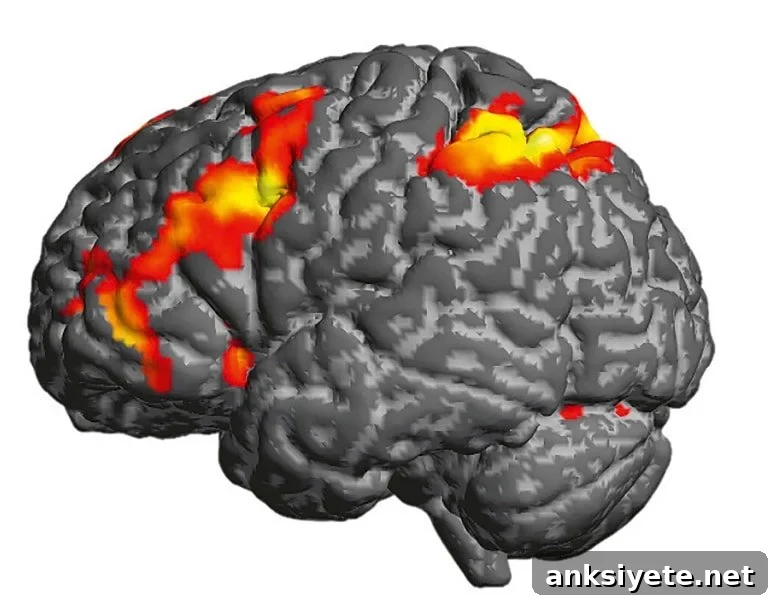
Applying computational models to the fMRI data allowed the team to quantify how closely brain activity tracked learned expectations and their adjustments when conditions changed. The analyses revealed that signals encoding prediction precision and prediction errors clustered in the anterior insula. Moreover, the magnitude and pattern of activity in this region varied with individuals’ anxiety levels, supporting the idea that altered predictive weighting contributes to persistent anxiety.
Underlying mechanisms
Stephan emphasizes clinical motivation: psychiatry lacks objective, mechanistic tests that reveal the biological roots of mental disorders. Current diagnoses rely largely on symptom descriptions rather than quantifiable measures of the neural processes that generate those symptoms.
By fitting formal models to observed brain responses, researchers can infer latent neural states that are not directly measurable—such as the effective strength of specific synaptic connections or the precision assigned to incoming sensory signals. These inferred variables provide testable, biologically plausible hypotheses about disease mechanisms.
Stephan notes promising examples where model-based approaches have real prognostic value. In a previous fMRI study, a network model describing how brain regions interact while viewing emotional faces predicted, with roughly 80 percent accuracy, whether patients with depression would recover within two years or remain chronically ill. While such methods are not yet standard clinical tools, they illustrate how computational neuroimaging could eventually inform diagnosis and treatment planning.
“Mathematical models offer a route to access hidden neural states and to link symptoms to specific biological mechanisms,” Stephan says. Continued development and validation of these approaches could help move psychiatry toward objective, personalized assessments and better outcome prediction.
About this mathematical modeling and neuroscience research news
Author: Press Office
Source: ETH Zurich
Contact: Press Office – ETH Zurich
Image: The image is credited to ETH Zurich / Sandra Iglesias