
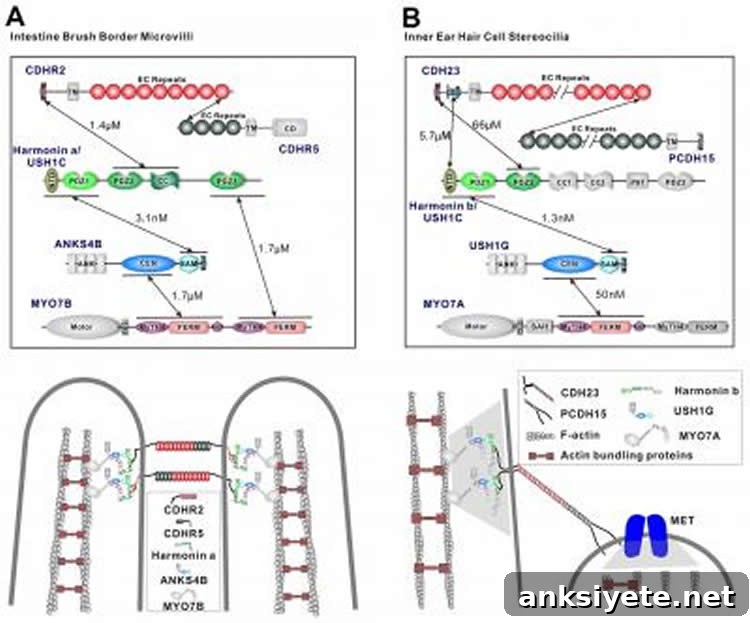
Brush border microvilli and inner ear stereocilia are distinct cellular structures that share surprising mechanistic similarities despite their different locations and functions. Microvilli are tiny, actin-supported membrane projections that line the apical surface of epithelial cells in the intestine and kidney, increasing surface area for absorption, secretion, and adhesion. Stereocilia are specialized, mechanosensing protrusions on hair cells that detect fluid motion and mediate senses such as hearing and balance. Although they serve different physiological roles, recent structural and biochemical work reveals that their tip-link complexes are organized in remarkably similar ways.
Researchers led by HKUST structural biologist Professor Mingjie Zhang performed a systematic biochemical and structural analysis of the protein network at the cytoplasmic face of the brush border inter-microvillar tip link. Their results, published online January 25, 2016 in Developmental Cell, demonstrate that the assembly and anchoring of microvilli tip-link cadherins rely on a conserved set of interaction principles that closely mirror those of the inner ear stereocilia tip-link (USH1) complex.
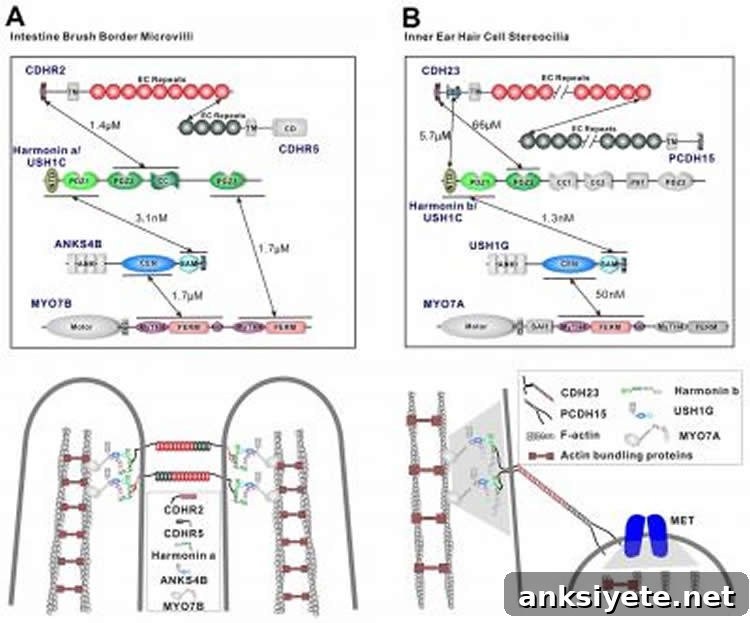
The HKUST team focused on a set of protein interactions that anchor tip-link cadherins to the actin core of microvilli. Specifically, they characterized interactions between protocadherin 24 and Harmonin (USH1C), between Harmonin and myosin VIIb (MYO7B), between Harmonin and ANKS4B, and between ANKS4B and MYO7B. These biochemical and structural experiments showed that Harmonin, ANKS4B, and MYO7B form a stable ternary scaffold that links cadherin-family adhesion proteins to the underlying actin bundles.
Mechanistically, both brush border inter-microvillar tip-link complexes and inner ear stereocilia tip-link complexes use heteromeric cadherin proteins to build filamentous inter-protrusion links capable of withstanding mechanical stress. Each system relies on scaffold proteins to organize the multi-protein complex, and Harmonin acts as the central hub in both contexts. Although Harmonin is the only component shared between the two systems, the interaction modes and organizational logic are strikingly similar.
Professor Zhang emphasized the broader significance: understanding how the microvillar tip-link complex is assembled and maintained provides fundamental insight into epithelial cell architecture and function. These mechanistic insights may also inform studies of disease. For example, single mutations in genes encoding stereocilia tip-link components are known to cause disorders such as Usher syndrome. While analogous mutations in gut microvilli do not always produce obvious intestinal symptoms, mapping the interaction network and identifying critical anchoring points can help researchers and clinicians recognize mutations that may underlie gut or kidney disorders linked to brush border dysfunction.
Funding: Research support was provided by the Research Grants Council of Hong Kong.
The authors declared no financial or other conflicts of interest in the published report.
Source: Sherry No — Hong Kong University of Science and Technology
Image Source: HKUST Division of Life Science
Original Research: “Mechanistic Basis of Organization of the Harmonin/USH1C-Mediated Brush Border Microvilli Tip-Link Complex” by Jianchao Li, Yunyun He, Qing Lu, and Mingjie Zhang. Developmental Cell. Published online January 25, 2016. DOI: 10.1016/j.devcel.2015.12.020
Abstract
Mechanistic Basis of Organization of the Harmonin/USH1C-Mediated Brush Border Microvilli Tip-Link Complex
Highlights
• The assembly of the brush border inter-microvillar link complex has been characterized.
• A Harmonin/ANKS4B/MYO7B ternary complex links cadherin adhesion proteins to actin bundles.
• Harmonin serves as the central scaffold organizing the inter-microvillar tip-link complex.
• Microvilli and stereocilia tip-link complexes share similar interaction modes despite minimal component overlap.
Summary
Brush border microvilli are actin-based protrusions on the apical surface of epithelial cells in the intestine and proximal kidney tubules. Although they resemble stereocilia from hair cells, the molecular organization of microvillar tip links was previously unclear. This study biochemically and structurally characterizes key interaction pairs: protocadherin 24 with Harmonin (USH1C), Harmonin with MYO7B, Harmonin with ANKS4B, and ANKS4B with MYO7B. The data reveal that Harmonin, ANKS4B, and MYO7B assemble into a stable ternary complex that anchors microvillar tip-link cadherins to actin bundles. Despite sharing only Harmonin, the brush border and stereocilia tip-link complexes are assembled through strikingly similar interaction principles. These findings clarify the mechanistic basis for formation and maintenance of brush border microvilli and may aid efforts to identify gene mutations that contribute to gut or kidney diseases associated with disrupted microvillar architecture.