
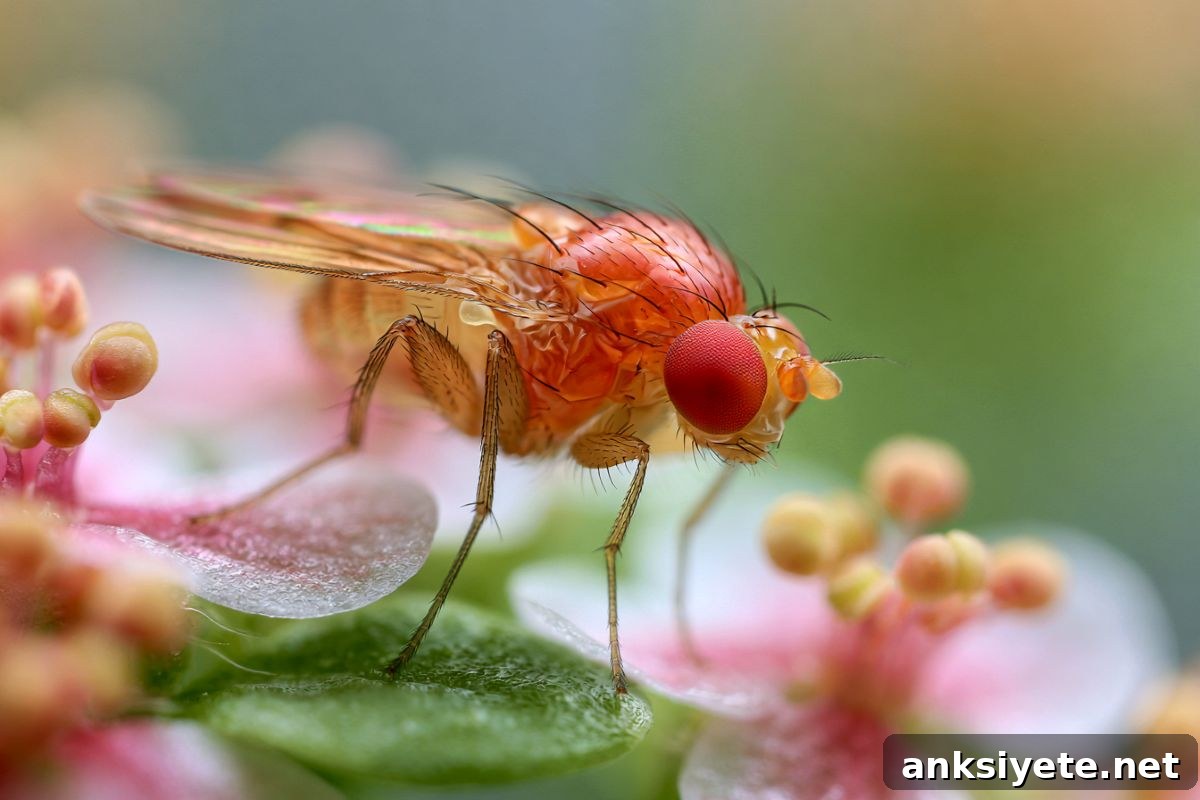
Summary: Researchers report that fruit flies (Drosophila melanogaster) find odor sources not by simple reflexes but by using a directional memory system. This internal vector-based strategy lets them track the edge of an odor plume and reorient back to the scent even when the plume shifts or the wind changes.
Using a virtual-reality treadmill combined with real-time neural imaging, the team discovered that flies do not simply walk down the plume’s center or always turn upwind. Instead, they reliably follow the plume’s outer boundary in a behavior the authors call “edge tracking.” Each time a fly crosses into and out of the odor, a specialized group of neurons in the brain’s central complex—FC2 neurons—stores an angular memory that points back to the plume edge. This stored directional cue serves as an internal compass, enabling the insect to return to the plume even when sensory cues become intermittent or misaligned with the wind.
Key Facts
- Edge tracking: Flies weave along the perimeter of an odor plume—entering briefly, then leaving and moving in clean air before returning—using the boundary as a stable spatial cue.
- Central complex compass: Directional navigation relies on FC2 neurons in the central complex, a conserved insect structure involved in spatial orientation.
- Angular memory: While inside the plume, FC2 activity aligns with the fly’s current heading. After exiting, the same neurons encode a vector aimed back toward the plume edge.
- Robust to changing conditions: Edge tracking remains effective even when the plume is angled relative to the wind or shifts position, allowing flies to find odor sources under varied and turbulent conditions.
- Critical circuitry: Chemically or genetically silencing FC2 neurons prevents flies from turning back to the plume after leaving it, demonstrating the behavior depends on stored directional information rather than only immediate sensory reflexes.
Source: Rockefeller University
When a fruit fly detects the scent of ripe fruit, it can reliably move toward the source—even from a distance and when the odor arrives as brief, fragmented puffs.
Traditionally, insect olfactory navigation has been modeled as a reflexive process: detect odor, turn upwind, and proceed. The new research from Vanessa Ruta’s laboratory challenges that view by showing that flies use a more flexible and memory-dependent strategy to navigate chemical landscapes that are invisible and continuously changing.
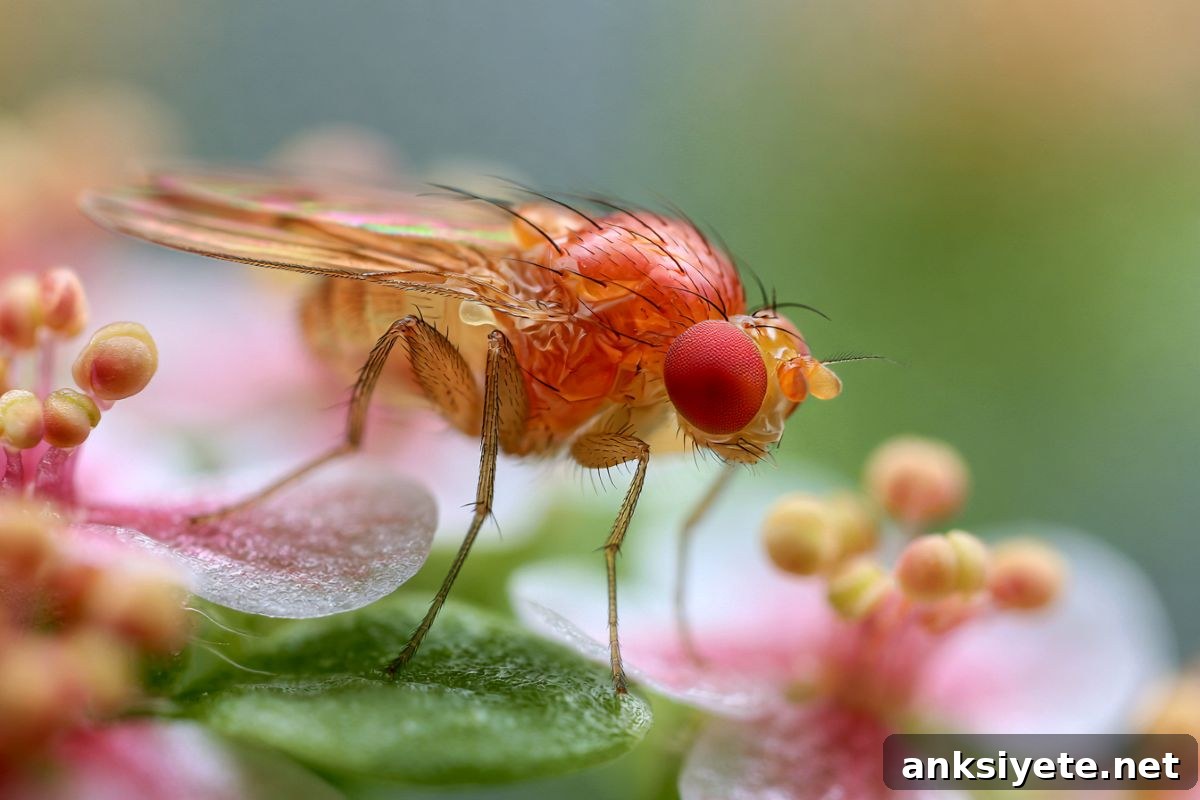
Ruta’s team created a controlled virtual reality arena in which a tethered fly walks on an air-supported ball. The system synchronizes a steady air current with the fly’s turns and releases precisely timed odor pulses at specified locations in a virtual map. This setup lets researchers know exactly what chemical signals the fly experiences at each moment—something that is difficult to achieve with natural plumes.
Following the edge
Contrary to expectations, flies did not stay centered in the odor corridor. Instead, they consistently tracked one edge: they would dart into the plume, quickly turn out, walk in odor-free air while maintaining orientation, and then return. The lab calls this patterned behavior edge tracking. Tests that altered plume angle relative to wind or that shifted the plume’s position on exit showed the strategy remains effective under diverse conditions. Even when given a recording of a highly turbulent, naturally fluctuating plume, flies switched strategies—using other search behaviors in the most fragmented regions, but reverting to memory-guided edge tracking once the plume became sufficiently coherent nearer the source.
These results indicate flies adapt their approach depending on plume structure: when odor encounters are too sparse and unreliable, they use different exploratory tactics; where the boundary can be re-encountered predictably, they store directional information at each crossing to guide future returns.
A compass in the brain
Simultaneous functional imaging and behavior revealed the central complex as the neural substrate for this tactic. FC2 neurons in the fan-shaped body track navigational goals and change their encoded direction depending on odor exposure. While inside the plume, FC2 activity corresponds to the fly’s present heading. Upon leaving, these neurons switch to represent a vector pointing back to the plume edge—an angular memory used to steer returns. Experimental silencing of FC2 cells eliminated the fly’s ability to turn back toward the odor, confirming that plume recovery depends on stored spatial information rather than immediate sensorimotor reflexes alone.
Unlike navigation to a fixed home or nest, tracking a drifting scent requires a flexible reference rather than a fixed location. The study shows flies use each brief odor encounter at the boundary as a chemical signpost, converting transitory sensory input into a directional memory that supports sustained navigation toward the source.
These findings reframe odor tracking as an active spatial computation using conserved navigation circuitry. The central complex, known to support orientation in ants and bees, similarly enables Drosophila to exploit odors as dynamic spatial cues. The work highlights the sophistication of insect navigation and the neural computations that underlie it—even in animals with small brains.
Key Questions Answered:
A: Classic models emphasized anemotaxis—an immediate turning upwind upon detecting odor. Natural plumes are turbulent and invisible, which made it difficult to observe the moment-by-moment behaviors at plume boundaries that reveal memory-based strategies.
A: FC2 neurons encode heading direction. Inside the plume they reflect the fly’s current heading; when the fly leaves the plume these cells maintain an angular vector pointing back to where the plume was last detected, guiding the fly’s return.
A: Because wind fragments plumes into intermittent puffs, following the edge lets the fly update spatial memory at each contact and relocate the plume path even when it shifts or breaks apart, making navigation more robust than simply following the centerline.
Editorial Notes:
- This article was edited by a Neuroscience News editor.
- The underlying journal paper was reviewed in full.
- Additional context was provided by editorial staff.
About this olfaction and memory research news
Author: Katherine Fenz
Source: Rockefeller University
Contact: Katherine Fenz – Rockefeller University
Image credit: Neuroscience News
Original Research: Open access. “A vector-based strategy for olfactory navigation in Drosophila” by Andrew F. Siliciano et al., published in Nature. DOI: 10.1038/s41586-026-10827-7
Abstract
A vector-based strategy for olfactory navigation in Drosophila
Odors are vital navigational cues for many animals, but their spatial structure is hard to infer because plumes are invisible and highly dynamic. To examine whether animals use memory of past odor encounters to infer plume structure, the authors developed a virtual-reality olfactory paradigm allowing Drosophila to explore defined chemical landscapes while recording neural activity and behavior.
They found that flies follow an odor corridor by tracking its boundary, alternating rapid counter-turns to leave the plume with directed returns to the edge. Behavioral modeling, calcium imaging, and neural perturbations indicate that this edge-tracking strategy depends on vector-based computations in the central complex. FC2 neurons in the fan-shaped body encode the direction back to the odor boundary when flies are outside the plume, showing that plume tracking recruits conserved navigation circuitry and that directional memories help flies navigate complex, shifting chemical environments.