
Symmetry is a fundamental principle of development. During embryonic growth, an organism’s brain and spinal cord, like the rest of the body, form left and right halves. Yet a specialized group of nerve cells behaves differently: their axons cross the midline from one side to the other. New research in mice clarifies the molecular interactions that guide these crossing neurons toward the anatomical midline.
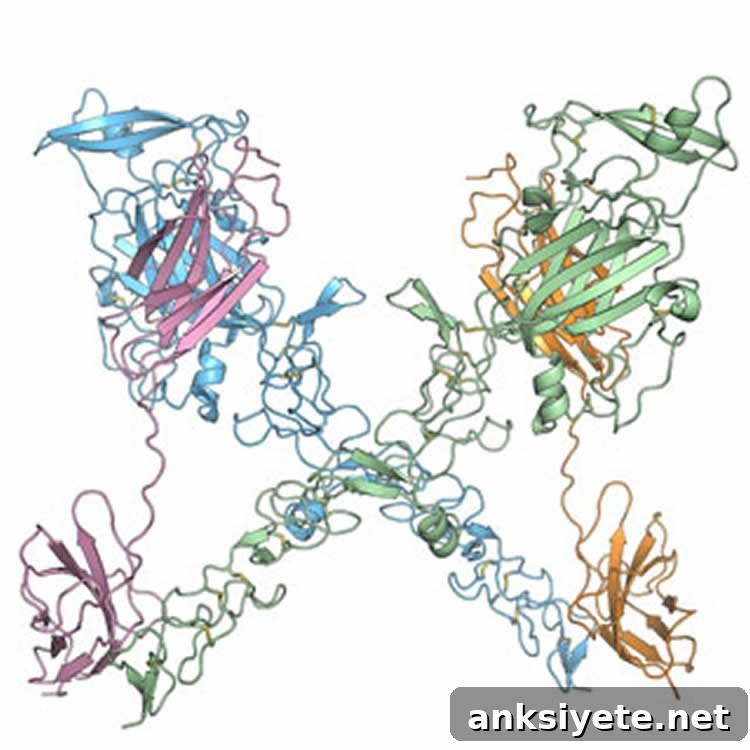
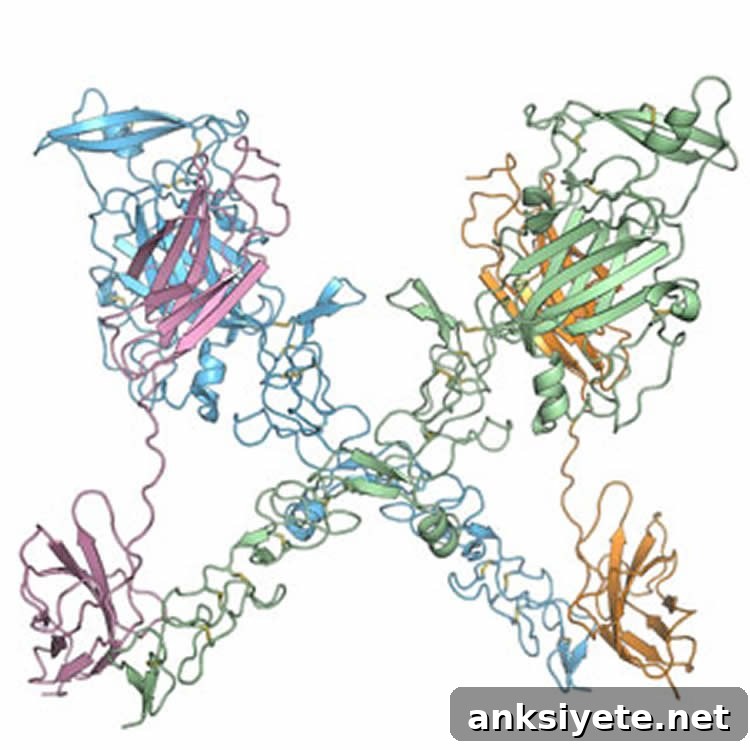
Axons—the long, threadlike projections of neurons—extend toward their targets under the influence of chemical guidance cues. At their tips, sensory receptor complexes detect these cues and translate them into directional growth. Scientists at Memorial Sloan Kettering Cancer Center and The Rockefeller University have now mapped, at high resolution, how the guidance cue Netrin-1 engages two axonal receptors—DCC and the less well characterized neogenin—to steer growing axons.
Netrin-1 is a secreted signaling protein known to act as either an attractant or a repellant, depending on the receptor context presented by a neuron. For the class of neurons called commissural neurons—whose axons must cross the midline—Netrin-1 functions as an attractant, drawing the axons toward the center so they can connect the two sides of the nervous system.
Using X-ray crystallography to visualize protein structures, the team led by structural biologist Dimitar Nikolov and research scientist Kai Xu discovered that a single Netrin-1 molecule contains two distinct receptor-binding sites located at opposite ends. This bivalent arrangement allows Netrin-1 to bind simultaneously to different receptors on the axonal surface, which helps explain how a single guidance cue can generate diverse responses depending on the receptor combinations expressed by a given neuron.
Previously, the receptor DCC (Deleted in Colorectal Cancer) was well established as a mediator of Netrin-1–driven attraction in commissural neurons. The new structural data demonstrate that neogenin, a protein with a structure similar to DCC, also binds Netrin-1 and functions as an additional receptor in this guidance system. Complementary experiments in mice, carried out by researchers in Marc Tessier-Lavigne’s laboratory, confirmed that neogenin, like DCC, senses Netrin-1 during commissural axon guidance.
The implications extend beyond basic developmental biology. Commissural axons are a crucial component of the circuitry by which one hemisphere of the brain governs movement on the opposite side of the body. Mutations in the DCC gene disrupt this cross-hemispheric coordination and cause congenital mirror movement disorder, a condition in which intentional movement on one side is involuntarily mirrored by the other side. Understanding the molecular architecture that governs axon guidance therefore sheds light on both normal neural wiring and the developmental origins of certain motor disorders.
The structural work also provides insight into why receptors such as DCC and neogenin exist in multiple splice isoforms—slightly different forms produced from the same gene. The researchers found that these isoforms interact with Netrin-1 in distinct ways, suggesting that alternative splicing may fine-tune how neurons interpret guidance signals. The functional consequences of these differential bindings for precise wiring patterns remain to be fully explored.
“Our study offers the first detailed, high-resolution view of molecular complexes that assemble on the surface of a growing axon and direct its movement,” says Dimitar Nikolov. “These assemblies define how neurons read extracellular cues to make wiring decisions. A deeper knowledge of these mechanisms could eventually inform strategies to promote axon regeneration or to design therapies for spinal cord and brain injuries.”
Marc Tessier-Lavigne adds that identifying an additional receptor involved in spinal cord axon guidance advances our understanding of the molecular logic that sculpts neural circuits. Together, the structural and functional findings reveal how combinations of guidance cues and receptors produce a functioning nervous system, and why miswiring leads to dysfunction.
Contact: Zach Veilleux – Rockefeller University
Source: Rockefeller University press release
Image Source: Image adapted from the Rockefeller University press release.
Original Research: Abstract for “Structures of netrin-1 bound to two receptors provide insight into its axon guidance mechanism” by Kai Xu, Zhuhao Wu, Nicolas Renier, Alexander Antipenko, Dorothea Tzvetkova-Robev, Yan Xu, Maria Minchenko, Vincenzo Nardi-Dei, Kanagalaghatta R. Rajashankar, Juha Himanen, Marc Tessier-Lavigne and Dimitar B. Nikolov in Science.