
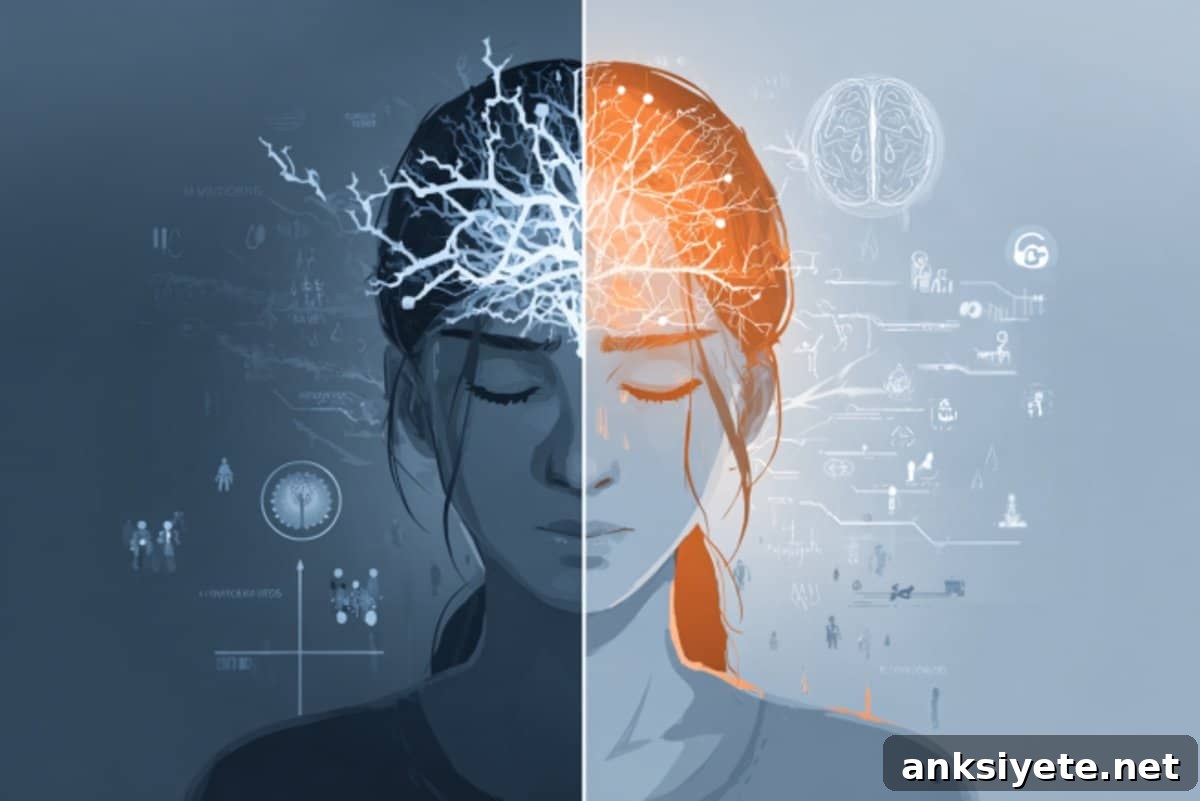
Summary: A new study shows that identical clinical signs of depression can arise from different brain profiles, revealing both one-to-one and many-to-one relationships between symptoms and neurobiology. Analyzing brain imaging from the UK Biobank, researchers found that patients who report comparable symptoms may nonetheless display markedly different neural patterns. One of the identified brain profiles was linked to impaired cognition, suggesting that MRI measures can provide predictive information beyond symptom assessments alone. This layered understanding of depression may help guide more personalized treatment strategies.
Researchers combined clinical evaluations with neuroimaging to explore how clinical symptoms and brain differences relate. Their work indicates that some clinical presentations correspond to distinct neurobiological patterns, while in other cases multiple brain profiles can underlie the same symptom set. These findings emphasize the complexity of depression and the value of integrating imaging data with symptom-based assessments to refine diagnosis and treatment planning.
Key facts:
- Multiple biological routes: Different neurobiological profiles can produce the same depressive symptoms.
- Imaging adds predictive value: MRI-based measures can help predict clinical outcomes, such as cognitive decline, that symptom screening alone may not detect.
- Implications for treatment: Subtyping depression by both symptoms and brain characteristics could improve the matching of patients to therapies.
Source: Elsevier
Overview
A study published in Biological Psychiatry examined how clinical heterogeneity in depression maps onto neurobiological variation. The research team investigated whether clinical subtypes align directly with unique brain profiles (one-to-one mapping) or whether multiple distinct brain patterns can produce the same clinical picture (many-to-one mapping). Their analysis used large-scale, population-based imaging data from the UK Biobank collected across several imaging sites.
John Krystal, MD, Editor of Biological Psychiatry, notes that depression is a highly heterogeneous condition and that accurate subtyping is crucial for directing effective, individualized treatments. The current study advances that goal by combining clinical data and brain imaging to derive subtypes with clearer biological signatures.
Lead investigator Janine D. Bijsterbosch, PhD, Mallinckrodt Institute of Radiology at Washington University School of Medicine in St. Louis, explains that patients with the same diagnostic label can differ widely in both clinical features (such as which symptoms appear, age at onset, and episode history) and neurobiology (the brain changes associated with symptoms). Prior research has examined these domains separately; this study aimed to clarify how they interact.
The team organized individuals with depression into groups based on specific clinical presentations. For example, they formed groups of participants who experienced a particular symptom—such as depressed mood—without other common symptoms like low motivation. They then compared the neurobiological profiles of these clinically focused groups to a comparison group with mixed symptoms.
Co-investigator Yvette I. Sheline, MD, of the Perelman School of Medicine at the University of Pennsylvania, reports that clinically homogeneous groups exhibited stronger and more distinct neuroimaging deviations than the heterogeneous comparison group. The study also produced the first clear evidence that multiple brain profiles can produce the same clinical presentation: within acutely impaired patients, imaging-driven clustering revealed two stable neurobiological subtypes that shared identical clinical profiles but differed significantly in cognitive function. One subtype showed worse cognitive performance, indicating that brain imaging identified clinically meaningful differences that symptom assessments alone missed.
Depression remains one of the most common mental health disorders: about 9.2% of Americans experience an episode each year. Despite its prevalence, depression is often underdiagnosed and treatments yield limited success for many patients—only about 30% respond to first-line treatment. The study’s authors emphasize that better subtyping, informed by both clinical presentation and neurobiology, could help improve treatment selection and outcomes.
Co-investigator Deanna M. Barch, PhD, of Washington University, highlights that the findings should encourage further research into the layered sources of heterogeneity in depression. Developing tools that account for both clinical and neurobiological variation will be essential to identify subtypes that may respond differently to specific interventions and to advance personalized care for people with depression.
About this depression and neuroscience research news
Author: Eileen Leahy
Source: Elsevier
Contact: Eileen Leahy – Elsevier
Image: The image is credited to Neuroscience News
Original research: Open access. “Parsing Clinical and Neurobiological Sources of Heterogeneity in Depression” by Janine D. Bijsterbosch et al., Biological Psychiatry. DOI: 10.1016/j.biopsych.2025.04.025
Abstract
Parsing Clinical and Neurobiological Sources of Heterogeneity in Depression
Background
Patients with depression differ in both clinical symptoms and neuroimaging findings, yet how these sources of variation relate is not well understood. Clarifying these relationships is essential for uncovering the disorder’s diverse neural origins and for developing more targeted clinical approaches.
This study evaluated whether depression heterogeneity reflects subgroups that are distinct on both clinical and neurobiological dimensions, or whether multiple neuroimaging profiles can produce the same clinical presentation.
Methods
The research used population-based UK Biobank imaging data collected across multiple sites. Investigators formed clinically dissociated groups to isolate specific depression features, including symptoms such as anhedonia, depressed mood, and somatic disturbance; indices of lifetime chronicity and acute impairment; and late onset. Within each clinically defined group, residual neuroimaging heterogeneity was assessed using data-driven clustering approaches.
Results
Clinically dissociated subgroups showed larger deviations in neuroimaging norms and had distinct neural profiles relative to a heterogeneous comparison group. Within the acute impairment group, imaging-driven clustering identified two stable neurobiological subtypes that differed significantly in cognitive ability despite sharing identical clinical presentations.
Conclusions
The study identified discrete neuroimaging profiles linked to specific clinical features of depression, offering a potential explanation for inconsistent findings in prior research. It also demonstrated that multiple neuroimaging profiles can underlie the same clinical presentation and revealed sub-clusters within acutely impaired patients that were distinguishable only through imaging, particularly by cognitive outcomes.
These results underscore complex, layered interactions between clinical symptoms and brain-based sources of heterogeneity. Integrating symptoms and neurobiology will be critical for defining depression subtypes that could be targeted by different therapeutic strategies.