
Summary: By applying a machine-learning model to neural recordings, researchers reveal how the brain encodes spatial maps and preserves memory traces during brief pauses and rest.
Source: Rice University.
Neural activity continues to replay memories even when an animal is not actively exploring. New collaborative research from Rice University and Michigan Medicine shows how brief bursts of firing across the hippocampus can reveal the structure of stored spatial maps and memory traces.
Led by Caleb Kemere (Rice) and Kamran Diba (Michigan Medicine), the team developed a quantitative approach to model memory using recordings of rapid, coordinated neural events. Their method focuses on population burst events — intense, short-lived waves of neuronal firing — captured both while animals explored and, crucially, while they paused or rested.
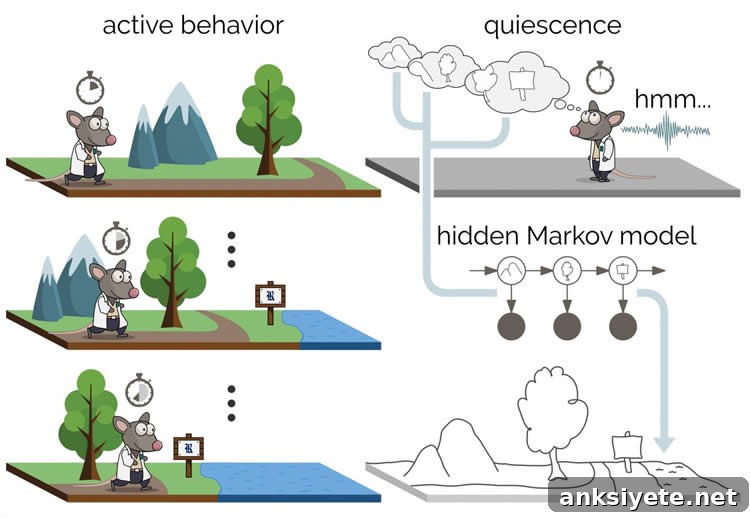
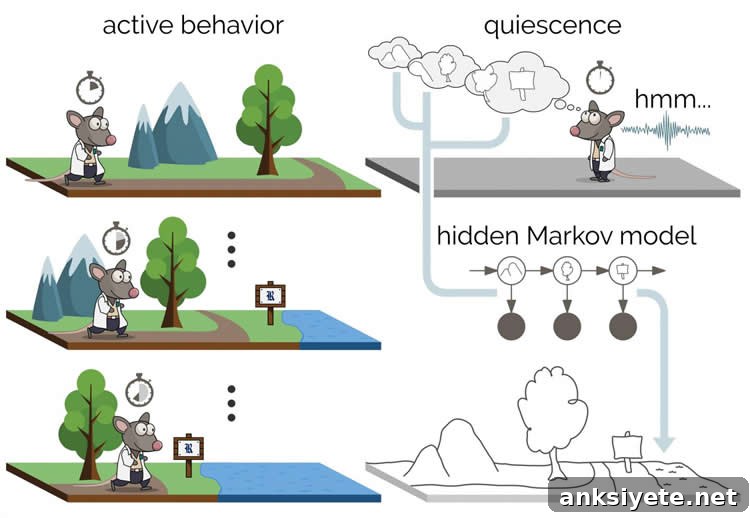
The researchers applied hidden Markov models, a class of sequential models widely used in machine learning, to identify and decode temporal patterns in hippocampal activity. They found that even small amounts of data recorded during rest periods are sufficient to reconstruct spatial maps and detect replayed experiences, offering a new window into how memories are organized and consolidated.
The full study appears in the journal eLife.
The hippocampus, a seahorse-shaped structure present in each brain hemisphere, contains neurons known as place cells that activate at specific locations and are central to spatial and episodic memory. In laboratory experiments, scientists measure these activity patterns with implanted electrodes that record neural firing in real time.
“Animals form a memory of an environment as they move around,” said Kemere, an assistant professor of electrical and computer engineering with expertise in neuroscience. “Individual neurons activate in particular places, creating an internal spatial map. During active exploration, animals spend roughly 40–60 percent of their time forming this map.”
“The remaining time they may be grooming, eating, or briefly pausing — not asleep, but quiet,” he added. “I call those pauses a form of introspection.”
Those paused periods provided the key data for this study. Under Diba’s direction, the team collected recordings while rats explored linear tracks and open-field mazes. During exploration, electrodes detected sharp-wave–associated population bursts — instances in which tens of thousands of neurons fire within about 100 milliseconds, creating ripple-like activity that propagates through the brain.
Previous work had shown that these population burst events often contain sequences of place cell activations corresponding to locations the animal has visited. Such replay of place-cell sequences is thought to participate in memory consolidation and planning.
Instead of starting from behavior-linked activity, the new analysis concentrated on the brief intervals when animals were paused — only about 2 percent of the total experimental time. Using hidden Markov models, the researchers separated “reactivation” bursts that likely represent memory replay from other noisy hippocampal signals.
The models demonstrated that rest-period PBEs carry sufficient information to reconstruct the spatial structure of the environment. In other words, without observing the animal’s movement, the team could infer maps of space and decode position-related information from covert neural sequences. These model-derived patterns matched well with independent Bayesian analyses of theta-associated activity recorded during active exploration.
“When I first recorded these data I focused on theta oscillations during running,” Diba said. “But the resting information ended up revealing richer aspects of memory content than I expected.”
Hidden Markov models provided a natural way to assemble pieces of a remembered sequence. “Markovian dynamics assert that the next state depends only on the current state,” explained Rice graduate student Etienne Ackermann, co-lead author. “In the brain, those underlying states are not directly visible, but we observe electrical proxies. A hidden Markov model lets us infer the most likely sequence of hidden states from those observations.”
By estimating many such sequences, the team could statistically identify those that correspond to a remembered environment even in the absence of supervised labels linking neural activity to the animal’s location. “I was surprised by how much environmental information the models captured,” Diba said, noting his lab’s role in event selection and experimental design.
“This study shows how advanced machine learning can expose the structure of memory when it is covertly expressed,” Kemere said. “Typically, hippocampal memory structure is revealed by correlating neural activity with behavior. Here, unsupervised learning reconstructed that structure from periods without overt behavior, uncovering a surprising richness in covert memory traces.”
The authors note that the models can be applied to existing sleep and rest datasets. Sleep is known to involve reactivation and consolidation, but quantifying which patterns reflect meaningful memory replay versus noise or dreaming has been difficult. These tools offer a principled, quantitative way to distinguish forming memories from unrelated activity and could enable new tests of hypotheses about sleep-dependent consolidation and forgetting.
Kourosh Maboudi (Michigan Medicine/University of Wisconsin–Milwaukee) is co-lead author. Other co-authors include Laurel Watkins de Jong (Michigan Medicine), Brad Pfeiffer (University of Texas Southwestern at Dallas), and David Foster (University of California, Berkeley).
Funding: Research support came from the National Science Foundation, the National Institute of Mental Health, and the Human Frontiers Science Program.
Source: David Ruth, Rice University
Publisher: Organized by Neuroscience News
Image Source: Image credited to Etienne Ackermann/Rice University.
Original Research: “Uncovering temporal structure in hippocampal output patterns” by Kourosh Maboudi, Etienne Ackermann, Laurel Watkins de Jong, Brad Pfeiffer, David Foster, Kamran Diba, and Caleb Kemere, published in eLife (June 5, 2018).
doi: 10.7554/eLife.34467
Rice University. “Neurons Ripple While Brain Rests to Lock in Memories.” Neuroscience News, 5 June 2018.
Abstract
Uncovering temporal structure in hippocampal output patterns
Place cell activity of hippocampal pyramidal cells constitutes a core substrate for spatial memory. Replay is observed during hippocampal sharp-wave–ripple-associated population burst events (PBEs) and supports consolidation and recall-guided behaviors. Historically, PBE activity has been analyzed relative to the place code. Here, we apply hidden Markov models to PBEs recorded in rats during exploration of linear mazes and open fields. We show that estimated models align with a spatial map of the environment and can decode animal position during behavior. Furthermore, the model can detect hippocampal replay using only PBE dynamics, without relying on the place code. These findings suggest that downstream brain regions could use PBEs as a substrate for memory. By forming models independent of overt behavior, this work also lays groundwork for studying non-spatial memory.