
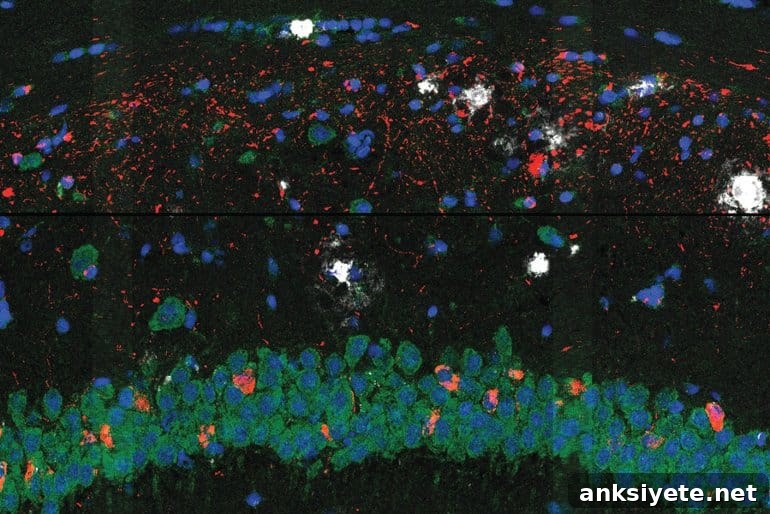
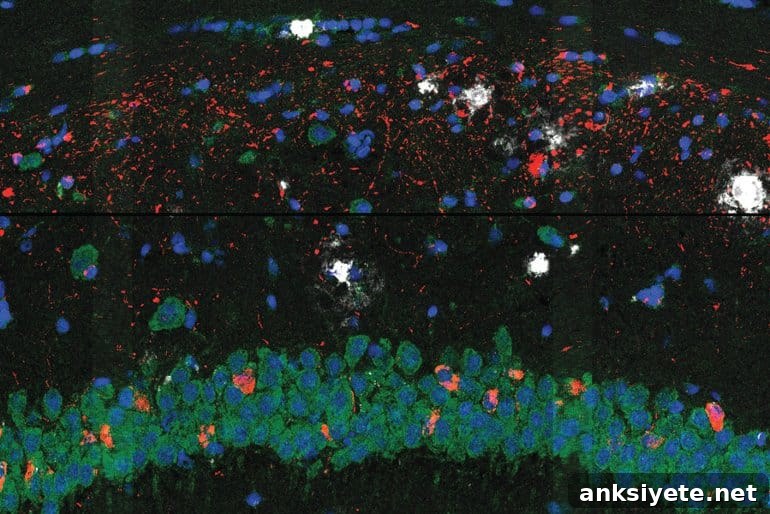
Summary: Researchers used a new technique called STARmap PLUS to track and map changes in tau and amyloid‑β proteins and the surrounding cellular environment as Alzheimer’s disease progresses in a mouse model.
Source: MIT
Excessive accumulation of two proteins in the brain—tau tangles inside neurons and amyloid‑β plaques outside them—is a hallmark of Alzheimer’s disease. How these protein deposits relate to neuron loss and other disease features remains unclear.
A team at the Broad Institute of MIT and Harvard reports new insights in a study published in Nature Neuroscience. They applied a novel spatial approach to reveal how cells and proteins organize and change near pathology in a mouse model of Alzheimer’s.
The technique, STARmap PLUS, concurrently maps the full RNA expression profile of individual cells and the spatial distribution of specific proteins within intact tissue sections. This integrated view preserves cellular neighborhoods and subcellular details that are lost when cells are studied after tissue dissociation.
Using STARmap PLUS on brain tissue from Alzheimer’s model mice at two disease stages, the team produced high‑resolution three‑dimensional maps of more than 2,700 genes together with key proteins. At the earlier stage they observed a consistent core–shell architecture around amyloid plaques: a central plaque core encircled by an inner shell of microglia—brain immune cells—and outer shells composed of other glial cell types that appear later in disease progression.
Microglia immediately adjacent to plaques exhibited gene expression patterns linked to neurodegeneration and an activated inflammatory state. The spatial gene signatures indicate that microglial activation occurs locally around plaques, suggesting these cells respond in place and may recruit neighboring cell types to form the surrounding shells, rather than activating far away and migrating inward.
This spatial ordering clarifies how distinct cell types assemble around protein deposits and provides clues about the sequence of cellular events during disease progression. The maps also showed that hyperphosphorylated tau accumulated predominantly in excitatory neurons within the CA1 region of the hippocampus and correlated spatially with enrichment of particular oligodendrocyte subtypes.
STARmap PLUS builds on an earlier STARmap method and was developed to co-map transcripts and proteins in the same tissue slice. The workflow uses molecular probes to convert target mRNAs into amplifiable DNA sequences, antibodies to label proteins, and a chemical anchoring step that fixes both DNA and proteins within a gel matrix. In situ sequencing and imaging then generate a spatially resolved dataset linking molecular signatures to precise tissue location.
A central advantage of STARmap PLUS is its ability to align protein localization and single‑cell transcriptomes from the same sample, enabling direct comparisons at subcellular resolution. The method can resolve features smaller than individual cells, improving cell identification in densely packed brain regions, and it is scalable to additional proteins or broader transcriptome coverage.
Implications for research and therapy
Applying STARmap PLUS to human brain samples is a critical next step to determine how closely mouse findings reflect human Alzheimer’s pathology. In animal models, the technique can address key therapeutic questions: for example, if antibody therapies remove plaques, do nearby microglia revert to a resting state and disperse? Would eliminating plaques or modulating microglial activation prevent local neuron loss?
Beyond Alzheimer’s, STARmap PLUS could be applied to many conditions where spatial relationships between cells and proteins matter, including cancer immunology, schizophrenia, and other neurological disorders. By providing an integrated, spatially precise molecular map, the method offers a powerful tool to pinpoint cellular mechanisms underlying disease and to evaluate how treatments alter tissue architecture and cell states.
“Studying tissues with preserved spatial context allows far more detailed inference about disease processes than analyses that rely on dissociated cells,” said Morgan Sheng, co‑senior author of the study and co‑director of the Stanley Center for Psychiatric Research. “STARmap PLUS adds a valuable new dimension to transcriptomics and should have widespread impact.”
Funding: This work was supported in part by the Searle Scholars Foundation, the Stanley Center for Psychiatric Research, and the Merkin Institute.
About this Alzheimer’s disease and brain mapping research news
Author: David Cameron
Source: MIT
Contact: David Cameron – MIT
Image: Credit: Zeng H, Huang J, Zhou H, et al.
Original Research: Closed access. “Integrative in situ mapping of single‑cell transcriptional states and tissue histopathology in a mouse model of Alzheimer’s disease” by Zeng H, Huang J, Zhou H, et al. Nature Neuroscience
Abstract
Integrative in situ mapping of single-cell transcriptional states and tissue histopathology in a mouse model of Alzheimer’s disease
Complex diseases involve spatiotemporal cellular and molecular changes that are challenging to capture comprehensively. Understanding these dynamics can illuminate mechanisms of disease initiation and progression.
We introduce STARmap PLUS, a method that combines high‑resolution spatial transcriptomics with targeted protein detection in the same tissue section. As proof of principle, we applied this approach to brain tissue from a mouse model of Alzheimer’s disease at 8 and 13 months of age.
The method produces a detailed cellular map of disease progression, revealing a core–shell structure in which disease‑associated microglia closely contact amyloid‑β plaques, while astrocyte‑like cells and oligodendrocyte precursor cells enrich in outer shells surrounding the plaque–microglia complex. Hyperphosphorylated tau localizes mainly to excitatory neurons in the CA1 region and correlates with local oligodendrocyte subtype enrichment.
STARmap PLUS bridges single‑cell gene expression with tissue histopathology at subcellular resolution, offering a tool to pinpoint molecular and cellular changes that underlie pathological processes.