
Summary: New research reveals how neurons in the motor cortex coordinate with muscles to produce different types of movement. Using optogenetics in mice, the team found that the motor cortex communicates with muscles in distinct temporal and network patterns depending on the behavior—insights that clarify how the brain controls walking versus skilled grasping.
Source: Zuckerman Institute
Study in mice answers a long-standing question about how the brain drives movement
Researchers at Columbia University have reported new findings that clarify how the brain’s motor cortex tells the body to move. The work, conducted in mice and published in Neuron, examines how neurons in the motor cortex coordinate activity to produce either simple movements, such as walking, or highly skilled actions, such as precise grasping. By combining optogenetic silencing with dense neuronal recordings and mathematical analysis, the team observed how the motor cortex exerts different kinds of influence over muscles depending on the behavior being performed.
“From walking to playing the piano, every movement requires coordinated communication between the brain and body,” said Thomas M. Jessell, PhD, codirector of Columbia’s Mortimer B. Zuckerman Mind Brain Behavior Institute and senior author on the paper. “This study let us monitor that communication in real time, revealing not only when the motor cortex drives muscles, but also how its internal neural patterns change with different actions.”
Although the motor cortex is widely associated with movement control, previous research has shown it is not strictly required for all motor behaviors. Animals with motor cortex damage can often recover basic walking, yet they typically fail to regain more specialized tasks like precise reaching and grasping. The current study directly compared motor cortex function for two behaviors that differ in their reliance on cortical control: treadmill walking and a trained reach-to-grasp task.
Andrew Miri, PhD, a postdoctoral researcher in the Jessell Lab and the paper’s first author, explained their experimental approach. The team used optogenetics to transiently silence the motor cortex in mice while the animals either walked on a treadmill or reached to grasp a joystick. Silencing the motor cortex produced behavior-specific effects: grasping was disrupted within about 10 milliseconds of cortical silencing, whereas walking did not show measurable change until at least 35 milliseconds after silencing. Those latency differences suggested that the motor cortex communicates with muscles through distinct mechanisms for each action.
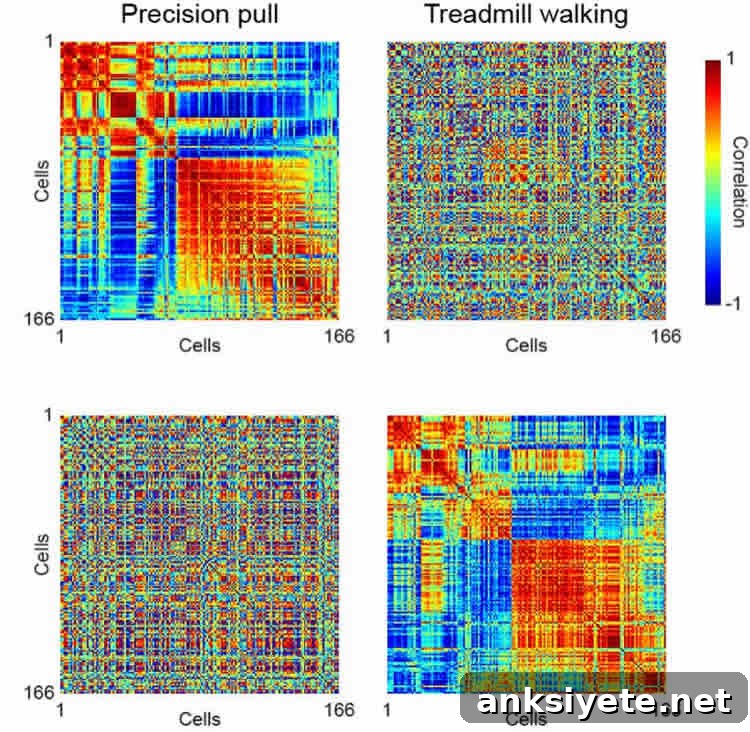
To probe those mechanisms, the researchers recorded electrical activity from hundreds of individual neurons in the motor cortex while animals performed the two tasks. Collaborating with Columbia’s Center for Theoretical Neuroscience, they used mathematical tools to visualize and quantify patterns of correlation among neurons during each behavior. What emerged was a clear difference in network organization: neurons that fired in tightly correlated patterns during the reach task were often uncorrelated during walking, and vice versa.
“Individual neurons fired during both behaviors, but what mattered most was how neurons’ firing patterns related to one another,” said Dr. Miri. “During the reach task, many neurons fired in coordinated groups that appeared to drive the skilled movement. During walking, those same neurons showed very different, often mismatched timing relationships.”
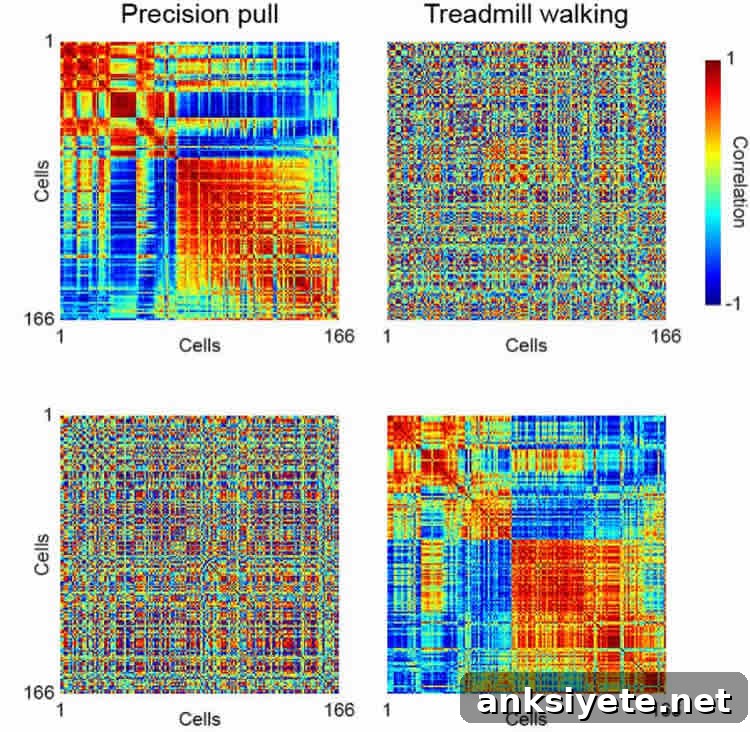
The study’s core insight is that the motor cortex uses dynamic, behavior-specific patterns of neuronal coordination to direct movement. It is not simply the activity of single neurons that matters, but the moment-to-moment structure of correlations across populations of neurons. Those population-level patterns can rapidly direct skilled actions like grasping, while simpler, more automatic behaviors like walking appear to rely less on the same tightly coordinated cortical patterns.
Dr. Jessell emphasized the broader implications. “This work provides a comprehensive explanation for why the motor cortex appears active during many behaviors yet is essential only for some. It helps explain why basic movements can recover after cortical damage while highly skilled movements often cannot,” he said.
These results have practical relevance for medicine and technology. A clearer understanding of motor cortex dynamics may improve brain-machine interfaces that aim to translate cortical signals into prosthetic movement and could aid early diagnosis or modeling of movement disorders such as amyotrophic lateral sclerosis (ALS). By revealing how specific patterns of cortical activity drive distinct movements, the study helps pave the way for targeted therapies and more accurate neural decoding strategies.
Funding: The research received support from the National Institutes of Health (including NIH-NINDS T32 Training Grant, DP2 NS083037, NS033245), the Helen Hay Whitney Foundation, the Simons Foundation (SCGB #325233), the Sloan Foundation, the McKnight Endowment, the Mathers Foundation, Project A.L.S., and the Howard Hughes Medical Institute.
The authors report no financial or other conflicts of interest.
Source: Anne Holden – Zuckerman Institute
Image credit: Andrew Miri/Jessell Lab/Columbia’s Zuckerman Institute
Original research: Published in Neuron.
Zuckerman Institute (2017, July 20). Patterns of Brain Activity Direct Specific Body Movements. NeuroscienceNews. Citation retrieved July 20, 2017.
Feel free to share this article.