
Summary: A new study reports that temporarily reducing activity in the left dorsolateral prefrontal cortex can boost our ability to think “outside the box.”
Source: Queen Mary University of London
Researchers from Queen Mary University of London and Goldsmiths, University of London, report that non-invasive brain stimulation can temporarily enhance creative problem solving.
The team achieved this by briefly suppressing activity in a key frontal brain region called the left dorsolateral prefrontal cortex (DLPFC), an area involved in rule-based thinking, reasoning and working memory. Their findings suggest that reducing DLPFC activity can relax learned constraints and help people generate novel solutions when familiar strategies fail.
The study, published in the journal Scientific Reports, tested how different forms of transcranial direct current stimulation (tDCS) affected performance on challenging problems that require abandoning conventional rules. Participants who received the cathodal stimulation that suppressed the left DLPFC solved more of the most difficult problems than those who received anodal (activating) stimulation or sham (no effective stimulation).
“When we solve problems we usually apply rules learned from past experience, and the DLPFC helps automate that process,” said Dr Caroline Di Bernardi Luft, first author from QMUL’s School of Biological and Chemical Sciences. “That approach works most of the time, but it can trap us when a novel solution requires breaking those learned rules. Loosening that automatic rule application appears to free people to think differently.”
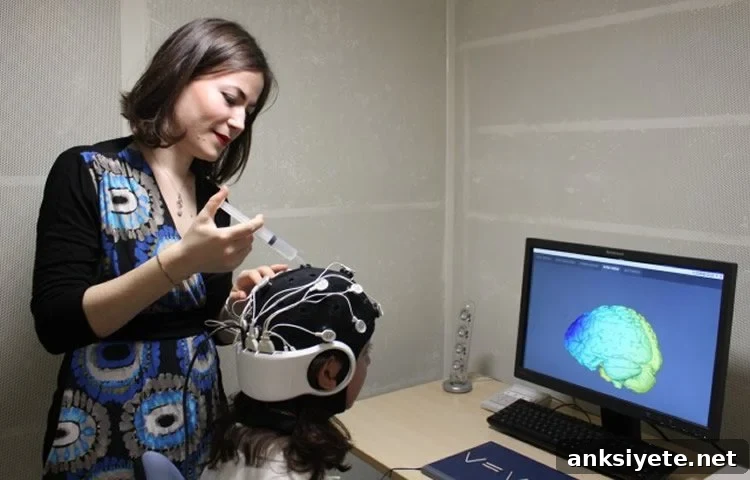
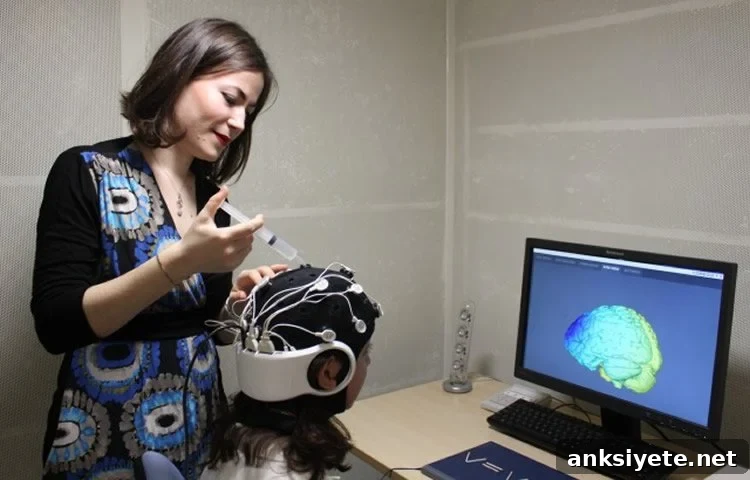
In the experiment, researchers used tDCS to pass a very weak, constant electrical current through saline-soaked electrodes placed on the scalp to alter DLPFC excitability. Cathodal stimulation temporarily reduced activity in the targeted area, while anodal stimulation increased it; sham stimulation produced no effective change. The currents used were low and safe, producing no harmful or unpleasant sensations.
Sixty volunteers completed a set of “matchstick problems” both before and after receiving one of three interventions: cathodal (suppressing) stimulation, anodal (activating) stimulation, or sham stimulation. The matchstick tasks require participants to modify arithmetic or algebraic expressions by moving matchsticks so that a correct equation results. Some items are particularly difficult because solving them demands relaxing ingrained arithmetic rules and reinterpreting the representation of the problem.
Participants who received cathodal stimulation over the left DLPFC were more likely to solve the problems that required the greatest relaxation of learned constraints. This supports the idea that temporarily lowering DLPFC activity helps break mental fixation and promotes representational change—an essential component of creative insight.
However, the study also revealed a trade-off. The cathodal group performed worse on problems with high working memory demands—tasks that require holding and manipulating several items in mind while testing multiple solution moves. Because the DLPFC supports working memory, suppressing it can hinder the mental tracking needed for these types of problems.
“These results highlight the potential for non-invasive brain stimulation to selectively enhance cognitive functions related to creativity,” Dr Luft commented. “At the same time, they caution against a one-size-fits-all view: the same intervention that helps in one cognitive domain can impair performance in another.”
She added that commercial claims promoting tDCS as a general cognitive enhancer should be treated with skepticism. The findings indicate that the benefits of brain stimulation depend heavily on the target brain region and the specific cognitive demands of a given task. “We are not at the point where people should be applying electrical stimulation to their heads at home expecting blanket improvements,” she noted.
Funding: The research was funded by the European Commission through the CREAM project (CReativity Enhancement through Advanced Methods).
Source: Queen Mary University of London
Image credit: Image adapted from the QMUL news release.
Original research: The study “Relaxing learned constraints through cathodal tDCS on the left dorsolateral prefrontal cortex” by Caroline Di Bernardi Luft, Ioanna Zioga, Michael J. Banissy & Joydeep Bhattacharya was published in Scientific Reports (published online June 7, 2017).
Relaxing learned constraints through cathodal tDCS on the left dorsolateral prefrontal cortex
Problem solving often relies on rules learned from past experience, and the dorsolateral prefrontal cortex (DLPFC) plays a central role in automating rule-based approaches. While efficient in many situations, this automaticity can create mental fixation when a novel problem requires a different representation or solution strategy. The authors tested whether transiently suppressing the left DLPFC with cathodal transcranial direct current stimulation (tDCS) would facilitate representational change. Participants solved matchstick arithmetic problems before and after receiving cathodal, anodal or sham tDCS to the left DLPFC. Cathodal stimulation increased the likelihood of solving problems that required maximal relaxation of learned constraints compared with anodal or sham stimulation. The findings suggest that cathodal tDCS over the left DLPFC can facilitate the relaxation of learned constraints and support creative problem solving, although it may impair tasks that rely heavily on working memory.