
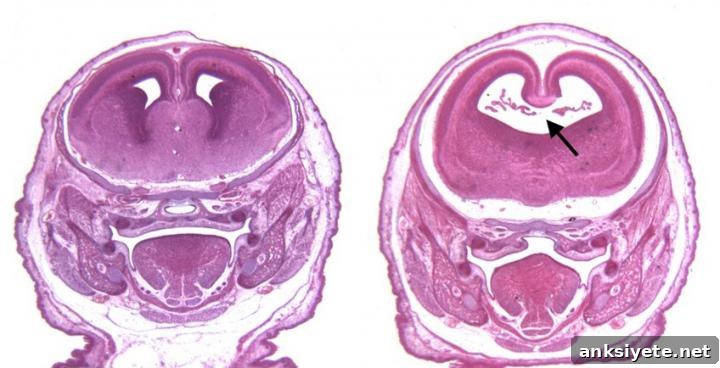
Summary: One-time exposure to cannabinoids such as CBD and THC during early pregnancy produces brain and facial development abnormalities in animal models that closely resemble defects seen in fetal alcohol syndrome.
Source: University of North Carolina Health Care
A recent study published in Scientific Reports (a Nature Research journal) reports that a single exposure to cannabinoids—both synthetic and naturally occurring—during an early window of pregnancy can cause growth and developmental abnormalities in the embryo. This is the first study to demonstrate this connection in mammals.
The experiments were conducted in mice, which closely model the key events of early embryonic development in humans, according to senior author Scott Parnell, PhD, an assistant professor of cell biology and physiology at the UNC School of Medicine.
“Embryonic development during this time is highly conserved across vertebrates,” said Parnell, a member of the UNC Bowles Center for Alcohol Studies. To strengthen their findings, the team also tested a synthetic cannabinoid in zebrafish and observed similar deformities, which supports the results across two different animal models.
The researchers found that exposure to cannabinoids—specifically CBD and THC, the primary active components of cannabis—produced brain and facial developmental changes that closely mimic those caused by prenatal alcohol exposure (fetal alcohol syndrome). When cannabinoids and alcohol were combined, the incidence of birth defects increased dramatically—more than doubling in many cases. The team’s data suggest these effects arise from interactions at the cellular and molecular level that disrupt the signaling pathways that guide normal growth and tissue patterning.
“The interaction between alcohol and cannabinoids we observed is particularly worrisome,” said Eric Fish, PhD, the study’s first author and a research associate at the UNC Bowles Center for Alcohol Studies. “Other studies show that cannabinoids and alcohol are often used together, and our results indicate this combination could be especially dangerous during early pregnancy.”
In these experiments, mice received cannabinoids alone or in combination with alcohol on day eight of pregnancy—an embryonic stage comparable to the third and fourth weeks of human pregnancy. This is a critical window when exposure to substances such as alcohol or cannabinoids is especially harmful, and it often occurs before pregnancy is clinically recognized. The CBD doses used were within ranges considered therapeutic for humans, while the THC levels were comparable to concentrations reached by people who smoke marijuana.
“We still have much to learn about the effects of marijuana, cannabinoid products, and CBD oil during pregnancy,” Parnell said. “Given what we already know about alcohol, and now these data on cannabinoids, there may be no truly safe period for such exposures during early embryonic development.”
Following these findings from single-dose exposures, Parnell and Fish plan to examine the effects of repeated, smaller exposures throughout pregnancy to better model typical human patterns of cannabinoid use.
Funding: This work was supported by grants U01-AA021651 and U54-AA019765 from the National Institute on Alcohol Abuse and Alcoholism (NIAAA), part of the National Institutes of Health. The research was also conducted in part through the Collaborative Initiative on Fetal Alcohol Spectrum Disorders (CIFASD), funded by NIAAA grants.
Source:
University of North Carolina Health Care
Media Contacts:
Carleigh Gabryel – University of North Carolina Health Care
Image Source:
Image credit: UNC School of Medicine.
Original Research: Open access
“Cannabinoids Exacerbate Alcohol Teratogenesis by a CB1-Hedgehog Interaction”. Eric W. Fish, Laura B. Murdaugh, Chengjin Zhang, Karen E. Boschen, Oswald Boa-Amponsem, Haley N. Mendoza-Romero, Michael Tarpley, Lhoucine Chdid, Somnath Mukhopadhyay, Gregory J. Cole, Kevin P. Williams & Scott E. Parnell. Scientific Reports doi: 10.1038/s41598-019-52336-w.
Abstract
Cannabinoids Exacerbate Alcohol Teratogenesis by a CB1-Hedgehog Interaction
The authors tested whether cannabinoids (CBs) increase the risk of alcohol-related birth defects using mouse and zebrafish models and investigated underlying mechanisms involving Sonic Hedgehog (Shh) signaling. The cannabinoids Δ9‑THC, cannabidiol (CBD), HU‑210, and CP 55,940 produced craniofacial and brain abnormalities similar to those caused by disrupted Shh pathways. Combined exposure to low doses of alcohol with THC, HU‑210, or CP 55,940 led to a higher incidence of defects—especially eye abnormalities—than either exposure alone. The researchers provide evidence that CBs impair Shh signaling by inhibiting Smoothened (Smo); delivering Shh mRNA or using a CB1 receptor antagonist reduced CB-induced defects. Proximity ligation experiments identified novel CB1–Smo heteromers, suggesting an allosteric interaction between these receptors. These results raise concerns about the safety of cannabinoid and alcohol exposure during early embryonic development and reveal a previously unrecognized link between two distinct signaling pathways, with implications for development and diseases such as addiction and cancer.