
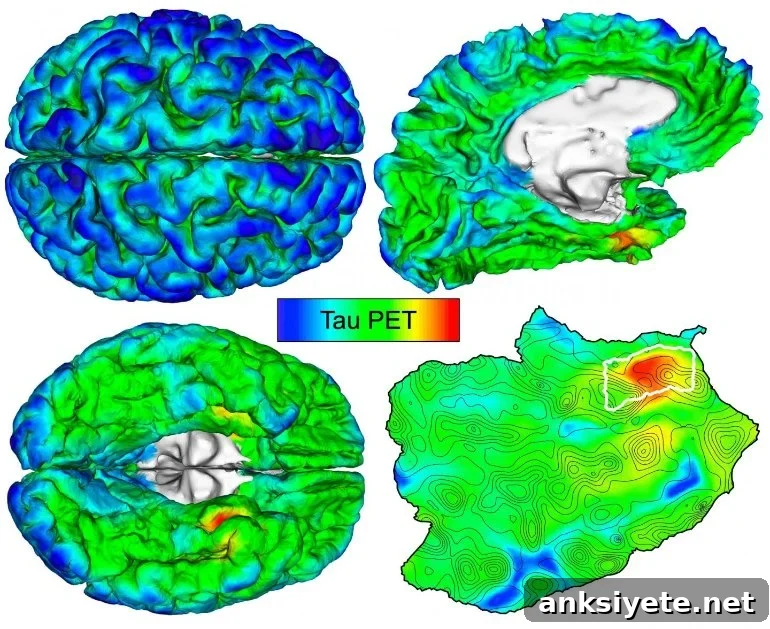
Summary: Researchers have developed an automated imaging method that identifies and follows the earliest tau protein deposits in the brain. This approach may enable earlier detection of Alzheimer’s disease and improve selection for preventive trials.
Source: Mass General
Background: Amyloid-beta and tau are the two main abnormal proteins that accumulate in the brain during the development of Alzheimer’s disease. Detecting their buildup at the earliest stages could allow clinicians to intervene before irreversible brain injury and cognitive decline occur.
A research team led by investigators at Massachusetts General Hospital (MGH) has created an automated technique to detect and monitor harmful tau deposits in individual patients’ brains. Published in Science Translational Medicine, this work points toward a method that could support earlier, more personalized diagnosis and tracking of Alzheimer’s pathology.
Lead author Justin Sanchez, a data analyst at MGH’s Gordon Center for Medical Imaging, notes that many therapeutic attempts may have failed because interventions were applied after the point when brain injury had already become irreversible. The new method aims to identify the very first cortical tau signals so that interventions can be tested and applied at a stage when they are more likely to make a difference.
Under the direction of Keith A. Johnson, MD, of the MGH departments of Radiology and Neurology, the investigators analyzed positron emission tomography (PET) images of amyloid-beta and tau from 443 adults enrolled in several observational studies of aging and Alzheimer’s disease. Participants ranged widely in age and cognitive status, from cognitively normal young adults to older individuals with clinical Alzheimer’s dementia. Using an automated anatomic sampling approach, the team localized the specific brain region in each scan most vulnerable to initial cortical tau accumulation.
The authors hypothesized that pinpointing each person’s unique cortical site of early tau would allow detection of tau emergence in cognitively normal individuals and enable tracking of tau’s spread across the cortex in relation to amyloid-beta burden and cognitive decline. Cortical tau that spreads from its origin into broader neocortical regions—particularly under the influence of amyloid-beta—is thought to be a primary driver of the neurodegenerative process in Alzheimer’s disease.
Their automated method consistently identified the rhinal cortex region in the medial temporal lobe as the most common initial cortical site of tau deposition. Importantly, initial tau signals at this rhinal cortex site appeared in some cognitively normal people without elevated amyloid-beta, with occurrences observed in individuals as young as in their late 50s. From this focal origin, tau then spread to the adjacent temporal neocortex and later to more distant cortical regions as amyloid-beta burden increased.
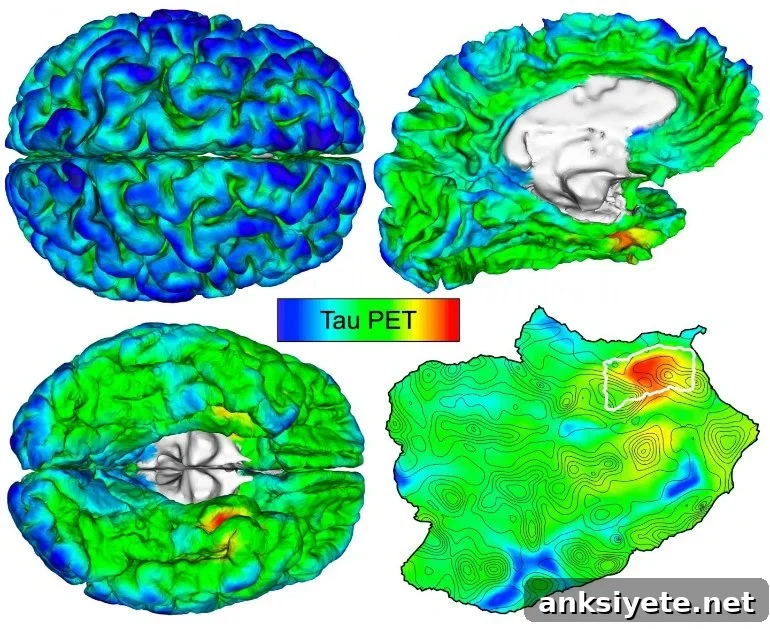
In a longitudinal subset of 104 participants followed for two years, the team found that individuals with higher baseline tau at the identified point of origin experienced the greatest subsequent spread of tau across the brain. This pattern supports the idea that early tau accumulation at a focal cortical site can predict later propagation and risk of neurodegeneration.
The study suggests that PET measurements targeted to precisely defined, individualized brain regions can improve prediction of future tau accumulation and potential progression to symptomatic Alzheimer’s disease. Identifying people at the earliest stage of tau accumulation could enable preventive strategies: treating tau pathology before extensive cortical involvement might prevent or slow cognitive decline.
The authors emphasize the practical value of an automated and individualized imaging method for clinical trials. Such a tool would help select cognitively normal participants who are most vulnerable to impending tau spread, improving trial efficiency and increasing the chances of demonstrating benefit from anti-tau therapies aimed at halting or delaying Alzheimer’s disease progression.
Funding: This research was supported by the National Institutes of Health.
About this Alzheimer’s disease research news
Source: Mass General
Contact: Michael Morrison – Mass General
Image: The image is credited to Justin Sanchez
Original Research: Closed access. “The cortical origin and initial spread of medial temporal tauopathy in Alzheimer’s disease assessed with positron emission tomography” by Justin Sanchez et al., Science Translational Medicine
Abstract
The cortical origin and initial spread of medial temporal tauopathy in Alzheimer’s disease assessed with positron emission tomography
Advances in molecular positron emission tomography (PET) allow precise anatomic tracking of pathological proteins across longitudinal studies of normal aging and dementia. According to a central model of Alzheimer’s disease pathogenesis, tau pathology begins focally in the medial temporal lobe and later expands under the influence of amyloid-beta to mediate neurodegeneration and cognitive decline. Initial tau deposition occurs many years before detectable amyloid-beta accumulation in a specific medial temporal area. Building on recent methods that focus PET measurements on tau-vulnerable temporal lobe anatomy, the researchers applied an automated anatomic sampling technique to quantify tau PET signal in 443 adults from multiple observational cohorts. They detected the earliest cortical emergence of tau near the rhinal sulcus in clinically normal individuals and, in a longitudinal subset (n = 104) with two-year follow-up, tracked amyloid-associated spread of tau from this origin first to adjacent temporal neocortex and then to extratemporal regions. Faster rates of tau spread were associated with higher baseline global amyloid-beta burden and greater medial temporal tau at baseline. These observations align with clinicopathological studies of Alzheimer’s tauopathy and provide a precise imaging framework for natural history studies and prevention-focused therapeutic trials.