
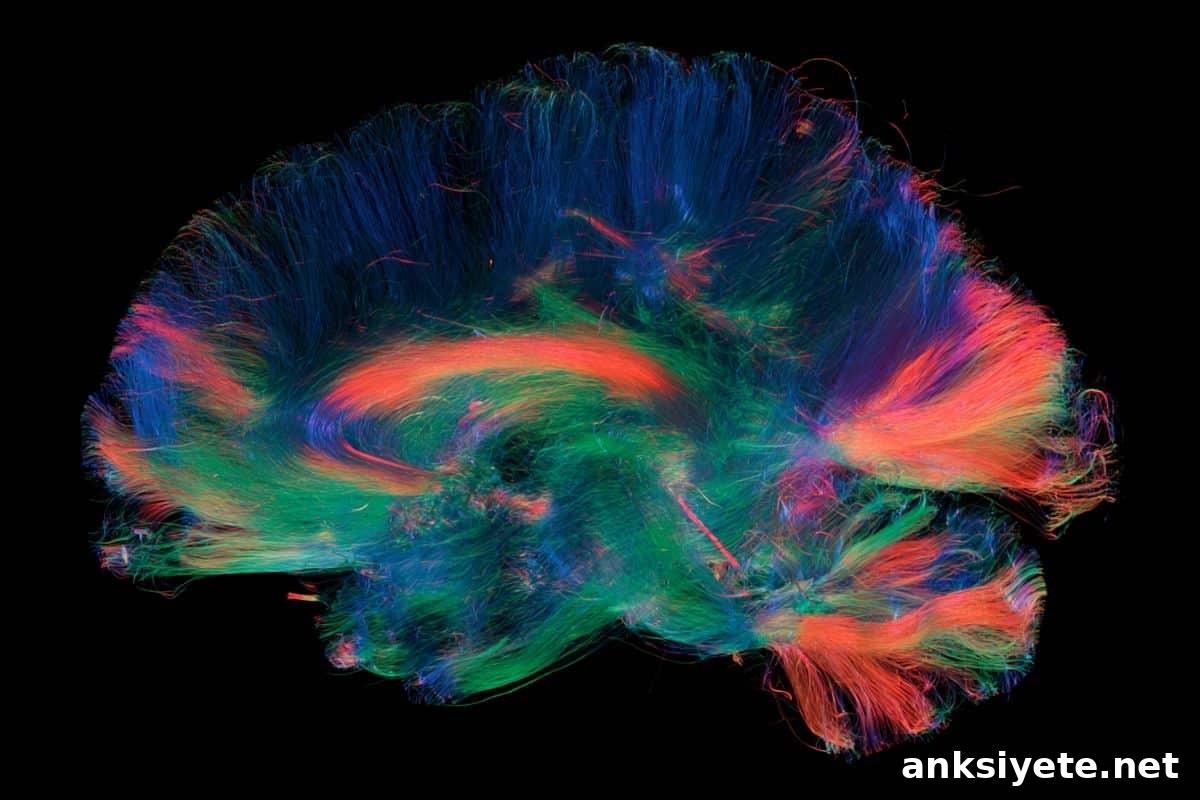
Summary: Researchers have created a biologically grounded whole‑brain computer model that links microscopic molecular chemistry to macroscopic neural activity, demonstrating how regional differences in receptor density influence brain‑wide coordination and information flow.
The team incorporated detailed, empirical maps of muscarinic acetylcholine receptor density across 68 cortical regions into The Virtual Brain (TVB) simulation platform, overlaying these maps on human structural connectome data to simulate brain states from wakefulness to sleep.
Key Facts
- Bridging Molecular and Whole‑Brain Scales: The model connects molecular receptor distributions with large‑scale neural dynamics using an open‑source computational platform.
- Accounting for Receptor Heterogeneity: Rather than assuming uniform receptor density, the model integrates region‑specific maps of muscarinic acetylcholine receptors across 68 cortical areas.
- Improved Regional Coordination and Information Flow: Biologically realistic heterogeneity enhances interareal functional connectivity and information routing during simulated wake and sleep states.
- Spontaneous Localized Slow Waves: The simulations naturally reproduce local sleep‑like slow oscillations in particular cortical regions while neighboring areas remain wake‑like—phenomena observed in sleep deprivation, attentional lapses, and near brain lesions.
- Non‑Uniform Neuromodulatory Effects: The work shows that neuromodulators such as acetylcholine act in a region‑specific manner determined by local receptor architecture, offering a framework for understanding disorders of consciousness and focal injuries.
Source: EBRAINS
Overview: A new computational model of the human cortex links microscopic chemical architecture to whole‑brain activity patterns and demonstrates that spatially structured receptor distributions critically shape how neural activity and information propagate across the brain.
Published in the Proceedings of the National Academy of Sciences (PNAS), the study was developed using The Virtual Brain (TVB), an open‑source whole‑brain simulation platform that forms part of the EBRAINS research infrastructure. The project received support from the EBRAINS 2.0 initiative and The Virtual Brain Twin Project.
“One of the central challenges in neuroscience is understanding how molecular‑level processes influence brain‑wide behaviour,” says Leonardo Dalla Porta, researcher at the Institute of Biomedical Investigations August Pi i Sunyer (IDIBAPS) and first author of the study. “This work provides a concrete example of how we can connect these different scales within a single computational framework.”
Unlike many large‑scale models that treat every cortical region identically, this model incorporates empirical maps of muscarinic acetylcholine receptor density across 68 cortical areas. These maps are combined with the brain’s structural connectome to produce simulations that reflect biologically realistic regional differences.
Across simulated states from full wakefulness to sleep, the receptor‑informed model produced stronger interregional coordination and more efficient information flow than homogeneous models. The researchers show that spatially structured heterogeneity supports more flexible and coordinated brain states and helps explain how the same neuromodulatory signal can induce different dynamics in different cortical areas.
The model also reproduces localized, sleep‑like slow waves appearing in isolated cortical patches while the remainder of the cortex remains in an awake‑like regime. This phenomenon mirrors real‑world observations during attentional lapses, sleep deprivation, and around structural brain injury.
These results underline that neuromodulators do not act uniformly across the cortex: their impact depends on local receptor concentration and distribution. When combined with anatomical connectivity, this receptor heterogeneity helps determine how the brain transitions between wakefulness, sleep, and altered or pathological states.
Key Questions Answered:
A: Traditional whole‑brain models often assume uniform regional behaviour, which overlooks how local molecular architecture shapes dynamics. By integrating empirical muscarinic acetylcholine receptor maps across 68 regions, this model captures how identical neuromodulatory signals produce distinct network responses depending on local receptor density, yielding more accurate and physiologically grounded predictions of whole‑brain activity.
A: Because cortical regions vary in their density of acetylcholine receptors, local sub‑networks can independently enter sleep‑like slow‑wave oscillatory states when neuromodulatory tone changes. The model spontaneously produces these isolated slow waves within an otherwise awake cortex, reproducing patterns observed during attentional lapses, sleep deprivation, and near focal lesions.
A: By linking molecular receptor profiles to large‑scale network dynamics, the framework enables simulation of state transitions relevant to conditions with disrupted consciousness, stroke, traumatic brain injury, and neurodegenerative diseases where neuromodulatory signaling is altered. This approach may inform mechanistic understanding and help generate testable hypotheses for therapeutic strategies.
Editorial Notes:
- This article was edited by a Neuroscience News editor.
- The journal paper was reviewed in full.
- Additional context was added by the editorial staff.
About this neuroscience research news
Author: Helen Mendes Lima
Source: EBRAINS
Contact: Helen Mendes Lima – EBRAINS
Image: Image credit: Neuroscience News
Original Research: Open access. “Spatially structured heterogeneity shapes large‑scale cortical dynamics in a model of the human cortex” by Leonardo Dalla Porta, Jan Fousek, Alain Destexhe, Maria V. Sanchez‑Vives. PNAS. DOI: 10.1073/pnas.2532072123
Abstract
Spatially structured heterogeneity shapes large‑scale cortical dynamics in a model of the human cortex
Biological heterogeneity is a defining feature of brain organization, spanning molecular to anatomical scales. Yet its influence on large‑scale cortical dynamics has been underexplored. This study integrates spatially structured regional heterogeneity derived from muscarinic receptor maps into a biophysically grounded large‑scale cortical model.
We demonstrate that structured heterogeneity enhances network synchronization and information flow, enabling more flexible and coordinated brain states. Additionally, this form of heterogeneity contributes to the spontaneous emergence of localized sleep‑like slow waves within an otherwise awake‑like regime.
These findings indicate that biologically informed intrinsic heterogeneity is an important organizing principle for cortex‑wide communication and state transitions, with implications for understanding neuromodulation, sleep dynamics, and clinical disorders affecting consciousness and local network function.