
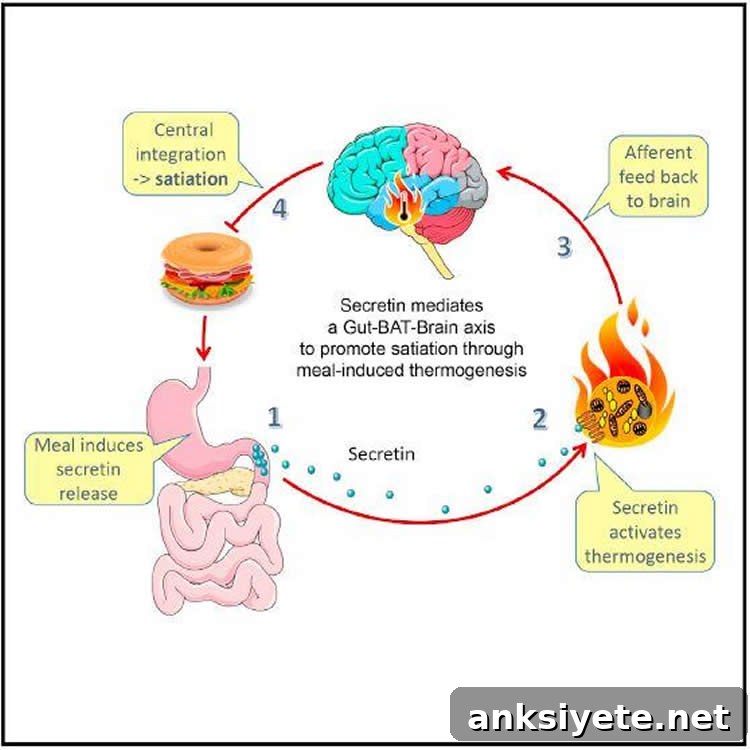
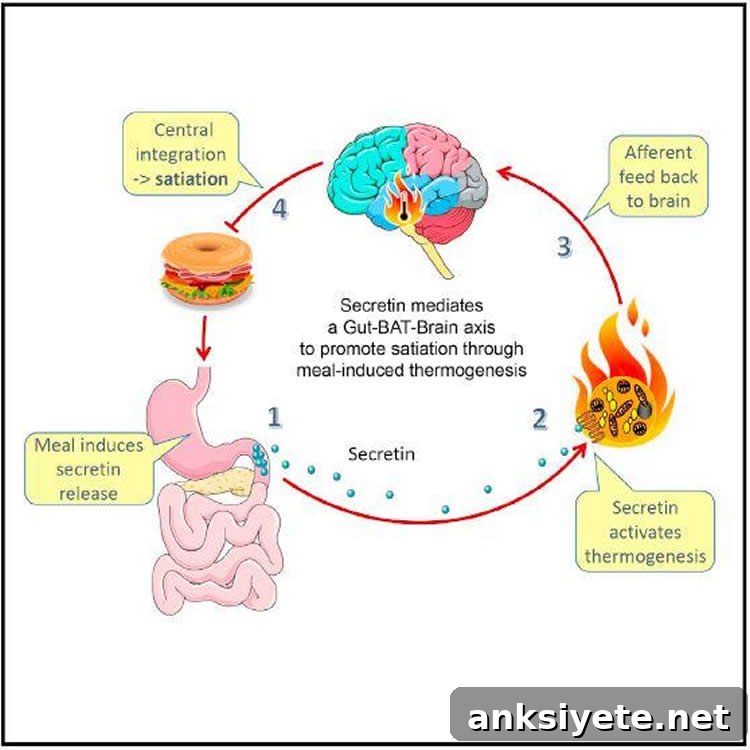
Summary: A new study reports brown fat interacts with secretin, a gut hormone, to signal the feeling of fullness to the brain during a meal.
Source: Cell Press.
Researchers in Germany and Finland report that brown adipose tissue (BAT), commonly known as brown fat, communicates with the gut hormone secretin to signal fullness to the brain in mice. Published November 15 in the journal Cell, the study strengthens evidence that BAT has a functional role in regulating food intake beyond its established role in producing heat.
“We demonstrate a connection between the gut, the brain, and brown tissue, uncovering a previously unknown facet of the complex regulatory system controlling energy balance,” says lead author Martin Klingenspor, chair of molecular nutritional medicine at the Technical University of Munich. “The view of brown fat as a mere heater organ must be revised, and more attention needs to be directed towards its function in the control of hunger and satiation.”
The researchers describe how signals generated during a meal can reach the brain by circulating in the blood or via nerve pathways in the small intestine. Their findings highlight an underappreciated function of secretin, a hormone first discovered in 1902 for its role in stimulating pancreatic bicarbonate secretion to aid digestion. In this study, secretin is shown to act as a key communicator between the gut and brown fat, contributing to the onset of feeling full during eating.
In controlled experiments with hungry mice, injections of secretin led to a clear reduction in appetite. At the same time, secretin increased heat production by brown fat, a process known as thermogenesis. When brown fat function was genetically or experimentally inactivated, secretin injections no longer suppressed food intake. This result suggests that secretin’s appetite-suppressing effect depends on its activation of brown adipose tissue, establishing a functional gut-secretin-BAT-brain axis in mice.
The team extended their observations to humans by measuring secretin and brown fat activity in a group of 17 volunteers. In a Finnish clinical study, investigators assessed brown fat oxygen consumption and fatty acid uptake from blood samples taken after an overnight fast and again 30–40 minutes after a meal. They found that higher postprandial secretin concentrations were associated with more metabolically active brown fat in those subjects, supporting a link between secretin release, BAT activation, and meal-related thermogenesis in humans.
Klingenspor notes that these discoveries could inform future strategies to modulate appetite. “Any stimulus that activates brown fat thermogenesis could potentially induce satiation,” he says. Because secretin secretion responds to nutrients, it may be possible to enhance postprandial secretin release by choosing specific starter foods or nutrients that trigger its secretion, thereby helping to reduce meal size and caloric intake.
The researchers also tested a modified form of human secretin delivered by chronic infusion in diet-induced obese mice. They observed a transient elevation in energy expenditure, indicating that secretin-driven BAT activation can influence whole-body energy balance. In the human subjects, controlled secretin infusions increased glucose uptake in brown fat, providing physiological evidence that secretin can activate BAT metabolic activity in people as well as in rodents.
These findings position brown fat as a more complex regulator of energy balance than previously appreciated. By linking a gut-derived hormone to thermogenic activation of BAT and subsequent signaling to the brain that promotes satiation, the study strengthens the case for exploring BAT-targeted nutritional or pharmacological interventions to combat obesity and metabolic disease.
Funding: This work was supported by the European Research Council (ERC), the Deutsche Forschungsgemeinschaft, and the Else Kröner-Fresenius-Stiftung.
Source: Carly Britton, Cell Press.
Publisher: Organized by NeuroscienceNews.com.
Image Source: Image credited to Li et al. / Cell, 2018.
Original Research: “Secretin-Activated Brown Fat Mediates Prandial Thermogenesis to Induce Satiation” by Yongguo Li et al., published in Cell, November 15, 2018.
doi: 10.1016/j.cell.2018.10.016
MLA: Cell Press. “Gut Hormone and Brown Fat Interact to Tell the Brain It’s Time to Stop Eating.” NeuroscienceNews. 15 November 2018.
APA: Cell Press (2018, November 15). Gut Hormone and Brown Fat Interact to Tell the Brain It’s Time to Stop Eating. NeuroscienceNews. Retrieved November 15, 2018.
Chicago: Cell Press. “Gut Hormone and Brown Fat Interact to Tell the Brain It’s Time to Stop Eating.” NeuroscienceNews, November 15, 2018.
Abstract
Secretin-Activated Brown Fat Mediates Prandial Thermogenesis to Induce Satiation
The molecular mediator and functional significance of meal-associated brown fat thermogenesis were previously unclear. This study identifies the gut hormone secretin as a non-sympathetic activator of BAT that mediates prandial thermogenesis and induces satiation, establishing a gut-secretin-BAT-brain signaling axis in mammals. Mechanistically, meal-associated increases in circulating secretin bind to secretin receptors on brown adipocytes and stimulate lipolysis, activating BAT thermogenesis. The resulting thermogenic signal is sensed in the brain and promotes satiation. Chronic infusion of a modified human secretin transiently increased energy expenditure in diet-induced obese mice, while human clinical data showed that post-meal thermogenesis correlated with circulating secretin and that secretin infusion increased brown fat glucose uptake. These findings underscore an underappreciated role of BAT in controlling satiation and suggest BAT as a promising target for obesity interventions.