
From frogs to humans, choosing a mate can be complex. Females in many species evaluate potential partners using multiple signs of health, stamina or parenting ability, and producing several reliable signals at once can be difficult for males.
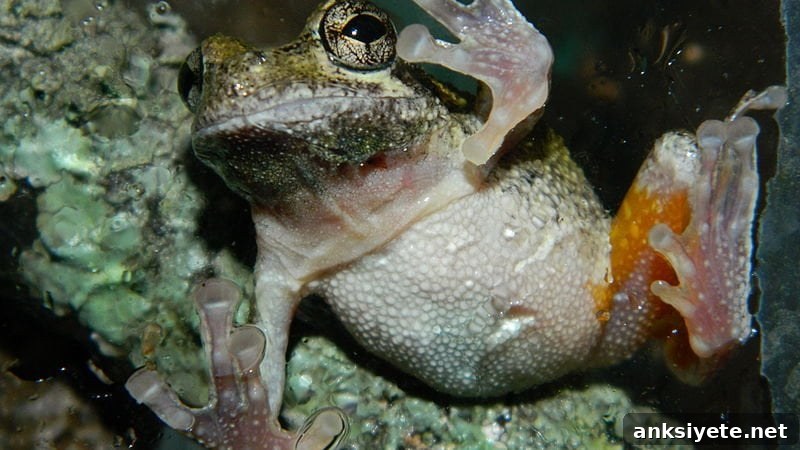
Researchers at the University of Minnesota studied this challenge in Cope’s gray treefrog (Hyla chrysoscelis). In this species, males produce trilled mating calls composed of repeated pulses. Each call typically contains between 20 and 40 pulses and males call between roughly 5 and 15 times per minute. Females show strong preferences, favoring calls that are both longer and more frequent, yet producing long calls and calling often creates a physiological trade-off for males.
The research, published in the August issue of Animal Behavior, tested how female preference operates when a male’s advertisement signal varies in two linked dimensions: call duration and call rate. Jessica Ward, the study’s lead author and a postdoctoral researcher in Mark Bee’s laboratory in the Department of Ecology, Evolution and Behavior, explains the pattern as a form of multitasking: “It’s kind of like singing and dancing at the same time,” she says.
The study evaluated recordings of roughly 1,000 calls and found clear evidence that males are constrained by a trade-off: individuals that produce longer calls generally do so at slower rates. Despite this constraint, females preferred signals that combined both attractive traits—longer call length and higher call rate—highlighting a preference for males that can manage multiple demanding tasks concurrently. The authors interpret this result as support for the multitasking hypothesis in sexual selection, which proposes that the ability to perform several difficult behaviors simultaneously signals high quality in a potential mate.
Behavioral ecologists are increasingly interested in how multiple male signals combine to influence female choice. Rather than focusing on single cues in isolation, the multitasking hypothesis addresses how dynamic signaling along multiple axes—such as duration and frequency—interacts with receiver preferences to shape mating decisions. In Hyla chrysoscelis, the dynamic nature of calling makes this a tractable system for testing how simultaneous signal components affect female behavior in a noisy social environment.
Beyond mate choice, this research connects to broader sensory and communication questions. Mark Bee’s lab investigates how female frogs identify individual calls within large choruses. Discriminating a single voice from many overlapping voices — the so-called “cocktail party” problem — is a challenge for humans and animals alike. In humans, difficulties with separating voices in noisy settings often appear with aging and can be an early sign of hearing decline. Understanding the neural and behavioral strategies frogs use to parse complex acoustic scenes may offer new ideas for improving auditory prostheses and hearing-aid algorithms.
Jessica Ward and colleagues used controlled playback and detailed acoustic analysis to quantify how call traits covary and how female frogs respond to those combinations. Their results demonstrate that female gray treefrogs are not simply additive in their evaluation of signals; instead, preferences can multiply across traits, meaning that males capable of sustaining both long calls and high calling rates gain a pronounced advantage in female choice.
These findings add to a growing literature showing that mate choice can favor individuals that successfully integrate multiple performance tasks, and they illustrate how physiological trade-offs constrain signal production. The study’s approach—combining a large dataset of natural calls with experimental tests of female preference—provides a clear example of how dynamic signaling and receiver choice interact in an ecologically realistic context.
Notes about this behavioral neuroscience research
Contact: Brooke Dillon – University of Minnesota
Source: University of Minnesota press release
Image Source: The Hyla chrysoscelis frog image is credited to Cjarvis42 and is licensed as Creative Commons Attribution-Share Alike 3.0 Unported.
Original Research: “Multitasking males and multiplicative females: dynamic signalling and receiver preferences in Cope’s grey treefrog” by Jessica L. Ward, Elliot K. Love, Alejandro Vélez, Nathan P. Buerkle, Lisa R. O’Bryan and Mark A. Bee. Published online August 2013 in Animal Behavior (doi:10.1016/j.anbehav.2013.05.016).