
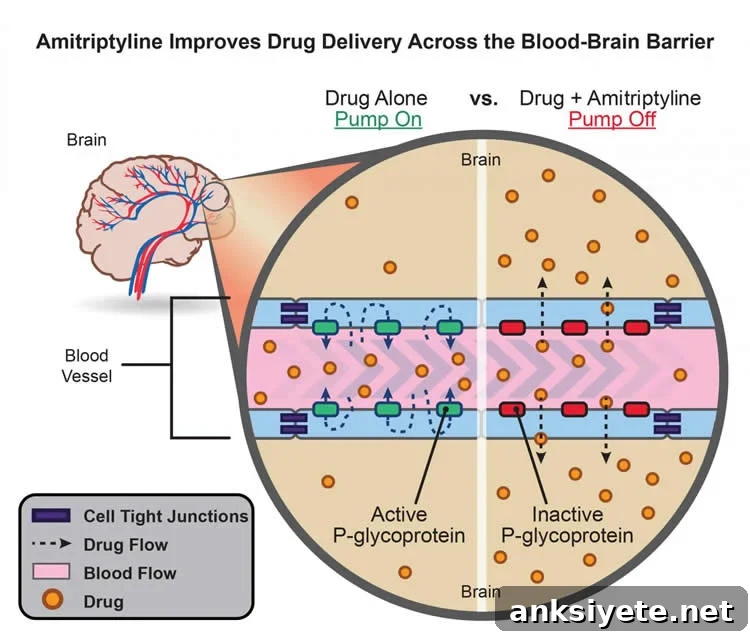
Summary: New NIH research reports that the antidepressant amitriptyline can temporarily reduce activity of the blood–brain barrier’s P‑glycoprotein pump in rats, allowing other drugs to enter the brain. This discovery may affect strategies for treating neurological disorders ranging from epilepsy and stroke to ALS.
Source: NIH/NIEHS.
NIH rat study suggests amitriptyline temporarily inhibits the blood–brain barrier, improving drug access to the brain
Researchers at the National Institutes of Health (NIH) report that administering the tricyclic antidepressant amitriptyline alongside drugs intended to treat central nervous system (CNS) conditions increases those drugs’ access to the brain in rat models by temporarily inhibiting a protective transporter in brain capillaries. The study, conducted in rats, was published online April 27 in the Journal of Cerebral Blood Flow and Metabolism.
The blood–brain barrier (BBB) protects the brain by selectively restricting entry of many substances, but that protection also prevents potentially beneficial therapies from reaching neural tissue. A key component of this selective barrier is the ATP‑binding cassette transporter P‑glycoprotein, which is located on the inner lining of brain blood vessels and actively pumps a wide range of foreign molecules back into the bloodstream before they cross into the brain.
Lead investigators at the NIH’s National Institute of Environmental Health Sciences (NIEHS) compared the effect of amitriptyline on P‑glycoprotein activity in normal (wild‑type) rat brain capillaries and in capillaries from a transgenic rat model that mimics human amyotrophic lateral sclerosis (ALS). In both settings, amitriptyline reduced P‑glycoprotein pump activity rapidly—within 10–15 minutes—and this effect was reversible when the drug was removed.
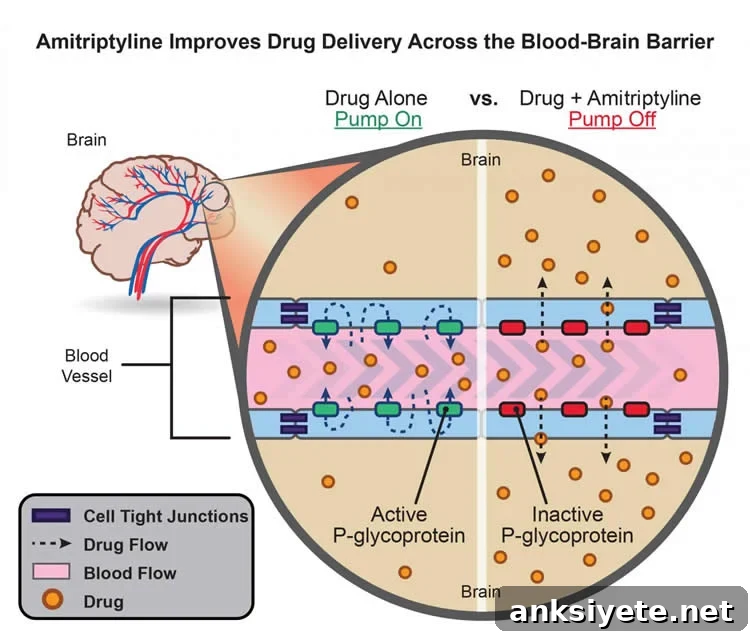
Ronald Cannon, Ph.D., a staff scientist at NIEHS, described P‑glycoprotein as the brain’s “doorman,” protecting neural tissue by sending many foreign molecules back into circulation. While that action shields the brain from toxins, it also keeps out therapeutic agents designed to treat CNS disorders. By transiently inhibiting the transporter, amitriptyline may allow lower doses of co‑administered drugs to reach the brain more effectively.
David Banks, an NIEHS postbaccalaureate fellow and lead author of the paper, emphasized the rapid onset and reversibility of amitriptyline’s effect on P‑glycoprotein as particularly attractive features for clinical translation. The research team cautions, however, that further studies are needed to determine safety, optimal dosing, and whether the approach translates from rats to humans.
The investigators suggest several potential clinical applications. For example, co‑administration of amitriptyline with an opioid might permit effective pain control with lower opioid doses, potentially reducing side effects and risks associated with higher doses, such as constipation and addiction. More broadly, the strategy could be explored to improve delivery of therapies for epilepsy, stroke, ALS, depression, and other CNS diseases where impaired drug penetration contributes to treatment challenges.
The findings have prompted the filing of a provisional patent application covering methods of co‑administering amitriptyline with central nervous system drugs. NIEHS Director Linda Birnbaum, Ph.D., noted that as the country faces growing burdens from neurological disease and opioid misuse, approaches that enhance targeted delivery of therapeutics to the brain may offer new options for patients and clinicians.
Funding: The study was supported by the NIH/National Institute of Environmental Health Sciences.
Source: Robin Arnette — NIH/NIEHS
Image Source: Image credited to NIEHS.
Original Research: Banks DB, Chan GNY, Evans RA, Miller DS, Cannon RE. “Lysophosphatidic acid and amitriptyline signal through LPA1R to reduce P‑glycoprotein transport at the blood–brain barrier.” Journal of Cerebral Blood Flow and Metabolism. Published online April 27, 2017. doi:10.1177/0271678X17705786
MLA: NIH/NIEHS. “Antidepressants May Enhance Drug Delivery to Brain.” Neuroscience News. 27 April 2017.
APA: NIH/NIEHS (2017, April 27). Antidepressants May Enhance Drug Delivery to Brain. Neuroscience News.
Chicago: NIH/NIEHS. “Antidepressants May Enhance Drug Delivery to Brain.” Neuroscience News. April 27, 2017.
Abstract
Lysophosphatidic acid and amitriptyline signal through LPA1R to reduce P‑glycoprotein transport at the blood–brain barrier
The blood–brain barrier (BBB) protects the brain from metabolic and environmental toxins while also limiting therapeutic access to the central nervous system. P‑glycoprotein, an ATP‑binding cassette transporter expressed in brain capillaries, actively removes many clinical substrates from the capillary lumen back into circulation, reducing their penetration into the brain parenchyma. This study identifies a signaling mechanism by which the bioactive lipid lysophosphatidic acid (LPA) and the tricyclic antidepressant amitriptyline reduce basal and induced P‑glycoprotein transport activity in intact rat brain capillaries. The effect occurs through the lysophosphatidic acid 1 receptor (LPA1R) and involves G‑protein coupling, Src kinase, and ERK1/2 signaling. The same mechanism decreased P‑glycoprotein activity in a human SOD1 transgenic rat model of ALS. These findings suggest a potential strategy to transiently lower BBB efflux and increase cerebral penetration of therapeutics in CNS disorders characterized by pharmacoresistance.