
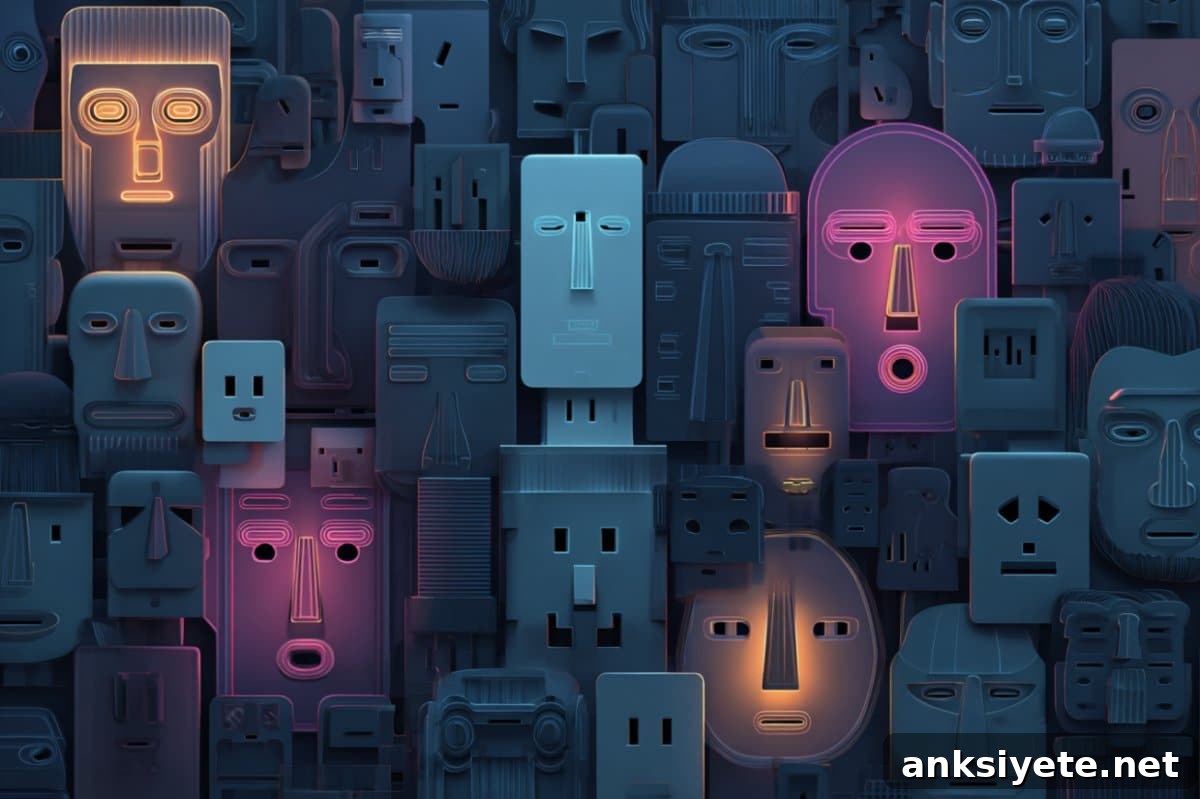
Summary: Seeing faces in everyday objects—known as face pareidolia—provokes a strong attentional response, a new study finds. Researchers compared how people respond to real averted gazes versus imagined gazes created by face-like objects and discovered that both types of cues attract attention, but they do so through different perceptual mechanisms.
Real faces guide attention using specific local cues such as eye orientation, whereas pareidolic, face-like configurations engage broader, global processing of the object’s overall structure. Interestingly, the study found that face-like objects can evoke an even stronger attentional effect than real averted gazes, a finding with potential applications for visual design and advertising.
Key Facts:
- Pareidolia captures attention: Objects that appear face-like can draw observers’ attention more robustly than averted gazes from real faces.
- Distinct mechanisms: Averted gazes rely on local features—especially eye direction—while face-like objects leverage their global configuration and the placement of eye-like elements.
- Practical potential: Designers and advertisers might use face-like patterns to increase visual engagement and memorability of products.
Source: University of Surrey
Introduction
If you have ever glanced at a cloud, a socket, or a coffee machine and briefly perceived a face, you have experienced face pareidolia. This common perceptual phenomenon prompts the brain to register face-like patterns in inanimate objects. Researchers at the University of Surrey set out to measure how such perceptions guide visual attention compared with genuine averted gazes from human faces.
Published in i-Perception, the study used a standard gaze cueing paradigm to compare attentional shifts produced by two stimulus types: real faces with averted gaze and objects that evoke face pareidolia. The goal was to identify both shared effects and the different underlying processes that lead observers to shift their attention in response to these cues.
Methodology in brief
Across four gaze cueing experiments, the researchers tested 54 participants. In each experiment, observers responded to targets appearing after brief presentations of either averted faces or face-like objects. The gaze cueing task measured how quickly and reliably attention moved in the cued direction, allowing comparison of the magnitude and timing of attentional shifts for the two stimulus categories.
Findings
Participants consistently shifted attention in response to both averted gazes and face-like objects. However, the processes driving that response differed. Real faces directed attention primarily through local, feature-based processing—most notably by the direction of the eyes. In contrast, face-like objects prompted attention through a holistic assessment of the object’s global configuration, where the arrangement of eye-like elements within the overall shape was the key factor.
Crucially, the study reports that face-like objects often produced a stronger attentional effect than averted gazes. The authors suggest that when the brain detects a plausible facial arrangement in an object, it rapidly recruits face-processing systems using global shape cues, which can amplify attentional orienting beyond what is driven by local gaze cues alone.
Interpretation and implications
These results deepen our understanding of visual perception by showing that the brain can use different routes to orient attention toward socially relevant cues—either by analyzing fine-grained facial features or by recognizing a face-like gestalt. The pronounced attentional pull of pareidolic stimuli highlights the sensitivity of human perception to face-like patterns, even in the absence of actual faces.
From a practical standpoint, the findings offer useful guidance for visual communication, product design, and advertising. Incorporating subtle face-like arrangements or prominent eye-like elements into packaging, displays, or digital content may increase the likelihood of capturing viewer attention and leaving a memorable impression without relying on explicit human imagery.
About this visual perception and pareidolia research news
Author: Melanie Battolla
Source: University of Surrey
Contact: Melanie Battolla – University of Surrey
Image: Image credited to Neuroscience News
Original Research: Open access. “How face-like objects and averted gaze faces orient our attention: The role of global configuration and local features” by Di Fu et al., i-Perception. DOI: 10.1177/20416695251352129
Abstract (summary)
Face pareidolia occurs when observers perceive non-existent faces in inanimate objects. Both face-like objects and averted gaze faces can orient attention, but they do so via distinct mechanisms. Using a gaze cueing task, this study compared cueing effects of the two stimulus types and found commonalities in their capacity to shift attention alongside clear differences in processing: averted gaze faces depend on local features such as eye direction, whereas face-like objects capitalize on global configuration to enhance attentional shifts via eye-like elements. These findings advance understanding of how the brain represents facial attributes even in the absence of physical facial stimuli and provide a theoretical basis for future research and applied uses of face-like stimuli in perception and attention.