
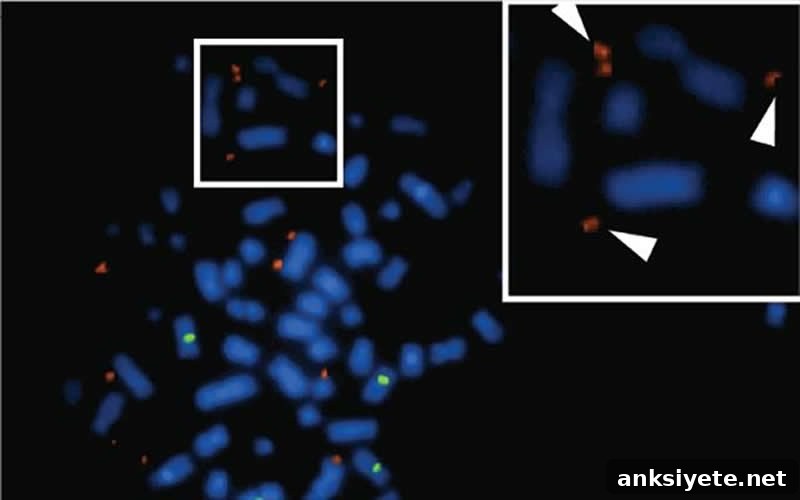
Summary: Extra copies of DNA carried with amplified oncogenes are essential for sustaining oncogene activation and enabling cancer cell survival.
Source: UCSD
Researchers have found that one way an oncogene gains the power to transform a normal cell into a cancer cell is by copying itself repeatedly. These amplified oncogene copies often include additional stretches of non-coding DNA, but until now it was unclear whether that extra DNA plays an active role in driving cancer or is simply incidental.
A team from the University of California San Diego School of Medicine and Case Western Reserve University School of Medicine examined human glioblastoma tumor samples and demonstrated that the non-coding DNA co-amplified with oncogenes is critical for maintaining oncogene activity and for tumor cell fitness. By comparing their results to a public database of tumor genomes, the researchers also showed that the specific non-coding regulatory elements included with amplified oncogenes can vary between tumor types, even when the same oncogene is involved.
The findings, published November 21, 2019 in Cell, provide insight into why targeted therapies against an oncogene sometimes work in one cancer type but fail in another.
“We have been focusing on targeting the oncogene itself, but this study shows we also need to consider the regulatory switches that travel with it,” said co-senior author Peter Scacheri, PhD, Gertrude Donnelly Hess Professor of Oncology at Case Western Reserve University School of Medicine and member of the Case Comprehensive Cancer Center.
Following the sequencing of the human genome, researchers learned that much of our DNA is non-coding. These non-coding regions include regulatory elements such as enhancers that control when and how strongly protein-coding genes are expressed.
In this study the investigators focused on EGFR, an oncogene that is often amplified and highly active in glioblastoma, a particularly aggressive brain tumor, as well as in several other cancer types. In tumors, EGFR copies frequently exist on circular DNA molecules that are separate from normal chromosomes—so-called extrachromosomal DNA.
“I led the first clinical trial testing a small-molecule EGFR inhibitor in glioblastoma back in 2004,” said co-senior author Jeremy Rich, MD, professor of medicine at UC San Diego School of Medicine and director of neuro-oncology at UC San Diego Health. “That trial failed, and years later we are still trying to understand why tumors that clearly rely on this gene do not respond to EGFR inhibitors.”
The researchers analyzed EGFR-containing circular DNA from 9 of 44 glioblastoma tumor samples donated by patients during surgery. They found that each circle could include dozens of enhancers and other regulatory sequences—often 20 to 50 distinct elements. Some of these regulatory elements were located adjacent to EGFR in the normal genome, while others had been recruited from distant genomic regions.
To test the importance of the extra regulatory sequences, the team silenced individual enhancers and regulatory elements on the extrachromosomal EGFR amplicons. The experiments showed that nearly every element they targeted contributed to tumor cell growth and survival.
“It appears the oncogene gathers as many switches as it can find, co-opting their normal regulatory roles to maximize its own expression,” Scacheri said.
First author Andrew Morton, a graduate student in Scacheri’s lab, then examined more than 4,500 patient tumor records spanning nine cancer types from a public cancer genomics database. He observed that co-amplification of enhancers with oncogenes is a widespread phenomenon. Examples include MYC amplifications in medulloblastoma and MYCN amplifications in neuroblastoma and Wilms tumor, where regulatory sequences are similarly recruited alongside oncogene copies.
“The field has been highly gene-centric, assuming that sheer copy number explains oncogene hyperactivity,” Morton said. “When you look at the non-coding genome, a different picture emerges—enhancers and regulatory architecture matter.”
The authors propose that the variety of enhancers found on extrachromosomal oncogene amplifications could influence how tumors evolve and develop resistance to chemotherapy. They also suggest that drugs targeting these regulatory elements or the molecular machinery that activates them might offer a complementary approach to direct oncogene inhibitors.
“This discovery has direct clinical relevance,” said Rich, who is also affiliated with the Sanford Consortium for Regenerative Medicine and the Sanford Stem Cell Clinical Center at UC San Diego Health. “Understanding the regulatory dependencies that shape oncogene amplification gives us new angles to consider for therapy.”
Additional study co-authors include: Nergiz Dogan-Artun, Princess Margaret Cancer Centre, University Health Network; Zachary J. Faber, Cynthia F. Bartels, Kevin C. Allan, Case Western Reserve University; Graham MacLeod, Stephane Angers, University of Toronto; Megan S. Piazza, Shashirekha Shetty, University Hospitals, Cleveland; Stephen C. Mack, Baylor College of Medicine; Xiuxing Wang, Qiulian Wu, UC San Diego; Ryan C. Gimple, UC San Diego and Case Western Reserve University; Brian P. Rubin, Cleveland Clinic; Peter B. Dirks, The Hospital for Sick Children, Ontario Institute for Cancer Research; Richard C. Sallari, Axiotl, Inc.; Mathieu Lupien, Princess Margaret Cancer Centre, University Health Network, Ontario Institute for Cancer Research, University of Toronto.
Source:
UCSD
Media Contacts:
Heather Buschman – UCSD
Image Source:
The image is credited to Case Western Reserve.
Original Research: Closed access
“Functional Enhancers Shape Extrachromosomal Oncogene Amplifications”, Peter Scacheri et al., published in Cell. DOI: 10.1016/j.cell.2019.10.039.
Abstract
Functional Enhancers Shape Extrachromosomal Oncogene Amplifications
Highlights
• Enhancers active in the cell of origin are co-amplified with oncogenes
• Circular extrachromosomal amplicons are associated with enhancer rewiring
• Endogenous and new enhancers on amplicons contribute to cell proliferation
• Biased co-amplification that selects functional enhancers is observed across several tumor types
Summary
Non-coding DNA amplified alongside oncogenes has often been overlooked. Using computational analyses across multiple cancer types, the study identifies significant co-amplification of non-coding regulatory DNA beyond the borders of amplified oncogenes. In glioblastoma, EGFR is preferentially co-amplified with its endogenous enhancers that are active in the tumor’s cell of origin. These regulatory elements, their interactions, and their contributions to cell fitness are maintained on high-level circular extrachromosomal DNA amplifications. A CRISPR interference screen reveals a wide range of additional elements on the amplicons that affect tumor cell fitness. The observed fitness dependencies reflect rearrangements of regulatory sequences and accompanying changes in chromatin topology on extrachromosomal amplicons. Together, these results suggest that oncogene amplifications are shaped by regulatory dependencies in the non-coding genome.