
University of Leicester researchers reveal how inositol phosphates activate HDAC-containing gene regulatory complexes
New findings from the University of Leicester shed light on how small signaling molecules called inositol phosphates control the activity of large gene regulatory complexes. The discovery refines our understanding of histone deacetylase (HDAC) regulation and may guide development of more selective therapies for diseases such as cancer and Alzheimer’s disease.
Led by Professor John Schwabe in the Department of Molecular and Cell Biology, the interdisciplinary team studied co-repressor complexes — multi-protein assemblies that suppress gene expression. These complexes include class I HDAC enzymes (HDAC1, HDAC2 and HDAC3), which remodel chromatin by removing acetyl groups from histone proteins and thereby change how DNA is packaged and read.
HDAC dysfunction is implicated in a range of conditions, from hematological malignancies to neurodegenerative disorders. Several HDAC inhibitors are already used clinically for certain lymphomas and myelomas, but improving specificity and reducing side effects requires a deeper knowledge of how HDACs are regulated within their native co-repressor complexes.
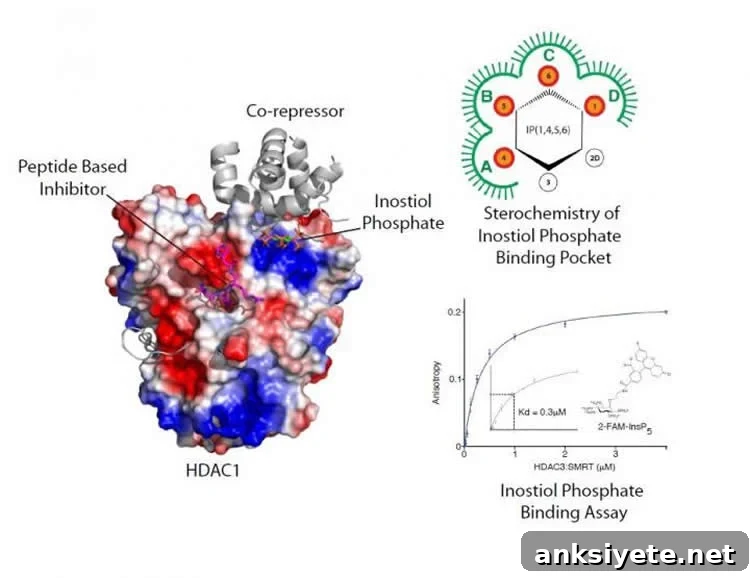
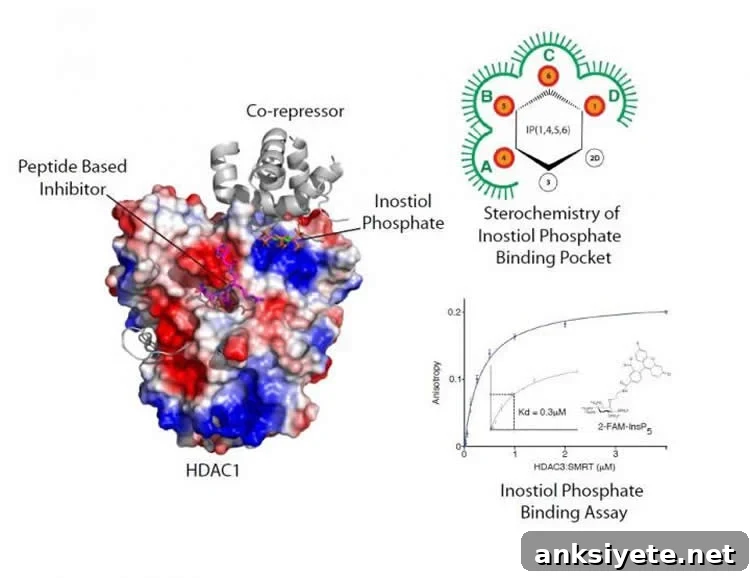
In the study published in Nature Communications, the researchers combined structural biology, chemistry and biochemistry to define how inositol phosphates activate HDACs inside co-repressor assemblies. They designed and synthesized new peptide-based inhibitor tools, mapped critical chemical features of inositol phosphate binding, and determined high-resolution crystal structures that reveal how substrate and regulator interact with the enzyme complex.
Working with collaborators in the University of Leicester’s Department of Chemistry and researchers at the University of Bath, the team produced a panel of chemically tailored probe compounds. These allowed them to interrogate how different inositol phosphate variants and peptide substrates bind to co-repressor complexes and to measure effects on enzyme activity.
The researchers defined stereochemical requirements for activation by inositol phosphates, showing that three adjacent phosphate groups on the inositol ring are essential for activating HDAC catalytic function, while other positions on the ring tolerate bulkier modifications. This helped explain which molecular features enable inositol phosphates to act as cofactor-like activators rather than merely occupying the binding pocket.
Crucially, the crystal structure of HDAC1 in complex with the co-repressor MTA1, a novel peptide-based inhibitor and inositol hexaphosphate provided a direct view of substrate recognition. The structure reveals an allosteric link between the inositol-binding pocket and the enzyme active site, suggesting that binding at the regulatory site shifts the conformation and dynamics of the active site to enhance catalysis. The authors interpret this as an entropically driven allosteric activation mechanism.
These results clarify how inositol phosphates act as molecular switches that tune HDAC activity within transcriptional repression complexes. By identifying the precise chemical and structural determinants of binding and activation, the work provides a stronger mechanistic foundation for designing next-generation HDAC modulators that operate with greater precision and fewer off-target effects.
Professor Schwabe commented that the research represents a successful interdisciplinary collaboration across structural biology, synthetic chemistry and enzymology. The chemical tools developed during the project were instrumental in mapping the activation mechanism and revealing how substrate interaction is coordinated with regulatory binding.
Funding: This study was supported by the Wellcome Trust and the Biotechnology and Biological Sciences Research Council (BBSRC).
Source: Professor John Schwabe, University of Leicester.
Image credit: University of Leicester.
Original research: The findings are reported in the open-access article “Insights into the activation mechanism of class I HDAC complexes by inositol phosphates” published in Nature Communications (Peter J. Watson et al.).
Abstract
Insights into the activation mechanism of class I HDAC complexes by inositol phosphates
Class I HDACs (HDAC1, HDAC2 and HDAC3) form the catalytic centers of multiple transcriptional repression complexes. Unexpectedly, enzyme activity in these complexes is regulated by inositol phosphates that bind in a pocket between HDAC and co-repressor subunits. To clarify the activation mechanism, the authors defined stereochemical requirements for binding and activity, demonstrating that activation requires three adjacent phosphate groups on the inositol ring while other positions tolerate bulky substituents. They provide biochemical evidence of allosteric communication between the inositol-binding pocket and the active site. The crystal structure of the HDAC1:MTA1 complex bound to a novel peptide inhibitor and to inositol hexaphosphate offers a molecular model for substrate recognition and supports an entropically driven allosteric activation mechanism.