Summary: Patterns of brain activity measured in infancy can forecast autism-related symptoms at 18 months. Infants who later exhibited higher autism symptoms showed reduced connectivity among frontal brain regions and increased connectivity across right-hemisphere temporoparietal areas involved in social information processing.
Source: Elsevier
Autism spectrum disorder (ASD) is often not diagnosed until behavioral symptoms become evident, typically in toddlerhood or later. Growing evidence indicates that atypical brain development begins much earlier. Detecting neural signs of ASD in infancy could make timely monitoring and intervention possible, potentially improving long-term developmental outcomes.
A team at the University of California, Los Angeles (UCLA), led by Shafali Jeste, MD, reports brain activity patterns in 3-month-old infants that predicted autism symptoms measured at 18 months. The study appears in Biological Psychiatry: Cognitive Neuroscience and Neuroimaging.
“Early identification and intervention are critical for improving outcomes for children with neurodevelopmental disorders,” said Cameron Carter, MD, Editor of Biological Psychiatry: Cognitive Neuroscience and Neuroimaging. “This study suggests that affordable, widely available tools such as electroencephalography (EEG) may help identify atypical neural development in infancy, at a stage when interventions might be most effective.”
The researchers used electroencephalography (EEG), a safe, noninvasive method that records electrical activity from the scalp. They focused on neural synchrony in the alpha frequency range (6–12 Hz), a band associated with long-range brain connectivity. To capture whole-brain patterns, the team applied multivariate analysis that integrated connectivity measures across regions.
First author Abigail Dickinson, PhD, explained, “A key feature of brain maturation is changing patterns of neural activity. We asked whether EEG-based connectivity metrics at three months could reveal atypical trajectories linked to later ASD symptoms.”
The study enrolled 65 infants who underwent spontaneous EEG recordings at 3 months: 29 infants with low familial likelihood for ASD and 36 infants at higher familial likelihood because they had an older sibling with ASD. When the children reached 18 months, trained clinicians assessed them for autism-related symptoms.
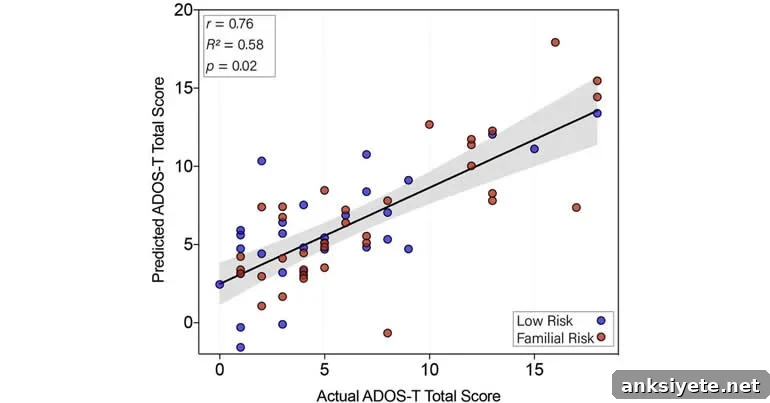
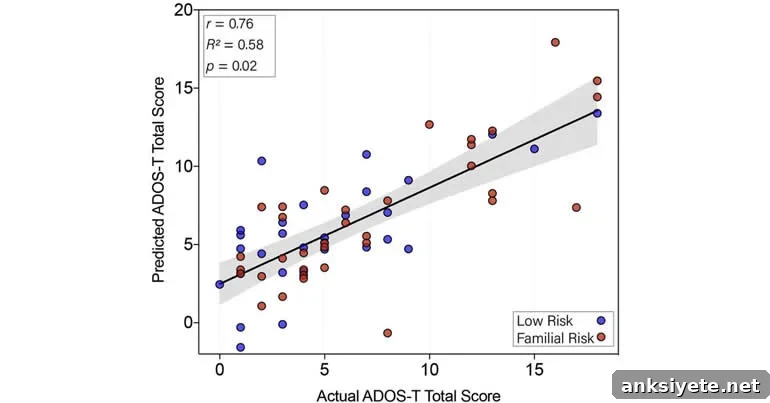
Using a machine-learning approach (support vector regression), the investigators trained a model on the 3-month EEG connectivity patterns to predict scores on the Autism Diagnostic Observation Schedule–Toddler Module (ADOS-T) at 18 months. The model’s predicted ADOS-T scores correlated strongly with the clinicians’ measured scores, indicating that early neural patterns were meaningfully related to later autism symptoms. The same EEG-based model did not predict general cognitive outcomes at 18 months, which suggests the connectivity signature may be relatively specific to ASD symptoms rather than reflecting broader cognitive development.
The specific neural profile linked to higher ASD symptoms included reduced connectivity among frontal regions at three months and increased connectivity across temporoparietal regions in the right hemisphere—areas involved in social perception and information processing. These early differences in connectivity emerged well before behavioral diagnoses are typically made, supporting the idea that disrupted network organization is an early feature of ASD rather than solely a result of later behavioral changes.
Dr. Dickinson noted that these results help clarify which brain networks show the earliest signs of disruption in infants who later develop autism symptoms. Because EEG is low-cost, portable, and well tolerated by infants, the authors propose it could be a practical screening tool to identify babies who may benefit from closer monitoring or early support services. Mapping early neural risk markers could allow clinicians and families to pursue targeted interventions during a sensitive window of brain development.
About this autism research article
Source:
Elsevier
Contacts:
Rhiannon Bugno – Elsevier
Image Source:
The image is credited to Society of Biological Psychiatry, Elsevier.
Original Research: Closed access
“Multivariate neural connectivity patterns in early infancy predict later autism symptoms” by Abigail Dickinson, Manjari Daniel, Andrew Marin, Bilwaj Gaonkar, Mirella Dapretto, Nicole McDonald, Shafali Jeste. Biological Psychiatry: Cognitive Neuroscience and Neuroimaging.
Abstract
Multivariate neural connectivity patterns in early infancy predict later autism symptoms
Background
Functional brain connectivity differs in older children and adults with autism spectrum disorder (ASD). If similar disruptions are detectable during infancy, they could serve as early markers and create opportunities for earlier intervention. Using a whole-brain, data-driven approach, this study tested whether EEG measures of neural connectivity at three months predict autism symptoms at 18 months.
Methods
Spontaneous EEG recordings were collected from 65 infants with and without familial risk for ASD at three months of age. Neural connectivity was quantified by measuring phase coherence in the alpha band (6–12 Hz). Support vector regression was applied to predict ASD symptoms at 18 months, with outcomes based on the Toddler Module of the Autism Diagnostic Observation Schedule, Second Edition (ADOS-T).
Results
Predicted ADOS-T scores based on the three-month EEG data correlated strongly with ADOS-T scores measured at 18 months (r = .76, p = .02, root-mean-square error = 2.38). Specifically, lower frontal connectivity and higher right temporoparietal connectivity at three months predicted higher autism symptoms at 18 months. The model did not predict cognitive ability at 18 months (r = .15, p = .36), suggesting that these connectivity patterns are more closely related to ASD-specific symptoms than to general cognitive development.
Conclusions
An unbiased, multivariate analysis revealed that neural connectivity patterns across frontal and temporoparietal regions at three months of age predicted autism symptoms at 18 months. Identifying such early neural differences could support closer monitoring of infants at risk and provide a valuable window for early intervention efforts aimed at improving developmental trajectories.