
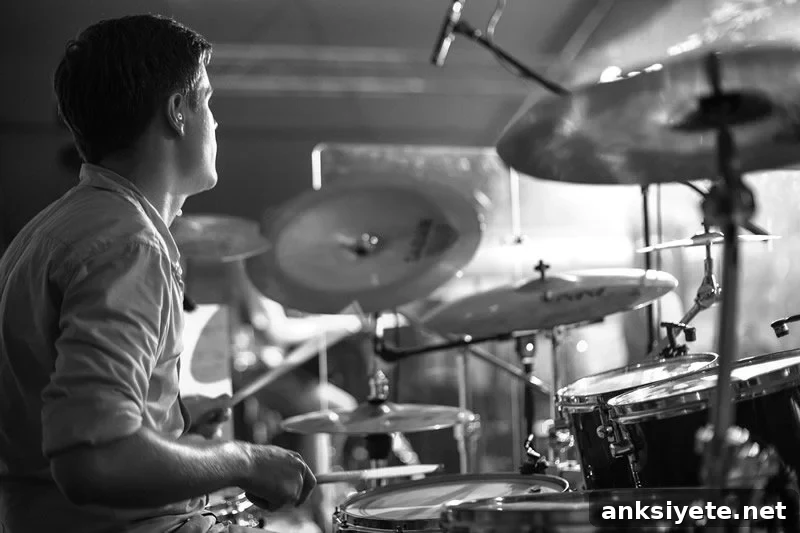
Summary: Long-term drummers show greater microstructural diffusion in the corpus callosum—the brain’s main bridge between the two hemispheres—an area crucial for coordinated motor planning and interhemispheric communication.
Source: RUB (Ruhr-Universität Bochum)
People who play drums regularly for many years differ from nonmusicians in both brain structure and function. A magnetic resonance imaging (MRI) study conducted by a team at Ruhr-Universität Bochum led by Dr. Lara Schlaffke (Bergmannsheil University Hospital) and Associate Professor Dr. Sebastian Ocklenburg (Biopsychology Research Unit) found that professional drummers tend to have fewer but thicker nerve fibres in the anterior part of the corpus callosum. In addition, their motor brain regions appear to operate more efficiently during motor tasks. These findings were published in the journal Brain and Behavior on 4 December 2019.
Why drummers were studied separately
Musical training is known to drive neuroplastic changes in the brain, but drummers have not been specifically examined in detail before. The Bochum researchers targeted this group because drummers routinely demonstrate exceptional motor coordination between the limbs. Most untrained individuals can manage fine motor tasks primarily with one hand and struggle to execute independent, simultaneous rhythms with both hands. Professional drummers, by contrast, routinely perform complex, independent limb movements that most people cannot do without long-term training.
Study design: drumming followed by brain imaging
To identify how extensive drumming practice changes brain organization, the researchers recruited 20 professional drummers with an average of 17 years of experience who currently practice more than ten hours per week. The drummers were compared with 24 nonmusical control participants. Both groups completed a drumming performance test to assess motor ability, then underwent a series of MRI scans using complementary imaging techniques to examine structural, functional, and biochemical brain measures. This multimodal approach allowed the team to link behaviour (drumming performance) with anatomical and functional neural markers.
Key findings: corpus callosum and motor efficiency
Compared with controls, drummers showed distinct microstructural differences in the anterior corpus callosum—the region that facilitates motor planning and coordination between hemispheres. Imaging results suggest that drummers have a lower number of fibres but with larger average thickness in this tract, a configuration that may support faster and more effective interhemispheric communication. Importantly, measures of fibre thickness in the corpus callosum correlated with drumming skill: participants with larger fibre-thickness metrics tended to perform better on the drumming tasks.
Functionally, drummers exhibited reduced activation in primary motor cortex regions during a finger-tapping task relative to controls. This lower level of activation is consistent with a more efficient or refined neural organization, a phenomenon often described as sparse sampling—professionals achieve equal or better performance using less cortical activation, reflecting optimized motor processing.
Implications and future directions
The study supports the idea that long-term, specialized motor practice leads to structural and functional reorganization of brain circuits involved in motor control. In drummers, a stronger relationship emerged between commissural structure (corpus callosum properties), biochemical markers tied to motor inhibition, and performance, suggesting an integrated adaptation across anatomy, chemistry, and function. The research team notes the value of recruiting older and more diverse participants in future studies to track how these adaptations evolve across the lifespan and with varying amounts of practice.
“We are grateful to our highly motivated participants,” said Lara Schlaffke. “Working with them was an enjoyable and informative experience.”
Source:
RUB (Ruhr-Universität Bochum)
Media contacts:
Lara Schlaffke – RUB
Image source:
The image is in the public domain.
Original research (open access):
“Boom Chack Boom — A multimethod investigation of motor inhibition in professional drummers.” Lara Schlaffke, Sarah Friedrich, Martin Tegenthoff, Onur Güntürkün, Erhan Genç, Sebastian Ocklenburg. Published in Brain and Behavior. DOI: 10.1002/brb3.1490
Abstract (summary)
Introduction
Human hand use is a primary mode of interaction with the environment and is represented asymmetrically in the brain. While many people can perform simple bimanual tasks, very few can execute complex, independent fine motor sequences with both hands at similar proficiency. Professional drummers present a unique population for studying this capacity because they routinely perform intricate, independent limb movements with a high degree of precision.
Methods
This study used a multimethod neuroimaging protocol to examine structural, functional, and biochemical correlates of fine motor behaviour in professional drummers (n = 20) versus nonmusical control participants (n = 24).
Results
Drummers displayed higher microstructural diffusion measures in the corpus callosum than controls. These microstructural parameters predicted drumming performance and were associated with GABA levels in motor cortex. In addition, drummers showed reduced motor cortex activation during a finger-tapping task, consistent with greater processing efficiency.
Conclusion
Professional drumming is associated with more efficient neuronal design in cortical motor areas and a stronger relationship between commissural brain structure and biochemical markers of motor inhibition.