
Summary: Researchers at MIT report that the synaptic protein CPG2 is markedly reduced in the brains of people with bipolar disorder (BD). They further show that specific genetic variants in the SYNE1 gene impair CPG2 expression or function. The work links molecular changes at excitatory synapses to genetic risk for bipolar disorder and may guide improved diagnosis and new therapeutic approaches.
Source: MIT.
MIT researchers identify reduced CPG2 protein in bipolar disorder and trace how SYNE1 variants disturb its expression and function
Researchers at The Picower Institute for Learning and Memory at MIT, led by Professor Elly Nedivi and former postdoctoral fellow Mette Rathje, report that the protein CPG2 is significantly less abundant in brain tissue from individuals with bipolar disorder. Their study goes beyond genetic association by demonstrating how specific variants in the SYNE1 gene—particularly those that affect the CPG2 region—can reduce CPG2 expression or alter its function at neuronal synapses. The findings illuminate a plausible cellular mechanism linking genetic risk to synaptic dysfunction in BD.
The team emphasizes that CPG2-related SYNE1 variants are not claimed to be the singular cause of bipolar disorder. Instead, these variants likely contribute to disease susceptibility, sometimes in combination, consistent with a complex genetic architecture in which multiple regulatory and coding changes interact with other risk and protective factors.
CPG2 and synaptic regulation in bipolar disorder
CPG2 was first discovered in Nedivi’s laboratory as an activity-regulated protein that helps control the number of glutamate receptors at excitatory synapses. Because glutamate receptor trafficking is a central mechanism for changing the strength of synaptic connections, alterations in CPG2 levels or function can have a direct impact on neural circuit function.
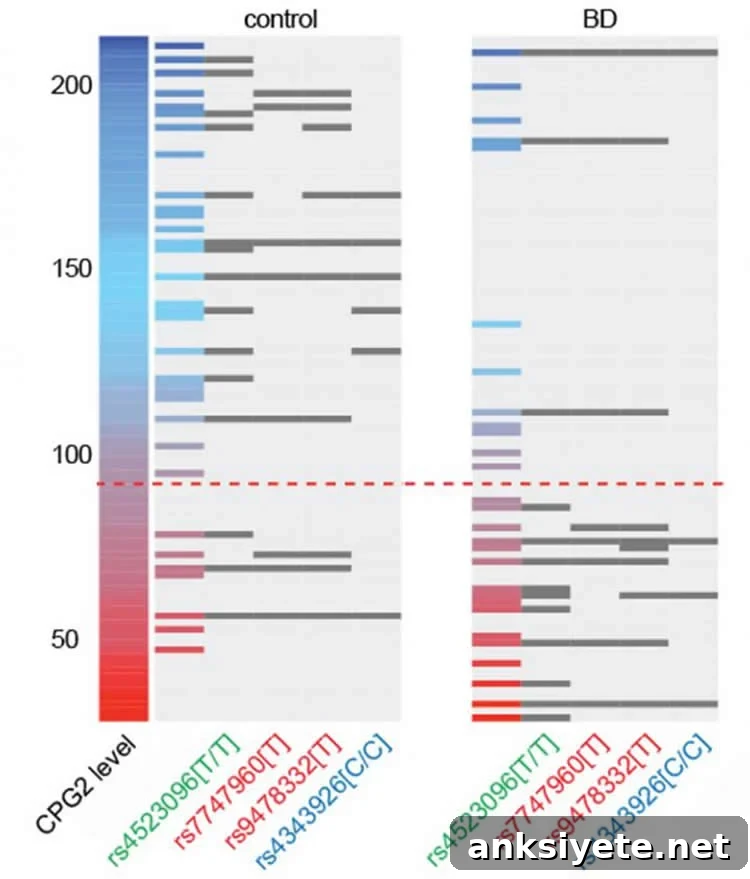
When genome-wide studies highlighted SYNE1 as a locus associated with bipolar disorder, the researchers focused on the portion of SYNE1 that encodes CPG2. Rathje collected postmortem brain tissue from six brain banks and compared samples from individuals diagnosed with bipolar disorder, samples from people with other neuropsychiatric conditions (including schizophrenia and major depression), and control samples without these diagnoses. CPG2 protein levels were specifically and significantly reduced in the bipolar disorder samples; other synaptic proteins did not show the same diagnostic specificity.
“Our results reveal a specific association between low CPG2 levels and bipolar disorder that is not observed in schizophrenia or major depression,” the authors note.
To identify potential genetic causes for the reduced protein levels, the team performed deep sequencing of SYNE1 in the same postmortem samples. They searched for non-coding variants in promoter or regulatory regions that could dampen CPG2 expression, as well as for missense and other coding variants that might alter the protein’s structure or cellular behavior.
Functional tests of regulatory and coding variants
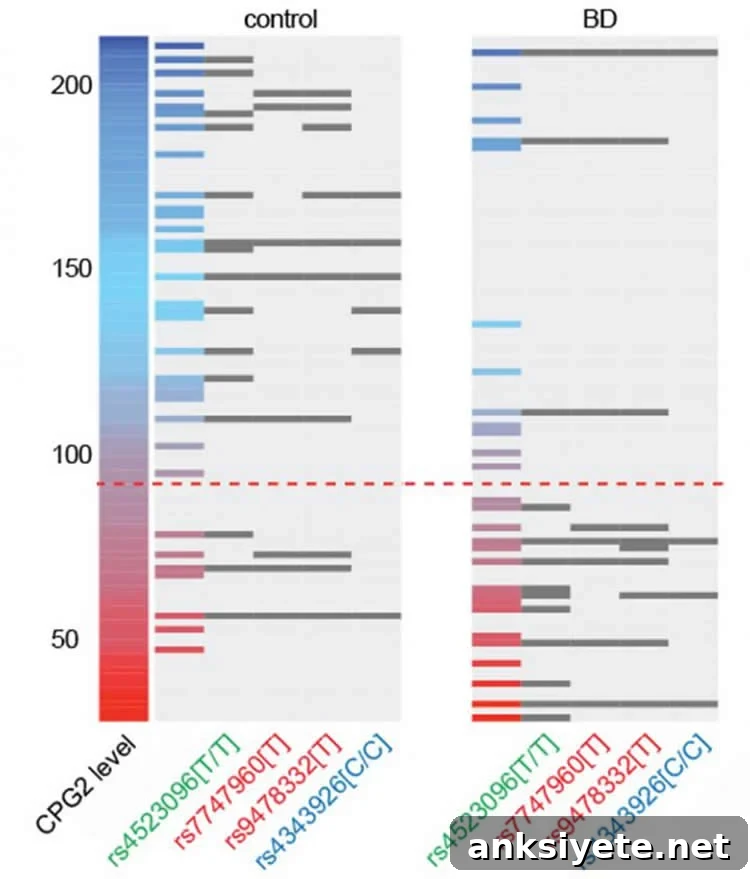
The researchers tested candidate non-coding variants by cloning human CPG2 promoter regions from control and BD-derived sequences and linking them to a reporter construct in cultured neurons. Several promoter variants reduced reporter expression, and in some cases pairs of promoter changes only produced a marked effect when present together—highlighting how combinations of regulatory variants can have stronger consequences than single changes.
To evaluate coding variants, the team used an established assay in which human CPG2 replaces the endogenous CPG2 in cultured rat neurons. This system allowed direct testing of whether particular amino acid changes disrupt CPG2 localization to dendritic spines or impair its ability to regulate glutamate receptor cycling. The authors identified missense variants that either prevented normal spine targeting or interfered with receptor trafficking, both of which would impair excitatory synapse function.
Collectively, these experiments map a direct path from genetic variation in the SYNE1/CPG2 region to measurable deficits in a synaptic protein’s abundance or activity—providing a mechanistic link that may help explain, for at least some individuals, how genetic risk contributes to bipolar disorder.
Next steps and implications
Nedivi’s lab plans follow-up studies to assess behavioral consequences of the most impactful variants in animal models and to probe more deeply how these changes alter glutamate receptor cycling. They also intend to continue analyzing human samples to better define how specific combinations of CPG2-affecting variants relate to BD risk, clinical presentation, and potential responsiveness to targeted interventions.
Funding: The study received support from The JPB Foundation, the Gail Steel Fund, the Carlsberg Foundation, the Lundbeck Foundation, and the Danish Council for Independent Research.
Authors of the study include Mette Rathje, Hannah Waxman, Marc Benoit, Prasad Tammineni, Costin Leu, Sven Loebrich, and Elly Nedivi.
Source: David Orenstein, MIT.
Publisher note: Organized by NeuroscienceNews.com. Image credit: Rathje, Nedivi, et al.
Abstract
Genetic variants in the bipolar disorder risk locus SYNE1 that affect CPG2 expression and protein function
Bipolar disorder is characterized by recurrent mood episodes of mania and depression and is influenced by both genetic and environmental factors. Genome-wide association studies have highlighted SYNE1 as a risk locus for BD, and the association signal overlaps the region that encodes the brain-specific protein CPG2. CPG2 localizes to excitatory postsynaptic sites and regulates glutamate receptor internalization. This study shows that CPG2 protein levels are significantly reduced in postmortem brain tissue from BD patients compared with controls and with patients diagnosed with schizophrenia or major depression. The authors identify genetic variants in promoter regions that reduce gene expression and coding variants that alter CPG2 localization and synaptic function. These findings connect genetic variation at the SYNE1/CPG2 locus to mechanisms of glutamatergic synapse dysfunction that could underlie susceptibility to bipolar disorder in some individuals, and they suggest avenues for improved diagnostic distinction and targeted treatments.