
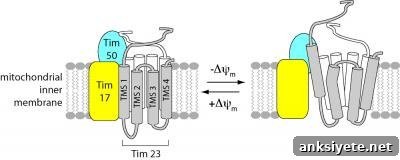
Researchers at the University of Connecticut used ultra-sensitive fluorescent probes to observe, for the first time, the structural dynamics of a crucial protein channel inside mitochondria, the cell’s primary energy-producing organelle.
The team discovered that the channel complex, known as the translocase of the inner mitochondrial membrane 23 (TIM23), is directly linked to the energized state of the mitochondrial inner membrane. Importantly, they observed that when the electrical potential across the membrane decreases, the TIM23 channel undergoes a measurable rearrangement: the helical segments lining the channel change shape. These findings clarify how the membrane’s electrical state can drive conformational changes in membrane proteins involved in protein transport.
The study, published in the peer-reviewed journal Nature Structural & Molecular Biology, provides evidence that the proton-motive force or membrane potential influences not only the activity of membrane protein complexes but also their molecular architecture. This mechanistic insight advances our understanding of how energy stored across biological membranes is converted into mechanical or structural work to facilitate protein translocation into mitochondria.
By applying fluorescent mapping at the subcellular level, the researchers also demonstrated a technique that can reveal dynamic structural changes in situ. Such methods have potential relevance for investigating mitochondrial dysfunction that contributes to neurodegenerative and metabolic disorders, where altered mitochondrial energetics and protein transport are frequently implicated.
Nikolaus Pfanner of the University of Freiburg, a leading expert in mitochondrial protein trafficking, and members of his research group described the work as “a major step towards a molecular understanding of a voltage-gated protein translocase.” They highlighted the broader importance of identifying molecular voltage sensors in membrane proteins and noted that the study opens new directions for finding voltage-responsive elements across diverse membrane systems.
To probe TIM23 dynamics, the UConn team introduced cysteine residues at specific sites within a transmembrane segment of TIM23 from the yeast Saccharomyces cerevisiae. These engineered cysteines were labeled with a highly sensitive fluorescent probe. By monitoring fluorescence changes in real time inside functioning mitochondria, the researchers were able to correlate the channel’s gating behavior and structural rearrangements with experimentally induced shifts in the membrane’s electrical field.
“Although this is an indirect method of assessing structure, measuring these fluorescent reporters within active mitochondria provided a rich, previously inaccessible view of the channel’s behavior,” said Nathan N. Alder, assistant professor in the Department of Molecular and Cell Biology in UConn’s College of Liberal Arts and Sciences and lead author of the study.
The research received support from the National Science Foundation, the National Institutes of Health, and the Robert A. Welch Foundation.
One of the most significant conclusions is that the magnitude of the membrane voltage gradient can meaningfully influence protein conformation. This suggests that membrane energization is not merely permissive for transport but may actively shape the structural state of transport machinery like TIM23.
Future work planned by the team includes reconstituting the TIM23 complex into an artificial membrane system to test whether the voltage-dependent structural responses persist outside the native mitochondrial environment. The researchers also aim to pinpoint the specific residues or regions within TIM23 that act as voltage-sensing elements.
“Identifying the voltage sensor will deepen our mechanistic understanding of the translocase and could inform studies of other membrane transporters whose dysfunction is linked to disease,” Alder said. “If transporter activity depends on coupling to the membrane potential, defects in that coupling could contribute to diseases such as cardiovascular disorders, cancer, or neurodegeneration.”
Notes about this biochemistry and electrophysiology research
Contact: Colin Poitras – University of Connecticut
Source: University of Connecticut press release
Image credit: TIM23 protein channel image credited to Nathan Alder and adapted from the University of Connecticut press release.
Original research: Abstract for “Structural changes in the mitochondrial Tim23 channel are coupled to the proton-motive force” by Ketan Malhotra, Murugappan Sathappa, Judith S. Landin, Arthur E. Johnson, and Nathan N. Alder in Nature Structural & Molecular Biology. Published online July 7, 2013. DOI: 10.1038/nsmb.2613.