
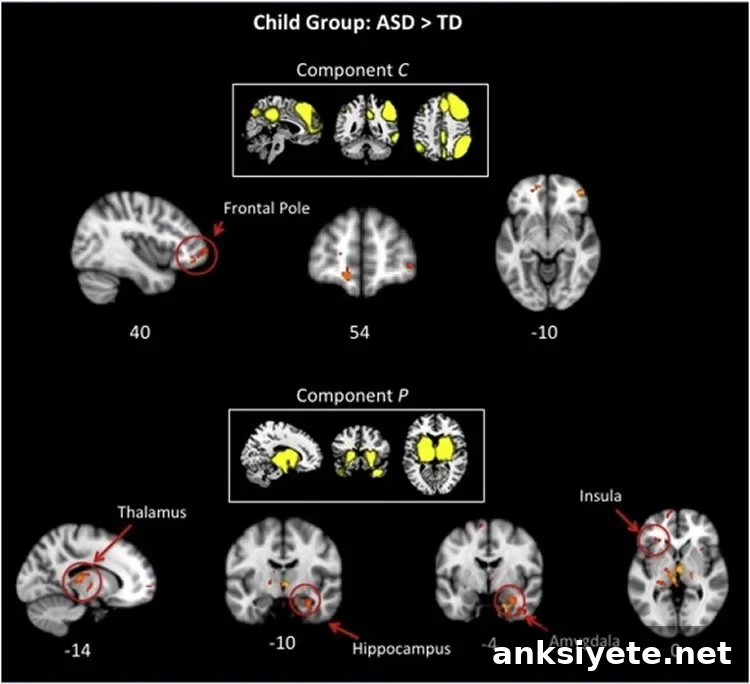
Researchers at the University of Miami find that large-scale connectivity in autism changes with age.
Autism spectrum disorder (ASD) is associated with alterations in how brain regions communicate. A new study from the University of Miami reports that large-scale patterns of functional brain connectivity in people with autism differ from typically developing (TD) individuals and that those differences shift across development. The research highlights the importance of accounting for age and developmental stage when studying brain network organization in ASD and when designing models to predict outcomes or responses to interventions.
“Our findings suggest that developmental stage must be taken into account to accurately build models that show how the brains of individuals with autism differ from neurotypical individuals,” said Lucina Uddin, assistant professor of Psychology at the University of Miami College of Arts & Sciences and corresponding author of the study. “We believe that taking a developmental approach to examining brain connectivity in autism is critical for predicting response to treatment in young children with ASD.”
The human brain contains more than a trillion neurons that form complex signaling networks. Functional connectivity studies measure how activity in different brain regions correlates over time, revealing organized networks that support cognition, social behavior, sensory processing, and other functions. Prior work in ASD has reported mixed results, with some studies indicating reduced connectivity (hypo-connectivity) and others reporting increased connectivity (hyper-connectivity) within or between networks. This new study, titled “Developmental Changes in Large-Scale Network Connectivity in Autism,” helps reconcile those inconsistencies by showing that connectivity patterns depend on age. The study is published in the journal NeuroImage: Clinical.
Key findings from the study:
- Children with ASD (ages 7–11) showed increased functional connectivity within several large-scale brain networks compared with typically developing children, along with reduced connectivity between different networks.
- Adolescents with ASD (ages 11–18) did not display the same within-network increases observed in younger children, but they continued to show reduced connectivity between networks when compared with TD adolescents.
- Adults with ASD (older than 18) did not show significant differences in either within-network or between-network functional connectivity relative to typical adults in this cohort.
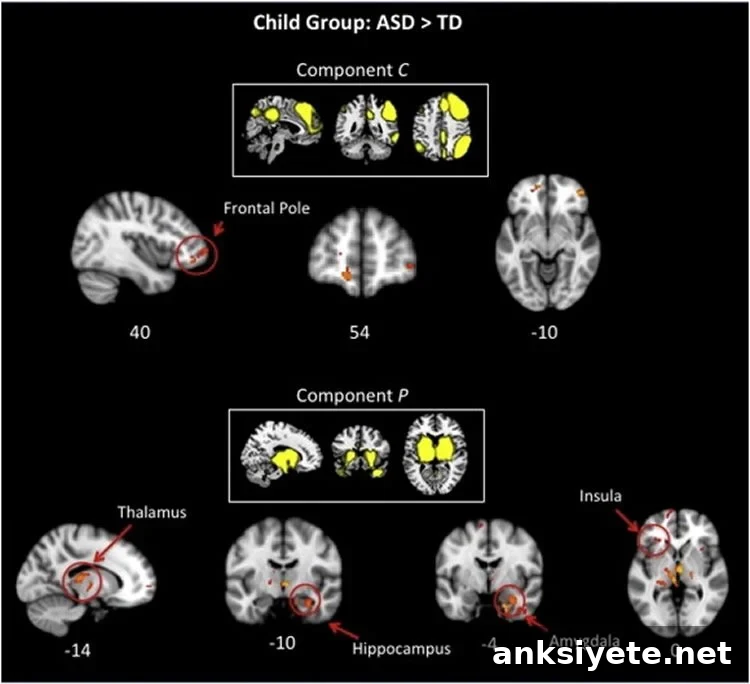
Interpreting within-network versus between-network changes provides insight into brain organization in ASD. Increased connectivity within a network can indicate stronger local or specialized processing, while decreased connectivity between networks may reflect reduced integration across systems that normally coordinate complex behaviors. Together, these alterations could contribute to core features of autism, including differences in social communication, sensory processing, and flexibility of behavior.
“This study helps us understand the functional organization of brain networks and how they change across the lifespan in autism,” said Jason S. Nomi, postdoctoral fellow in the Department of Psychology at the University of Miami and lead author of the study. The findings underscore that connectivity differences are not static; they evolve across childhood, adolescence, and adulthood. Considering developmental stage when analyzing brain data may explain why past studies produced seemingly conflicting results.
The researchers emphasize that developmental trajectories matter for clinical translation. A connectivity pattern seen in a young child with ASD may not be present later in adolescence or adulthood, and this variability could influence how individuals respond to specific therapies or interventions. Ongoing research from this group is focusing on a key developmental milestone—puberty—to more precisely map how brain networks reorganize during that transition in individuals with autism.
Contact: Megan Ondrizek – University of Miami
Source: University of Miami press release
Image Source: The image is credited to Jason S. Nomi and Lucina Q. Uddin / NeuroImage: Clinical and is adapted from the open access research paper. The image is licensed Creative Commons Attribution-NonCommercial-NoDerivatives 4.0 International. The image size has been adapted to fit the article format.
Original Research: Full open access research for “Developmental changes in large-scale network connectivity in autism” by Jason S. Nomi and Lucina Q. Uddin in NeuroImage: Clinical. Published online March 6, 2015.