
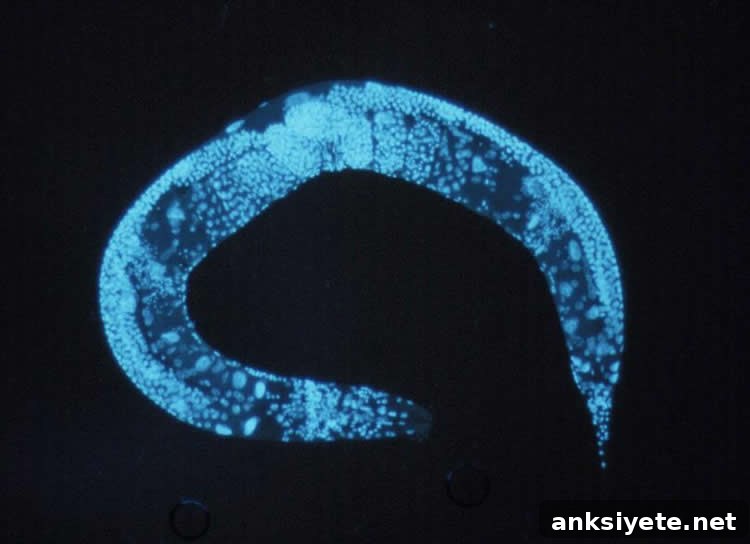
Researchers at the Salk Institute discovered that a simple smell-driven behavior in nematode worms can predict individual lifespan. By measuring how Caenorhabditis elegans move toward an appealing, food-like scent, the team linked patterns of neural activity to later longevity. This finding, published September 22, 2015 in the journal eLife, sheds light on how sensory information is processed in small nervous systems and how neural circuits change during aging.
“We are not claiming that a stronger sense of smell will directly cause a longer life,” says Sreekanth Chalasani, an assistant professor in the Salk Institute’s Molecular Neurobiology Laboratory. “Rather, this odor-driven behavior appears to reveal underlying physiological differences between individuals.”
C. elegans is a well-established model for studying neural circuits and aging. The worm’s compact nervous system includes 12 pairs of specialized sensory neurons that detect environmental cues. Earlier work had identified a few specific neuron pairs required for attraction to certain odors. In the current study, Chalasani and colleagues took a comprehensive approach: they monitored activity across all 24 of these chemosensory neurons while exposing the animals to benzaldehyde, a compound with an almond-like aroma that serves as an attractive cue for the worms.
Instead of finding activity confined to the previously characterized neuron pairs, the researchers observed participation by additional cells. They categorized the responding neurons into two functional groups: primary neurons that directly sensed benzaldehyde and secondary neurons that became active in response to signals transmitted by the primary group. This layered arrangement forms a circuit in which primary detectors convey information to secondary nodes, a design the authors suggest improves the animal’s ability to gauge odor intensity and context.
“When multiple different cells contribute to detecting the same stimulus, the combination of their signals gives the nervous system more dynamic and refined information,” explains Sarah Leinwand, a graduate student in the Chalasani lab and first author on the paper. “That flexibility enables an animal to generate distinct behavioral outputs depending on the strength of a cue or the specific combination of neurons that are engaged.” For example, certain behaviors may require a high concentration of odor that only triggers a particular set of neurons, while weaker cues produce different patterns of activity and thus different responses.
Building on the observation that olfactory function often declines with age, the team next examined how this primary–secondary circuit changes over the worm’s lifetime. They found that primary neurons retained much of their responsiveness as animals aged, but the secondary neurons showed a gradual reduction in activity. This selective decline suggests that intercellular communication—how signals are passed from primary to downstream neurons—becomes less effective with age. Such a breakdown in signaling may be a general feature of aging nervous systems beyond C. elegans.
Importantly, the study connected neural function to behavior and to longevity. Worms were tested in a behavioral assay that measured how well they moved toward a point source of benzaldehyde. Individuals that performed better in this odor-guided task also showed stronger activity in the secondary neurons, and, on average, these animals later lived about 16% longer than siblings that showed poorer odor-guided performance. These results link measurable differences in sensory-driven behavior and circuit function to real differences in lifespan, even among genetically similar animals.
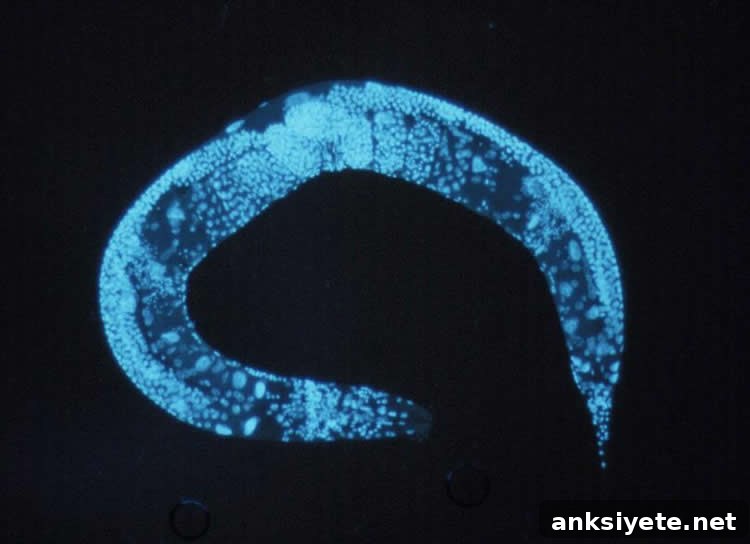
“Even though these worms are siblings with similar genomes, they vary considerably in neuronal signaling, behavior, and lifespan,” says Chalasani. “Some individuals appear to maintain stronger signaling between primary and secondary cells, which may underlie their superior performance and extended longevity.”
If the integrity of signaling between neurons proves to be a crucial factor in aging across species, then strategies aimed at preserving or restoring neural communication could become promising avenues to mitigate age-related decline or rejuvenate brain function. The authors emphasize that many questions remain about the precise molecular and cellular changes that cause some animals to retain better nervous system function and longer lives.
Other contributors to the study include Claire Yang of the Salk Institute, Daphne Bazopoulou and Nikos Chronis of the University of Michigan, and Jagan Srinivasan of Worcester Polytechnic Institute.
Funding: The work was supported by the Rita Allen Foundation, the W. M. Keck Foundation, the National Institutes of Health, Achievements Rewards for College Scientists, and the National Science Foundation.
Source: Salk Institute
Image Source: The image is in the public domain
Original Research: The study was published in eLife during the week of September 22, 2015.