
New therapy shows promise in protecting the brain from stroke-related damage
Researchers at the University of Missouri report promising results for a new experimental therapy designed to protect the brain after stroke. Published in the journal Molecular Neurodegeneration, the study evaluates a novel compound that targets a specific enzymatic pathway implicated in post-stroke injury. The compound acts as a selective gelatinase inhibitor directed primarily at the matrix metalloproteinase MMP-9, with the goal of limiting bleeding and preserving vulnerable brain tissue during the critical hours after a stroke.
Stroke remains a leading cause of death and disability in the United States, and the race to limit brain injury begins immediately after symptoms first appear. Current emergency approaches for ischemic stroke—the most common type caused by blood clots—include clot-busting drugs such as tissue plasminogen activator (tPA). While tPA can significantly improve outcomes, it must be given within a narrow time window because it increases the risk of bleeding in the brain. Beyond surgical interventions, options to extend that treatment window or to protect the brain during early injury are limited.
“Time is literally a matter of life and death for stroke victims,” said Zezong Gu, MD, PhD, corresponding author of the study and assistant professor of pathology and anatomical sciences at the MU School of Medicine. “Although this compound is still in the research stage, our findings suggest it could be used alongside tPA in the future to extend the safe timeframe for emergency therapy in ischemic stroke. We also see potential for treating hemorrhagic stroke, the less common form caused directly by brain bleeding.”
The Missouri team worked with collaborators at the University of Notre Dame to test a thiirane class gelatinase-selective inhibitor that targets MMP-9, a member of the matrix metalloproteinase (MMP) family. MMP-9 is one of more than 20 MMPs known to influence blood vessel integrity, cell interactions and tissue remodeling in the brain. After stroke, uncontrolled MMP activity contributes to blood-brain barrier breakdown, hemorrhagic conversion, inflammation and neuronal injury.
Dr. Gu and colleagues have been studying MMP-9 for years. In 2005, Gu co-authored a paper in the Journal of Neuroscience that identified MMP-9 as a promising therapeutic target in stroke. Building on that work, the current study uses a selective inhibitor to block the harmful actions of MMP-9 while preserving the enzyme family’s normal physiological roles. The approach aims for targeted neurovascular protection rather than broad enzyme suppression.
“Matrix metalloproteinases have important roles in normal brain development and vascular structure,” Gu explained. “But when their activity becomes unregulated after injury, they drive many of the pathological processes that worsen stroke outcomes. Our compound appears to rescue blood vessels from MMP-9–related damage and at the same time reduce neuronal loss.”
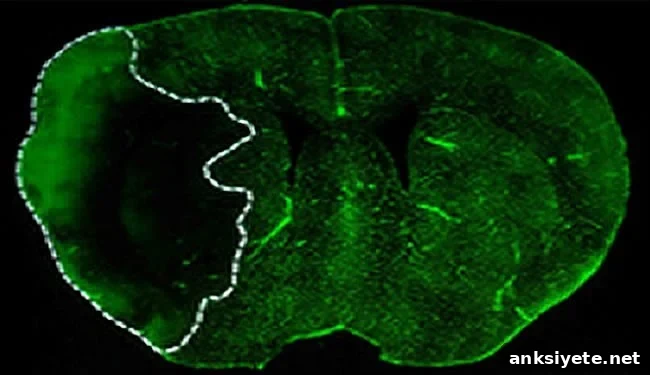
To evaluate the compound’s protective potential, the team used a mouse model of embolic focal cerebral ischemia that replicates key aspects of human ischemic stroke. The MU Center for Translational Neuroscience, where the experiments were performed, is among the few laboratories in the United States that can reliably induce a controlled blood clot in mouse brains for such testing. This capability allowed the researchers to observe how the inhibitor influenced hemorrhage progression, blood-brain barrier integrity and neuronal survival under realistic conditions.
“Being able to study this inhibitor in an embolic stroke model gives us unique, clinically relevant data,” said Jiankun Cui, MD, lead author of the paper and assistant professor of pathology and anatomical sciences. “The results show the compound can interrupt key pathological events that lead to worsening injury after stroke, suggesting potential for future development as a neuroprotective therapy.”
While these results are preclinical and further testing is required, the study highlights a promising strategy for stroke neuroprotection: selectively inhibiting MMP-9 to preserve the neurovasculature and extend treatment options. If validated in additional studies, such an approach could complement current emergency treatments and help reduce the devastating effects of stroke.
Research and contact information
Contact: Laura Gerding – University of Missouri School of Medicine
Source: University of Missouri School of Medicine press release
Image source: Neuroscience News image adapted from University of Missouri School of Medicine press release.
Original research: Abstract for “Inhibition of MMP-9 by a selective gelatinase inhibitor protects neurovasculature from embolic focal cerebral ischemia” by Jiankun Cui et al., Molecular Neurodegeneration 2012, 7:21. DOI: 10.1186/1750-1326-7-21