
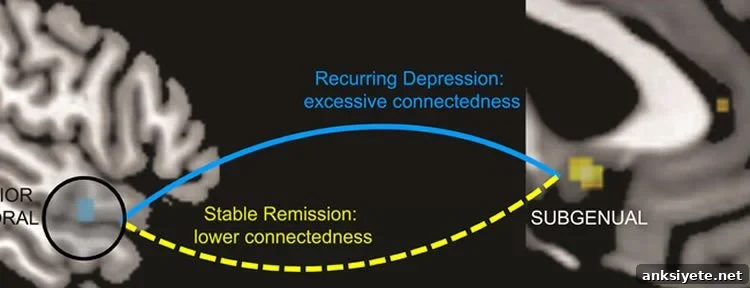
Functional magnetic resonance imaging (fMRI) may help predict which patients in remission from major depressive disorder (MDD) are at higher risk for future depressive episodes, according to research published in JAMA Psychiatry.
A team from King’s College London and The University of Manchester, with funding cited from the Medical Research Council (MRC), used task-based fMRI to examine brain connectivity in 64 unmedicated patients who had recovered from MDD. While in the scanner, participants were asked to imagine acting badly toward a close friend and to report self-blaming emotions such as guilt. Clinicians then monitored symptoms over 14 months. By the study’s end, 37 participants remained in remission and 27 experienced a recurrence of depression.
Analyses revealed that participants who later had recurrent episodes showed stronger functional connectivity between two brain regions previously associated with guilt and self-blame: the anterior temporal lobe (ATL) and a subgenual region of the cingulate cortex. Those who remained well did not show this elevated connectivity. A control group of 39 people without a personal or family history of MDD also lacked this pattern.
Using connectivity differences during self-blaming versus other-blaming emotional scenarios, the researchers were able to predict recurrence with 75% overall accuracy (48 of 64 cases). Predictions failed for 16 participants (25%). In addition to the ATL–subgenual connection, the recurring group displayed hyperconnectivity between the ATL and other regions including the right ventral putamen, claustrum, and temporoparietal junction, which contributed to the predictive model.
Dr. Roland Zahn, the lead investigator at the Institute of Psychiatry, Psychology & Neuroscience (IoPPN), King’s College London, commented that this is the first study to demonstrate that fMRI signatures measured during recovery can forecast future depressive episodes. He noted that such a biomarker could help clinicians decide who might benefit from continuing antidepressant treatment and who might safely discontinue medication.
Dr. Zahn added: “Before this approach can be rolled out and used in the clinic, we need to test it in an independent group of patients and improve it so that its accuracy reaches about 80 percent. If future studies can reach this mark, then this approach will be vitally important, because there are currently no reliable ways to predict recurrence after recovery.”
Dr. Kathryn Adcock, head of neurosciences and mental health at the MRC, said this research could help identify people most likely to benefit from long-term treatment and could improve clinical trial design by enabling recruitment of more homogeneous patient groups.
Funding: The article notes support from the Medical Research Council (MRC). The funding statement included with the study also lists the Department of Science and Technology, Government of India; the National Centre for Biological Sciences; and the Tata Institute of Fundamental Research.
Source: Jack Stonebridge – King’s College London
Image credit: The image is credited to the researchers and adapted from an MRC press release.
Original research: Abstract for “Self-blame–Selective Hyperconnectivity Between Anterior Temporal and Subgenual Cortices and Prediction of Recurrent Depressive Episodes” by Karen E. Lythe et al. in JAMA Psychiatry. Published online October 7, 2015 (doi:10.1001/jamapsychiatry.2015.1813).
Abstract (summary)
This prospective cohort study evaluated whether fMRI connectivity during self-blaming versus other-blaming emotions could predict recurrence of depressive episodes in patients with remitted MDD. Seventy-five psychotropic medication–free remitted patients were recruited; after exclusions and follow-up, 31 remained in stable remission and 25 developed a recurrent episode over 14 months and were included in the main analysis. Thirty-nine healthy controls with no personal or family history of MDD were also studied for comparison.
The primary outcome compared right superior anterior temporal lobe (RSATL) connectivity with a predefined subgenual cingulate and septal region (SCSR) during self-blaming relative to other-blaming emotions. Results confirmed that higher RSATL–SCSR connectivity during self-blame predicted subsequent recurrence: the recurring group showed significantly greater connectivity than the stable MDD group and controls. Additional RSATL hyperconnectivity with the right ventral putamen, claustrum, and temporoparietal junction was also observed in those who later relapsed. These regions together predicted recurrence with 75% accuracy.
Conclusions: This study provides initial evidence for an fMRI signature of risk for depressive relapse in remitted MDD. The authors emphasize the need for independent validation and optimization to establish this signature as a clinically useful prognostic biomarker.