Summary: For the roughly 60 million Americans living with chronic pain, the sensation is not simply prolonged discomfort—it reflects a biological misinterpretation. A new study has traced a specific neural circuit that sustains chronic pain, revealing a loop that activates after injury or inflammation and that can be selectively silenced without removing protective acute pain.
By tagging neurons with a fluorescent marker and following their connections from the spinal cord to the brain and back, researchers mapped a dedicated “sensitization” loop. Crucially, turning off that circuit abolished chronic hypersensitivity in mice while preserving normal acute pain responses—the reflexive warning that prevents immediate harm.
Key Facts
- Distinct systems: Acute and chronic pain rely on different neural mechanisms. Acute pain signals immediate danger; a separate circuit appears responsible for chronic, pathological pain.
- The sensitization loop: The newly identified circuit originates in the spinal cord, passes through thalamic nuclei and the primary somatosensory cortex, reaches the brainstem (including the rostral ventromedial medulla, RVM), and returns to the spinal cord.
- Touch misinterpreted: In chronic states this loop causes the brain to interpret light touch as painful.
- Artificial induction: Repeated activation of this circuit in healthy mice produced a persistent pain state lasting weeks, even without injury.
- Treatment promise: Because this loop is not active during normal acute pain, it offers a target to treat chronic pain without blunting essential protective sensations.
Source: Stanford University
A new map of a brain circuit specific to chronic pain points to a promising treatment path for the many people living with persistent pain, according to a study published in Nature.
“We were surprised to find that acute pain and chronic pain can be completely separate,” said Xiaoke Chen, senior author and associate professor of biology at Stanford. “There is a dedicated circuit that only activates after injury, which gives us the opportunity to target chronic pain specifically while leaving protective acute pain intact.”
The work received support from the NeuroChoice Initiative, a Wu Tsai Neurosciences project focused in part on understanding biological mechanisms related to addiction risk among people taking prescription opioids for chronic pain.
A misinterpretation in the brain
Pain evolved to warn animals of danger and to motivate actions that protect and heal the body. Chronic pain, however, continues long after the original threat has resolved. It can follow injury, inflammation, or other conditions and is associated with higher risk of mental health challenges and opioid misuse.
A defining feature of chronic pain is sensitization—an exaggerated response to stimuli that would normally be benign. “In chronic pain, the brain misinterprets touch as a painful stimulus,” Chen explained. Identifying the neural loop that produces this misinterpretation offers a route to correct it.
Past studies indicated that stimulating the periaqueductal gray (PAG) and its downstream region, the RVM, can reduce pain. That suggested the brainstem could play a role in chronic pain, but a full circuit connecting peripheral injury signals to brain regions that drive chronic sensitization had not been mapped until now.
Mapping a new pain pathway
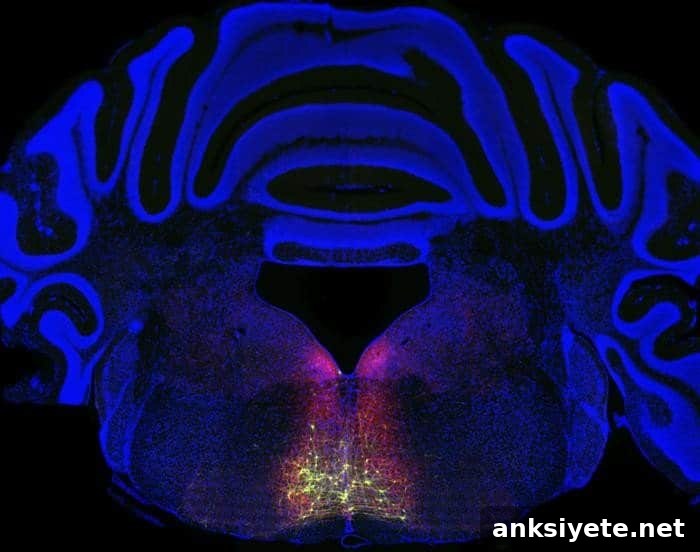
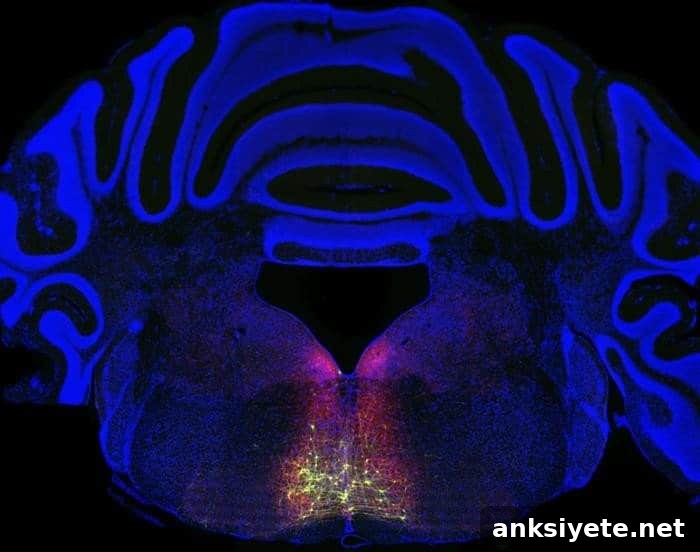
To trace the full circuit, researchers began with a population of RVM neurons already implicated in pain sensitization. They used genetic labeling methods to make those neurons and their connections fluoresce, revealing a multisynaptic loop that begins in the spinal cord, continues through the ventral posterolateral and posterior thalamic nuclei, reaches the primary somatosensory cortex, connects to midbrain structures including the lateral superior colliculus, and returns to the spinal cord through μ-opioid-receptor-expressing RVM neurons.
When the team chemically silenced any node of this loop in mouse models of inflammatory or neuropathic pain, mechanical hypersensitivity disappeared and normal nociceptive thresholds were restored. Importantly, silencing the circuit had little effect on normal nociception in healthy mice, indicating the loop is specifically engaged during chronic pain.
Conversely, repetitive activation of nodes in this circuit in otherwise healthy mice produced long-lasting mechanical hypersensitization, demonstrating that activity in this loop is sufficient to induce a chronic pain state. “Just activating these neurons is enough to induce chronic pain,” Chen said.
These experiments establish the circuit’s specific role in driving chronic mechanical pain and clarify that it is distinct from systems that mediate acute, protective pain. The researchers propose that reducing pain and promoting pain are likely controlled by separate circuits: the newly described loop promotes chronic pain, whereas the PAG-RVM system can reduce pain.
Jamming the chronic pain circuit
With the circuit mapped, the next steps focus on finding the molecular changes that cause RVM neurons to engage this loop after injury or inflammation. Identifying those molecular signals could enable development of drugs that block or disrupt the loop’s activity. Such therapies might relieve chronic pain without compromising acute pain needed to sense immediate danger.
The team is also analyzing genetic data from people with chronic pain to determine whether similar molecular changes occur in humans. Confirming shared mechanisms would support translating these findings into new non-opioid treatments.
At a more basic level, the discovery raises a question about why the brain would have a dedicated chronic pain circuit. One hypothesis is that it evolved to monitor internal damage that the brain itself cannot directly detect. For now, the precise evolutionary purpose remains uncertain.
Key Questions Answered:
A: It is an open biological question. Chen suggests the circuit may serve to monitor internal damage that the brain cannot sense directly. In chronic pain, however, this system appears to overreact and mislabel harmless sensations as injury.
A: The study’s major implication is the opposite: because the chronic loop is distinct from the acute pain system, therapies that target this loop could reduce persistent pain without impairing acute protective pain responses.
A: The loop has been mapped and validated in mice. Researchers are currently checking human genetic databases for comparable molecular markers. If the markers match, it could enable new classes of non-opioid medications, though clinical translation will require further research.
Editorial Notes:
- This article was edited by a Neuroscience News editor.
- Journal paper reviewed in full.
- Additional context added by staff.
About this pain research news
Author: Nathan Collins
Source: Stanford University
Contact: Nathan Collins, Stanford University
Image: Courtesy Xiaoke Chen/Stanford University
Original Research: Open access. “Deconstruction of a spino-brain–spinal cord circuit that drives chronic pain” by Qian Wang, Joo Han Lee, Gregory Nachtrab, Yuan Yuan, Lei Yuan, Wei Qi, Manuel A. Mohr, Jing Xiong, Mark A. Horowitz & Xiaoke Chen. Nature. DOI: 10.1038/s41586-026-10296-y
Abstract
Deconstruction of a spino-brain–spinal cord circuit that drives chronic pain
Tissue inflammation or peripheral nerve injury can lead to chronic pain. Although spinal-cord-projecting neurons in the rostral ventromedial medulla (RVMSC neurons) promote pain chronification, how peripheral injury signals drive these neurons was unclear.
This study reports a circuit loop extending from the spinal cord to the ventral posterolateral and posterior thalamic nuclei, proceeding to the primary somatosensory cortex and returning to the spinal cord via the lateral superior colliculus, which connects to μ-opioid-receptor-expressing RVMSC neurons.
Silencing any node in this multisynaptic loop had little effect on normal nociception in healthy mice, but eliminated mechanical hypersensitization and restored normal response thresholds in mouse models of inflammatory and neuropathic pain. In healthy mice, repetitive—rather than acute—activation of each node was sufficient to induce long-lasting mechanical hypersensitization.
These findings reveal a spino-brain–spinal cord circuit loop that links ascending and descending pathways and specifically drives chronic mechanical pain, highlighting potential cellular targets for treating chronic pain.