
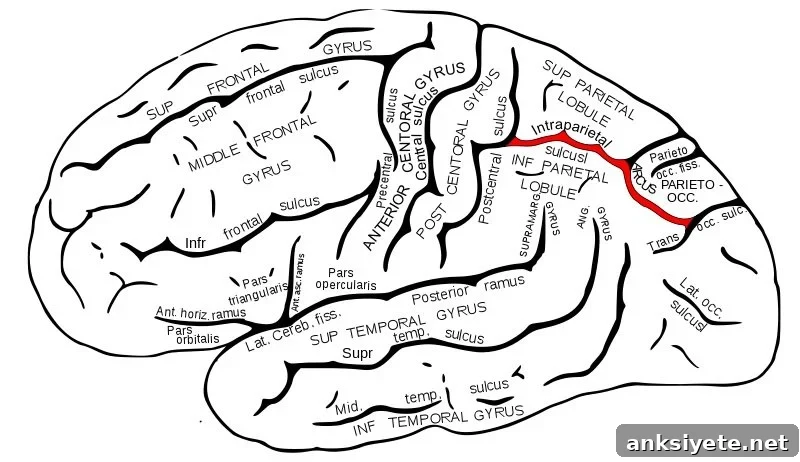
A region of the brain long associated with visual and spatial processing also helps sort visual information into meaningful categories, a new study from the University of Chicago reports.
Primates excel at organizing visual input into familiar groups—such as fruit versus vegetables—and at directing attention and movements to specific locations in a scene. The new research, published in Neuron, demonstrates that those two capabilities—spatial processing and visual categorization—can be represented simultaneously within the posterior parietal cortex.
“We discovered that multiple functions can coexist in the same brain area and even within single neurons,” said David Freedman, PhD, assistant professor of neurobiology at the University of Chicago and lead investigator on the study. “Individual cells in this parietal region can independently encode both spatial and cognitive information.”
Freedman’s lab studies how learning shapes the brain and how visual information is retained in short-term memory. To probe how parietal neurons represent categories, the team trained monkeys on a simple task in which moving patterns must be grouped into two categories—similar to an umpire calling balls and strikes. Over several weeks the animals learned to assign motion patterns to the correct category.
After training, the researchers recorded electrical activity from neurons in the parietal lobe while the monkeys performed the categorization task. Analyzing those activity patterns allowed the scientists to decode what information the neurons were signaling.
“The firing patterns in these parietal neurons strongly reflected which category the motion belonged to,” Freedman said. Over multiple studies, his group has repeatedly observed category-related signals in the lateral intraparietal area (LIP), an area traditionally associated with eye movements and attention. This overlap raised a question: how can a region specialized for spatial processing also support non-spatial functions like visual categorization?
To address that question, the team modified the task so the monkeys were required to make eye movements to cues appearing at different screen locations while still categorizing the motion patterns. Because LIP is involved in planning eye movements, the researchers wondered whether those spatial demands would interfere with category signals.
Instead of interference, they found that single neurons multiplexed both types of information. Parietal cells encoded spatial (eye-movement) signals and category information at the same time, independently of each other. “Both the movement-related and category-related signals were present and decodable with high accuracy,” said the study’s first author, Chris Rishel, PhD, formerly of Freedman’s lab. “This shows that seemingly unrelated kinds of information can be represented simultaneously by the same neurons.”
The authors conclude that LIP likely plays a key role in transforming visual input from earlier sensory areas into abstract category representations used during decision-making. These results add to a growing body of evidence that cortical regions are not strictly modular but instead can support multiple overlapping functions.
What does the brain gain from this territorial arrangement?
“There has been a tendency to view distinct cortical areas as highly specialized modules,” Freedman noted. “Our findings reinforce the view that many brain areas perform multiple, overlapping roles.”
Such multifunctional organization may increase the brain’s efficiency and capacity. If a single region can carry out several computations, the brain can pack more functionality into limited cortical space. That flexibility likely makes mapping brain function more complex for researchers, but it may offer a performance advantage for behavior and learning.
The researchers plan next to investigate how category representations in LIP develop over the course of learning—how neuronal responses change as animals acquire new categorical distinctions.
Notes about this neuroscience research
The paper, “Independent category and spatial encoding in parietal cortex,” was published online March 6 in the journal Neuron. This study was supported by the National Institutes of Health, the National Science Foundation, the McKnight Endowment Fund for Neuroscience, the Alfred P. Sloan Foundation and the Brain Research Foundation. Gang Huang, formerly a research technician in the laboratory, also contributed to the research.
Contact: John Easton – University of Chicago Medicine
Source: University of Chicago Medicine press release
Image Source: The brain image with the intraparietal sulcus highlighted is in the public domain.
Original Research: Abstract for “Independent Category and Spatial Encoding in Parietal Cortex” by Chris A. Rishel, Gang Huang and David J. Freedman in Neuron. Published online March 6, 2013. doi: 10.1016/j.neuron.2013.01.007