
Summary: A new AI system identifies neurons in brain microscope images more accurately and efficiently than previous methods. By teaching the model to recognize distinct neuronal parts and using topological priors, the approach improves automated neuron tracing and supports large-scale brain mapping efforts.
Source: Cold Spring Harbor Laboratory
Scientists at Cold Spring Harbor Laboratory (CSHL) have developed an artificial intelligence system that recognizes neurons in microscopic brain images more effectively than earlier approaches. The team enhanced automated neuron tracing and connectivity detection by training the model to distinguish different neuronal components—cell bodies, axons, and dendrites—each having characteristic shapes and behaviors. This advance addresses a growing bottleneck in neuroscience: extracting reliable circuit maps from massive image datasets.
Accurate maps of neuronal connections are essential for understanding how the brain processes information and generates behavior. As modern imaging technologies produce ever-larger volumes of high-resolution brain images, manual analysis by expert neuroanatomists has become impractical. CSHL Professor Partha Mitra, leader of the project, explains that expert human annotators bring decades of experience and contextual judgment to the task—skills that standard machine-learning systems have lacked.
“We aimed to build a virtual neuroanatomist,” Mitra says. “Human experts have looked at hundreds of thousands of images and can interpret complex visual context quickly. The challenge is to give automated methods enough prior knowledge so they can approach that level of performance and reduce the need for extensive manual proofreading.”
Traditional deep-learning models can learn to segment and trace neuronal structures, but they typically require very large annotated datasets and still produce error rates that necessitate substantial human correction. To bridge this gap, the CSHL team combined encoder–decoder deep networks with topological data analysis to encode structural priors about neuronal connectivity.
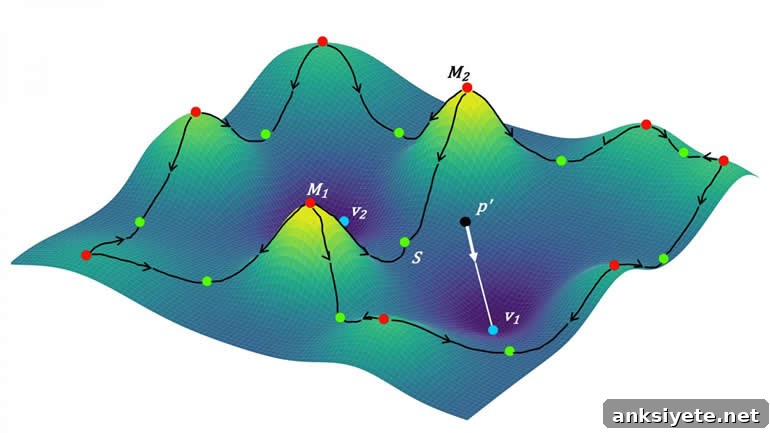
Topology, often described as “rubber-sheet geometry,” emphasizes connectivity and the global shape of structures rather than precise distances or angles. Using topological data analysis—specifically techniques based on discrete Morse theory—the researchers represented neuronal images as landscapes of peaks, valleys, and connecting ridges. This mathematical perspective helps the AI distinguish continuous neuronal processes and identify features such as axonal swellings that correspond to synapses.
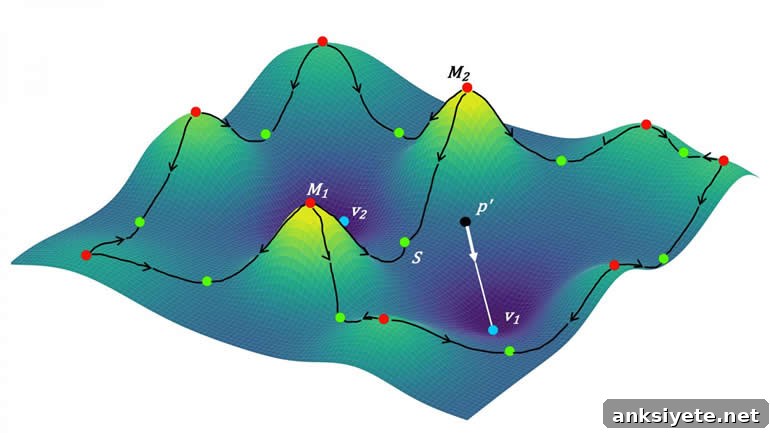
By teaching the system simplified geometric descriptions of neuronal components—rounded somas, thin axons, and branching dendrites—the hybrid architecture improved detection of fine-scale structures across diverse neuronal morphologies. The approach integrates topological priors with state-of-the-art convolutional encoder–decoder networks to produce semantic segmentation tailored to neuroanatomical compartments.
In benchmark tests, the hybrid method showed substantial gains in identifying topological features such as continuity of processes and local intensity maxima corresponding to synaptic swellings. The team reports precision and recall approaching 90% when compared with human observers, a level that substantially reduces the volume of human proofreading required for scientific-grade datasets.
Mitra cautions that fully automated analysis will still need human review to ensure the highest scientific quality, but the new system markedly lowers the effort demanded of expert annotators. By reducing the manual workload, the method accelerates large-scale projects like the U.S. Brain Initiative that aim to map connections across whole brains.
The CSHL group plans to refine and scale their AI tools further with support from a new National Institutes of Health grant. The researchers expect the hybrid architecture—combining discrete Morse-based topological priors with deep-net segmentation—to generalize to other imaging modalities and data domains where preserving connectivity and global structure is critical.
About this artificial intelligence research article
Source:
Garvan Institute of Medical Research
Contacts:
Sara Roncero-Menendez – Cold Spring Harbor Laboratory
Image Source:
The image is credited to Mitra lab/CSHL, 2020.
Original Research: Closed access
“Semantic segmentation of microscopic neuroanatomical data by combining topological priors with encoder–decoder deep networks” by Samik Banerjee, Lucas Magee, Dingkang Wang, Xu Li, Bing-Xing Huo, Jaikishan Jayakumar, Katherine Matho, Meng-Kuan Lin, Keerthi Ram, Mohanasankar Sivaprakasam, Josh Huang, Yusu Wang & Partha P. Mitra. Nature Machine Intelligence.
Abstract
Semantic segmentation of microscopic neuroanatomical data by combining topological priors with encoder–decoder deep networks
Neuronal circuit mapping at cellular resolution traditionally depends on careful tracing and interpretation by experienced neuroanatomists. New imaging technologies produce terabytes to petabytes of high-resolution images, making manual annotation infeasible. Deep learning offers scalable alternatives, but these models often require vast annotated datasets and still yield error rates too high for direct scientific use without human proofreading. Here, we introduce a hybrid architecture that combines topological priors derived from discrete Morse theory with high-performing encoder–decoder deep networks for neuronal connectivity analysis. This approach embeds structural knowledge about connectivity and local intensity features into the learning process, improving detection of continuous neuronal processes and synaptic swellings. We demonstrate significant performance improvements, with precision and recall near 90% relative to human observers, and adapt the architecture to a high-performance pipeline for semantic segmentation of whole-brain light-microscopic data into hierarchical neuronal compartments. We anticipate that this hybrid strategy will generalize to other domains where topological structure is essential to accurate segmentation and interpretation.