
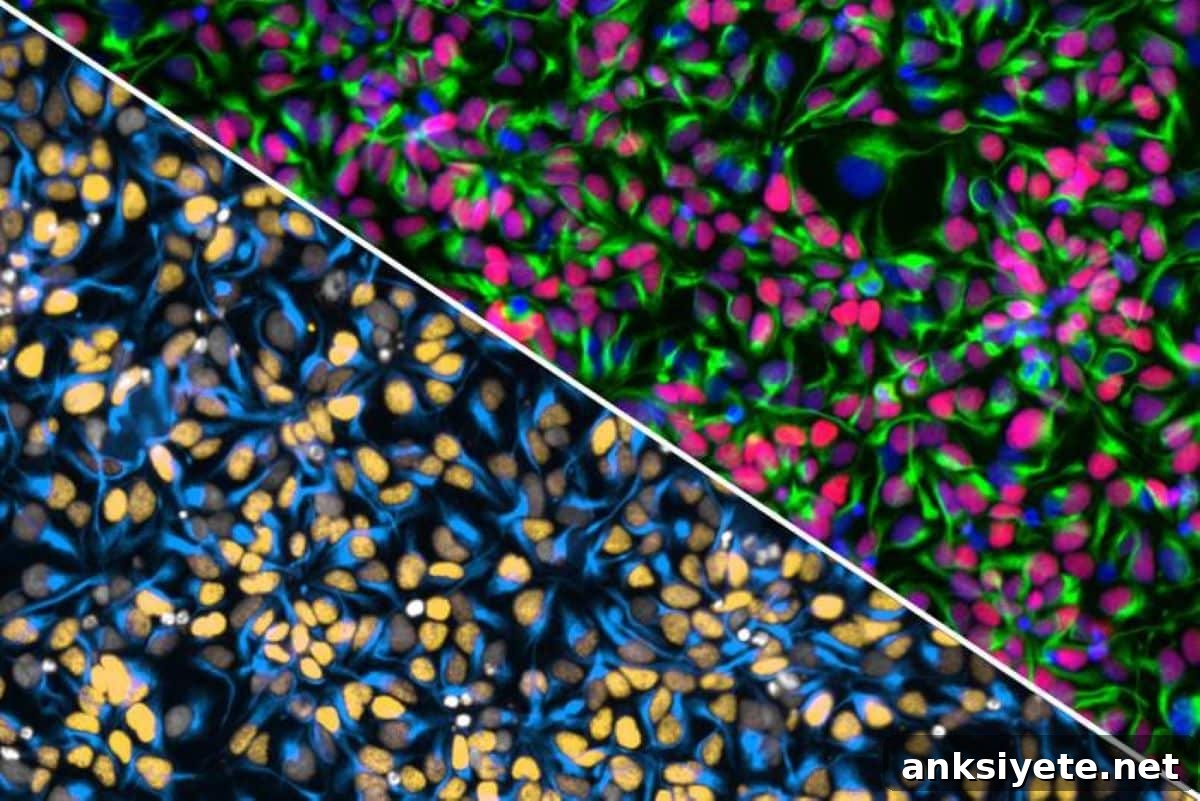
Summary: Researchers at UCLA developed a “cell village” experimental system together with a statistical framework called Townlet to measure individual cellular fitness across many human genetic backgrounds.
The method pools neural progenitor cells from dozens of genetically distinct donors into a single shared culture well, removing batch effects and environmental variability that arise when each donor is grown in separate dishes.
Key Facts
- Elimination of inter-well technical noise: Growing neural progenitor cells from multiple donors in a single pooled well exposes all cell lines to identical microenvironmental conditions (oxygen, temperature, handling), so observed differences reflect underlying biology rather than subtle experimental variation.
- Townlet statistical framework: Pooled DNA sequencing yields proportional compositional data (a changing pie chart that always sums to one). UCLA computational scientists created Townlet to separate mathematical compensation effects from genuine biological increases or decreases in donor cell abundance.
- Mechanism behind 16p11.2-associated macrocephaly: By comparing pooled neural progenitor cells from 12 carriers of the 16p11.2 deletion and 11 controls, the study showed that the deletion intrinsically speeds cellular division, linking early neural overproliferation to larger head size seen in some autism cases.
- Genetic mapping of proliferation (ZFHX3): Tracking genomic variation across 35 mixed donors associated baseline proliferation rates with a regulatory region near ZFHX3, a gene implicated in limiting cell division during neurodevelopment.
- Variable vulnerability to lead (ARNT2): Exposing a 39-donor village to lead produced wide differences in donor viability (about 20% to 90% cell death). Part of this variation mapped to a locus near ARNT2, a gene involved in cellular stress responses.
Source: UCLA
Cell fitness — how readily cells divide and how well they survive — shapes development, organ size and disease risk.
Cell fitness varies between individuals because of genetic and environmental influences. Those differences can affect susceptibility to developmental disorders, neurodegeneration and cancer. Accurately measuring how cell fitness varies across human genomes is essential to understanding vulnerability and resilience, and to guiding more personalized prevention and treatment strategies.
Traditional approaches are limited by low donor diversity and by technical variation when each donor’s cells are cultured separately. Small differences in handling or well conditions can obscure or mimic true biological effects.
In a paper published in the American Journal of Human Genetics, UCLA researchers introduced a pooled “cell village” approach: neural progenitor cells (NPCs), which give rise to neurons during brain development, are mixed from many donors and cultured in the same well so every donor experiences identical experimental conditions.
“Cell villages reduce technical noise and let us test far greater genetic diversity in a single experiment,” said co-senior author Dr. Michael F. Wells, assistant professor of human genetics at the David Geffen School of Medicine at UCLA and a member of the UCLA Broad Stem Cell Research Center, who helped develop the platform.
Pooling many donors produces complex compositional data, so the team developed Townlet, a statistical tool designed to provide accurate, donor-specific fitness estimates from pooled sequencing readouts.
Why pooled villages outperform separate dishes for detecting genetic effects
When donors are cultured in separate wells, tiny differences in oxygen, temperature or handling can create background variability that masks subtle genetic effects. A cell village places all donors in one well so differences in representation over time reflect biology rather than technical artifacts.
The researchers used sequencing to measure each donor’s fraction of the pooled population across time points. Those changing fractions reveal which donors’ cells expand or decline under identical conditions.
“Growth rates measured in villages match those observed when donors are cultured separately, but the village format is more reproducible and precise,” said co-first author Tim Derebenskiy, a graduate student in the Wells lab.
Overcoming a statistical pitfall
Proportional readouts introduce a mathematical dependency: because fractions must sum to one, an increase in one donor’s share forces others to shrink even if their absolute cell numbers are unchanged. Standard statistical tools that ignore this compositional constraint can misinterpret mathematical shrinkage as biological decline.
Townlet uses Dirichlet-based modeling to account for those constraints and to distinguish artifacts of composition from true biological changes in growth or survival.
Resolving a question in autism biology
The team applied the approach to a debated question: why some carriers of the chromosome 16p11.2 deletion — a known autism risk factor — present with macrocephaly. Mixing NPCs from 12 deletion carriers and 11 controls in shared villages, the researchers found that deletion cells divided faster than controls consistently, supporting a model in which early neural progenitor overproliferation contributes to larger head size observed in some individuals with autism.
Because head overgrowth often appears in the first year of life, before behavioral diagnosis, linking it to accelerated neural cell division provides a timeline and mechanistic clue for neurodevelopmental differences associated with autism.
Distinct genetic contributors to growth and survival
In a larger 35-donor village, natural differences in NPC proliferation associated with variation near ZFHX3, a gene previously implicated in controlling cell division in the developing brain; this association was replicated in an independent donor set. For survival under toxic stress, exposure of a 39-donor village to lead revealed wide inter-individual variability in viability. Part of that sensitivity mapped near ARNT2, suggesting genetic modifiers of environmental neurotoxicity.
These findings point to two practical opportunities: identifying individuals with genetic susceptibility to environmental toxins, and targeting stress-response pathways to protect vulnerable cell populations.
Why it matters and future directions
Co-first author Chloe Hanson, a graduate student in the Pimentel lab, sees cell villages and Townlet as tools that let researchers study human biological variation more directly and at scale, potentially reducing reliance on animal models.
Townlet’s code has been released publicly so other labs can apply the method. The research team envisions expanding this approach into an “atlas of human vulnerability,” mapping genetically influenced cell fitness across more cell types and environmental exposures to inform personalized risk assessments and interventions.
“This system contributes to the long-promised personalized medicine revolution by revealing how genetic differences shape cellular responses and by identifying exposures that certain people may be especially sensitive to,” Wells said.
Additional authors on the study include Ana Rodriguez Vega, Yashika S. Kamte, Rachel G. Fox, Laila Sathe, Hannah Lambing, Tyler E. Dietterich, Derek Hawes, Ralda Nehme, Olli Pietiläinen, Aarno Palotie and Patrick Allard.
Funding
This work was supported by the National Institutes of Health, the Howard Hughes Medical Institute, the Hypothesis Fund, the UCLA Broad Stem Cell Research Center, the California Institute for Regenerative Medicine, the Dana Foundation, the Academy of Finland Center of Excellence for Complex Disease Genetics and the Sigrid Jusélius Foundation.
Key Questions Answered
A: Separate wells introduce subtle variations in temperature, oxygen and handling that create technical noise and can mask small biological differences. The cell village format places all donor cells in the exact same environment, so observed differences in proliferation or survival are more likely to reflect genetics or meaningful biological factors.
A: Pooled sequencing reports each donor’s relative share of the total population, which must always add up to 100%. If one donor’s cells expand, the percentages for others must shrink mathematically even if those cells are growing in absolute terms. Townlet models these compositional constraints with Dirichlet-based regression to separate mathematical artifacts from true biological changes.
A: By pooling neural progenitor cells from carriers of the 16p11.2 deletion and controls in shared villages, the researchers observed that deletion-carrying NPCs consistently divided faster than control NPCs. That accelerated proliferation provides a cellular mechanism that can explain early brain overgrowth and macrocephaly seen in some individuals with autism.
Editorial Notes:
- This article was edited by a Neuroscience News editor.
- Journal paper reviewed in full.
- Additional context added by staff.
About this genetics and neuroscience research news
Author: Ani Vahradyan
Source: UCLA
Contact: Ani Vahradyan – UCLA
Image credit: Timothy Derebenskiy / Wells Lab
Original Research: Open access. “Cell villages and Dirichlet modeling map human cell fitness genetics” by Chloe Hanson, Timothy Derebenskiy, Ana Rodriguez Vega, Yashika S. Kamte, Rachel G. Fox, Laila Sathe, Hannah Lambing, Tyler E. Dietterich, Derek Hawes, Ralda Nehme, Olli Pietiläinen, Aarno Palotie, Patrick Allard, Harold Pimentel, Michael F. Wells. American Journal of Human Genetics. DOI: 10.1016/j.ajhg.2026.07.005
Abstract
Cell villages and Dirichlet modeling map human cell fitness genetics
Cellular capacity to proliferate and survive underlies development and disease. Standard assays to measure cell fitness are essential but often lack donor diversity and suffer high technical variability, limiting reproducibility and scale.
To address these challenges, the authors designed and validated a pooled “cell village” screening approach using cultures of 12–39 genetically distinct human neural progenitor cell lines, and they developed Townlet, a Dirichlet-based statistical framework for analyzing compositional data from these villages.
Applying these methods, the team detected hyperproliferation in NPCs with the autism-associated 16p11.2 deletion, mapped variation in NPC proliferation to loci near ZFHX3, and identified genetic modifiers of lead sensitivity implicating ARNT2. Combined, these tools advance a scalable and genetically diverse in vitro platform for dissecting human variation in cell fitness and gene–environment interactions.